Showing posts with label 112 2nd. Show all posts

Tuesday, March 31, 2015

PTAB affirms indefiniteness when CRM claim recites human action ("subscribe")


Takeaway: In an application for a computerized valuation platform, the Examiner rejected a computer-readable medium claim as indefinite. The Examiner took issue with the phrase "subscribing to the web-based valuation service," asserting that the word "subscribe" implied a human action, which conflicted with the claim's recital of a method performed by computer instructions. The Applicant argued that the action was done through computer instructions, at the request of a user. In support of this argument, the Applicant presented a dictionary definition ("to obtain a subscription") which did not mention performance by a human. The Board found that the definition offered by the Applicant did involve human activity, and thus affirmed the rejection. (Ex parte Allaway, PTAB 2014.)

Details:
Ex parte Allaway
Appeal 2012-006215; Appl. No. 11/009,547; Tech. Center 3600
Decided:  December 15, 2014

The application on appeal described a computerized valuation platform for intellectual property assets. During prosecution, the Applicant presented a system claim and a comupter-readable medium (CRM) claim. The CRM claim on appeal read:
     35. A computer-readable medium encoded with computer executable instructions .... , the instructions perform a method comprising:
      publishing at least one portable formula module defining one or more valuation formulas associated with an intellectual property asset at a network server that offers a web-based valuation service;
      subscribing to the web-based valuation service from a client device to access the at least one portable formula module;
      acquiring one or more values associated with variables of the one or more valuation formulas from a network database utilizing an automated acquisition that pulls information from the network database in response to a subscriber request;
      determining one or more valuation results associated with the intellectual property asset by executing the one or more valuation formulas using the acquired values; and
      displaying the determined one or more valuation results of the intellectual property asset valuation on an information presentation interface of the client device.
(Emphasis added.)
The Examiner rejected all claims under § 101 and § 103. The Examiner also rejected CRM claims 35 and 37 as indefinite. The Examiner explained that independent claim 35 was indefinite since "it is unclear how [a CRM] subscribes to a web-based valuation service (a human user activity)." (Emphasis added.) The Examiner used the same rationale for dependent claim 37, which recited "the client device further subscribing to ..."

During prosecution the Applicant argued against the indefiniteness rejection of independent claim 35. The Applicant first noted that the Examiner seemed "seem[ed] to rely on the notion that 'subscribing' is a human activity by its very definition." But according to the Applicant, the term was not given this meaning by the Applicant's disclosure, by the prior art, or by a POSITA (citing MPEP 2173.02). The Applicant also introduced a definition ("to obtain a subscription," from Dictionary.com), which did not mention performance by a human. Thus, the Applicant concluded that the indefiniteness rejection was improper.

The Applicant also addressed the indefiniteness rejection of dependent claim 37 by explaining that the " 'subscribing' is done at the behest of a user (presumably human) through a computer-readable medium encoded with computer-executable instructions." The Applicant asserted that the term was consistent with usage by a POSITA, and gave a specific example ("digital video recording device subscribing to a show at the behest of the user or having a server push content to a user's device or computer at the behest of a user.") The Applicant also referenced a portion of the Specification to support this interpretation.
In the next Office Action, the Examiner did not address the dictionary definition proffered by the Applicant. The Examiner did respond to the arguments for dependent claim 37 by commenting on the portion of the Specification mentioned by the Applicant. According to the Examiner, the Specification taught that "the subscribing is not directed to a system or set of computer instructions, but rather to actions of the individual user. This creates confusion as to when direct infringement or the claim limits occurs."

The Board affirmed the indefiniteness rejection. The Board first explained the requirements of a prima facie case of indefiniteness, as explained by the Federal Circuit's In re Packard decision:
When the USPTO has initially issued a well-grounded rejection that identifies ways in which language in a claim is ambiguous, vague, incoherent, opaque, or otherwise unclear in describing and defining the claimed invention, and thereafter the applicant fails to provide a satisfactory response, the USPTO can properly reject the claim as failing to meet the statutory requirements of § 112(b) 
The Board noted that all of the meanings in the Applicant's proffered dictionary definition (from Dictionary.com) involved human activity, as did the Applicant's own examples offered in the Appeal Brief (TiVo and iTunes). The Board then found that the Examiner had presented a "well-grounded rejection" which the Applicant's arguments had not overcome, and thus ffirmed.

My two cents: The Board got this one wrong. When read in the context of the claim, publish and subscribe are not human actions. A POSITA would recognize these as computer actions that are part a well-known design pattern. (See this Wikipedia entry for "Publish-subscribe pattern".)

The CRM claim at issue recited "publishing" as well as "subscribing." Interestingly, the Examiner did not assert that "publish" was indefinite. Whatever led the Examiner to conclude that "publish" was
understood by a POSITA should also apply to "subscribe."

To make a much stronger case, the Applicant should have offered evidence of the technology-specific meaning of "subscribe." I did a cursory web search and found a Wikipedia entry as well as several technical articles discussing the Publish-Subscribe pattern (e.g., Oracle® Database Application Developer's Guide, Microsoft Patterns and Practices).

Monday, December 2, 2013

Board finds indefiniteness when Applicant argument inconsistent with language of claim

Takeaway: An Applicant appealed the prior art rejection of a claim to noise reduction electronics. The Applicant argued that the reference didn't teach "wherein the actuator is ... directly mounted on a surface of the component influenced by the vibrations." The actuator was positively recited in the body of the claim, but the component was not. The Board entered a new indefiniteness rejection. The Board found that the Applicant's argument implied that the component was part of the claimed combination, while the structure of the claim itself implied that the component was not. Thus, the claim was ambiguous and indefinite under Ex parte Miyazaki.(Ex parte Bendel, PTAB 2013.)

Details:

Ex parte Bendel
Appeal 2012-001251; Appl. No. 11/901,804; Tech. Center 3600
Decided: Nov. 21, 2013

The application was directed to noise reduction electronics. A representative claim on appeal read:
     1. A device for actively influencing vibrations in a component, comprising:
     a sensor for detecting the vibrations;
     an electrically actuatable piezoelectric actuator for acting on the component; and
     a regulation and control unit in which actuating signals are generated from sensor signals of the sensor in order to adjust the actuator;
     wherein the actuator is one of (a) directly mounted on a surface of the component influenced by the vibrations, and (b) enclosed inside a wall of the component influenced by the vibrations.
(Amendments shown.)
The Applicant amended as shown above in response to an anticipation rejection in the first Office Action. The Examiner maintained the anticipation rejection in the next Office Action, and the Applicant appealed.

In the Appeal Brief, the Applicant argued that the reference did not teach either of the alternative limitations describing the location of the actuator. According to the Applicant:
[T]he cited sections of Fischer merely describe actuators 4 enclosed within a vibration damper module 1. Thus, the actuators 4 are merely situated within a device for actively influencing vibrations in a component. Nowhere does Fischer disclose that its actuators 4 are directly mounted on a surface of a component influenced by vibrations, as opposed to the device for actively influencing vibrations, as provided for in the context of claim 1.
The Examiner provided further explanation of his position in the Answer, as follows:
The Applicant takes an overly narrow construction of (1) what constitutes the "component" and (2) what it means to be "influenced" by vibrations.  First, claim 1 does not require the "component" to be entirely separate from the device ... the claim in no way precludes the "component" from being some part of the "device" itself. Second, the mere fact that the vibration damper module 1 is producing vibrations does not preclude some portion of it from being "influenced" by these vibrations as well. All that is required to meet the limitation of claim 1 is that the component changes in some way (i.e., is "influenced") due to the vibrations of the device.  Given the broadest possible reasonable interpretation of the claim, the housing 5 of the vibration damper module 1 is "influenced by vibrations" because it goes from a state of rest to a state of "tension" in producing the counter vibrations. 
The Applicant filed a Reply Brief arguing that the Examiner's interpretation of the claim language at issue was unreasonable:
[A]ny reading of the present application makes plain that "a component influenced by vibrations" does not form a part of "a device for actively influencing vibrations."  Moreover, the Examiner's overly broad interpretation of the presently claimed subject matter leads to the nonsensical result of a device that produces influencing vibrations that influence itself, and simultaneously produces damping vibrations to dampen the influencing vibrations previously produced.  ... it is completely nonsensical to produce influencing vibrations only to then try to damp those same vibrations.  ... one of ordinary skill in the art would know that in order to prevent vibrations in a device for actively influencing vibrations, one may simply not produce any influencing vibrations from the outset, instead of producing influencing vibrations only to then have to simultaneously produce damping vibrations.
The Board didn't reach the merits of the anticipation rejection and instead entered a new indefiniteness rejection under Ex parte Miyazaki ("more than one plausible interpretation"). The Board first noted that the preamble did not recite a device in combination with a component, but rather recited the component being influenced as the target of the intended use of the device. However, in the Appeal Brief the Applicant distinguished the reference with arguments about the component. The Board found that this contradiction between the preamble and the position taken by the Applicant made the claim ambiguous:
   Since Appellant appears to be arguing that the wherein clause states a  condition that is material to patentability, claim 1 appears to be ambiguous. In other words, it is not clear whether Appellant’s claim 1 recites a device per se, with intended use language as to the component, or a combination of a device and a component wherein the actuator is one of directly mounted on the surface of the component or enclosed inside a wall of the component.
   As claim 1 is a claim under examination that is susceptible of more than one plausible interpretation, claim 1 is indefinite because the scope of the claim differs significantly depending upon which of the plausible interpretations one adopts. See Ex parte Miyazaki, 89 USPQ2d 1207, 1211- 12 (BPAI 2008) (precedential) ) (“if a claim is amenable to two or more plausible claim constructions, the USPTO is justified in requiring the applicant to more precisely define the metes and bounds of the claimed invention by holding the claim unpatentable under 35 U.S.C. § 112, second paragraph, as indefinite.”).

My two cents: Arguing that a claim element distinguishes over the reference make a claim ambiguous? Really? Nah, I don't buy it.

The Board's reasoning goes like this:
A) claim term recited in preamble but not in body means term gets no patentable weight
B) Applicant argued that same term distinguishes over the reference, i.e., gets patentable weight
C) A and B are contradictory, thus claim is ambiguous.

The way I look at it, A is a presumption that the Applicant attempted to rebut with B. Looking at the claim alone, maybe the term gets no patentable weight. But Applicant argued the reference didn't teach the term at issue, thus implying the term gets patentable weight. Maybe the Applicant's rebuttal is persuasive, and maybe it isn't. But it seems ridiculous to use this argument to find the claim contradictory and thus indefinite. If anything, the Applicant argument makes the claim more definite.

Monday, July 22, 2013

Board reverses indefiniteness of claim that references a published patent application

Takeaway: The Examiner rejected as indefinite a claim which referred to a published patent application: "A nonwoven mat ... suitable for use as the scored and folded vertical webs spanning between an exposed mat and a backer mat in a compressible ceiling tile as disclosed in published U.S. Patent Application No. 20020020142 filed April 23, 2001 ..." The Examiner cited Ex parte Fressola as authority, asserting that Fressola allowed incorporation by reference "only in exceptional circumstances where there is no practical way to define the invention in words and where it is more concise to incorporate by reference than duplicating a separate document into the claim. The Board reversed the rejection. The Board distinguished Fressola on the grounds that Fressola's claim included no limitations other than a reference to Fressola's specification and drawings. (Ex parte Jaffee, PTAB 2012.)

Details:
Ex parte Jaffee
Appeal 2010011413; Appl. No. 10/718,007; Tech. Center 1700
Decided:  March 15, 2012

The application described a fibrous mat and a method of manufacturing the mat. According to the abstract, the disclosed mats are flame resistant, have good strength after being scored and folded, and are particularly useful in making lightweight, compressible ceiling panels.

The original claims to the mat specified only physical properties of the fibers and of the curing resin. To overcome prior art, the Applicant amended during prosecution to specify a number of properties of the mat itself. The Applicant also argued that "the mats of the invention were designed for ceiling tiles of the type described in U.S. 20020020142, as pointed out in the specification," while the mat in the primary reference did not have these properties. The Examiner responded by commenting that the claims were directed to a mat rather than a ceiling tile, and the claims themselves did not specify that the mat meets the requirements of the vertical, folding panels in the ceiling tile of  U.S. 20020020142.

In response, the Applicant further amended one of the independent claims so that it referred to the ceiling tile. After this amendment, claim 91 read:
      91. A nonwoven mat having a basis weight of 2 to about 2.6 lbs/100 sq. ft, a high flame resistance and unexpected excellent tensile strength, flex and recovery properties after scoring and folding and suitable for use as the scored and folded vertical webs spanning between an exposed mat and a backer mat in a compressible ceiling tile as disclosed in published U.S. Patent Application No. 20020020142 filed April 23, 2001, including the ability to, after being scored, folded, and compressed, to spring back to the original shape and orientation ...
      the fibrous nonwoven mat comprised of
      a blend of fibers comprising about 84 to about 92 wt. percent of chopped glass fibers having an average fiber diameter in the range of about 13 to about 17.5 microns and a length in the range of about 0.7 to about 1.1 inches and about 8 to about 15 wt. percent of polyester fibers having a length of about 0.25 +/0.07 inch,
     the blend of fibers being bound together with about 20 to 30 wt. percent, based on the dry weight of the fibrous nonwoven mat, of a cured resin consisting essentially of a resin derived from an aqueous homopolymer or copolymer of polyacrylic acid and a polyol, with or without a polycarboxy polymer,
     the fibrous nonwoven mat having a Taber Stiffness of at least about 50 gram centimeters and passing the National Fire Protection Association's (NFPA) Method #701 Flammability Test.
 The next Office Action included an indefiniteness rejection for claim 91 because "claims may not incorporate another publication, but instead should clearly spell out the intended structure, composition, etc. of the invention." The rejection indicated that the limitation was "interpreted as intended use limitation that does not contribute to the structure or chemistry of the claimed article."
After several more rounds in which the Examiner maintained the prior art and indefiniteness rejections, the Applicant appealed both.

In arguing against indefiniteness,the Applicant first noted that the Examiner had cited no authority that prohibited a claim from referring to a published patent application. Next, the Applicant noted that claim 51 was not rejected as indefinite, even though it pointed out with less particularity, by including the "spring back to the original shape" language without reference to the publication. Third, the Applicant argued that reference to a patent publication was a concise way of describing specific "spring back" properties for which no standard test yet existed. Finally, the Applicant addressed a position taken by the Examiner in prosecution: that a claim should be self-contained and understandable by a POSITA without guidance from a separate document. According to the Applicant, "it has long been accepted and practiced to use shorthand terms and identifiers to incorporate or explain limitations in the claims." Moreover, claim 51 referenced "the NFPA Method #701 Flammability Test" and yet was not subject to an indefiniteness rejection.

In the Answer, the Examiner provided authority for the indefiniteness rejection. The Examiner relied on Ex parte Fressola (27 USPQ2d 1608, 1609 (Bd. Pat. Appl. & Inter. 1993) for the proposition that "incorporation by reference is permitted only in exceptional circumstances where there is no practical way to define the invention in words and where it is more concise to incorporate by reference than duplicating a separate document into the claim. Incorporation by reference is a necessity doctrine, not for applicant's convenience." (Emphasis added.) The Examiner asserted that here, "there is a practical way to define the invention in words as demonstrated in instant claim 51."

The Board reversed the prior art rejection and the indefiniteness rejection. In discussing the indefiniteness rejection, the Board distinguished Ex parte Fressola, where the claim relied entirely on the entire specification and figures: "42. A system for the display of stereographic three-dimensional images of celestial objects as disclosed in the specification and drawings herein." In the instant case, the reference "merely sets forth a capability requirement of the mat described in the claim," and the Examiner failed to explain "how reciting the capability requirement in that form causes the claim to fail to circumscribe a particular area with a reasonable degree of precision and particularity."

My two cents: The Board got this one wrong. The claim here is different than Fressola, but is still indefinite. Patent applications disclose a lot of things, so claiming "as disclosed in patent publication X" is almost certainly indefinite. Tell me exactly what characteristics are included in a mat "suitable for use as the scored and folded vertical webs ... in U.S. 20020020142."

Is it a tile where "the dividers are elongated cells having collapsible sides so that when lateral or transverse pressure is applied to the cell in predetermined directions it will collapse into a shallow space." The publication says one embodiment contains such dividers.

Is it a tile where the dividers are "of an elongated cellular or tubular configuration." The publication says one embodiment contains such dividers.

"The inquiry under section 112, paragraph 2, now focuses on whether the claims, as interpreted in view of the written description, adequately perform their function of notifying the public of the patentee's right to exclude." Solomon v. Kimberly-Clark Corp., 216 F.3d 1372, 1379, 55 USPQ2d 1279, 1283 (Fed. Cir. 2000). Jaffee's claims do not provide such notice to the potential infringer or the public.

Related posts: I discussed Ex parte Fressola in another blog post: BPAI holds that claim which includes figure is not indefinite.

Monday, September 3, 2012

BPAI affirms indefiniteness when claim positively recites "at least one flooring panel" and then refers to "panels of the least one flooring panel"


Takeaway: During prosecution, the Examiner rejected a claim to a flooring system as being indefinite. The claim positively recited "at least one flooring panel" but then referred to "lips configured to overlap ... a joint between panels of the at the least one flooring panel and the connecting element". The Examiner found that the inconsistency between "at least one flooring panel" (singular) and the "panels" (plural) rendered the claim indefinite. The Board affirmed, finding that the broadest reasonable interpretation of "at least one panel" encompassed a single panel, yet the reference to panels implies multiple panels. (Ex parte Grafenauer, BPAI 2012.)

Details:

Ex parte Grafenauer
Appeal 2010009906; Appl. No. 11/533,634; Tech. Center 3600
Decided:  February 29, 2012

The application on appeal disclosed flooring panels with connecting elements. Claim 15 read:
15. A system, comprising:
      at least one flooring panel with a decorative layer top layer, the at least one flooring panel comprising a tongue and a groove on side edges lying opposite one another; and
      a connecting element comprising a groove and a tongue on side edges corresponding to the tongue and the groove of the at least one flooring panel,
      the connecting element further comprising, in an area of the side edges, lips configured to be a sole sealing mechanism and to bear on a top side of the at least one flooring panel and overlap a butt joint between panels of the at least one flooring panel and the connecting element.

During prosecution, the Examiner objected to claim 15, which used the phrase "at least one" with the plural term "panels."
As applicant is only claiming one panel, it appears the claim should be directed to --at least one flooring panel-- rather than "at least one flooring panels".

In response, the Applicant amended to consistently refer to "at least one flooring panel" (singular), so that the claim read:
A system comprising:
      at least one flooring panel ...; and
      a connecting element comprising ...
      the connecting element further comprising ... lips configured to ... bear on a top side of the at least one flooring panels and configured to overlap a butt joint between panels of the at least one flooring panel and the connecting element.

However, the claim did still refer to "panels of the at least one flooring panel." Because of this inconsistency, the Examiner rejected claim 15 as indefinite, taking issue with the "overlap" limitation:
Further, the limitation "overlap a butt joint between panels of the at the least one flooring panel and the connecting element" renders the claim indefinite (lines 8-9 of the claim). It appears the limitation should be directed to more than one panel as the claim recites the lips of the connecting element bearing on the top side of the panels (see fig. 1 of disclosure). However, the claim as presented, only positively recites a singular "at least one flooring panel" as previously noted.
(Emphasis added.)

The Applicant appealed the indefiniteness rejection of claim 15, along with several prior art rejections. Claim 15 is repeated below:
15. A system, comprising:
      at least one flooring panel ... ; and
      a connecting element
      the connecting element further comprising ... lips configured ... to bear on a top side of the at least one flooring panel and overlap a butt joint between panels of the at least one flooring panel and the connecting element.
(Emphasis added.)

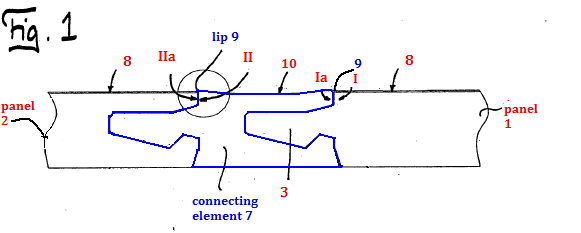
In the Appeal Brief, the Applicant referred to Figure 1 (shown below) to explain how a person of ordinary skill in the art would understand claim 15.
More specifically, Figure 1, clearly shows lips (9) configured to bear on a top side (8) of an adjacent panel (2) and configured to overlap a butt joint between panels (1,2) of the at least one flooring panel and the connecting element (7).
(Additional numbers added.)

The Examiner's Answer reiterated that the claim recited a singular panel with lips bearing on the singular panel, yet the figures showed each lip bearing on a separate panel. The Answer also stated that "it is unclear if the claim is reciting a singular flooring panel or more than one flooring panel."

The Applicant filed a Reply Brief with a lengthy rebuttal. The Applicant explained why a claim to a single panel nonetheless recited plural panels.
     Claim 15 recites, in part:
... the connecting element further comprising, in an area of the side edges, lips configured to be a sole sealing mechanism and to bear on a top side of the at least one flooring panel and overlap a butt joint between panels of the at least one flooring panel and the connecting element.
... That is, a lip on each panel can overlap with an adjacent panel. This language is clearly described in the specification. The claims do not recite that more than one lip is configured to bear on the singular at least one flooring panel. The Examiner is misreading the claims and taking the claim language out of context.
     Also, Appellants submit that although one lip is shown in FIG. 1 and FIG. 2 for each panel, ... two lips can be required so that the lips can provide the sealing mechanism for two, adjacent panels. Additionally, in the context of the claims, the lips are used so that they can provide sealing between at least one panel (e.g., "singular"). ...
     Lastly, for claim 15 to read correctly and for it to be understandable, it is necessary to place the claimed elements in the proper environment. For this reason, although claim 15 is directed to at least one panel, the claim uses the terminology "panels" in order to show how the lips are used with adjacent panels. This is clear from the record and the specification.

The Board affirmed the indefiniteness rejection, focusing on the inconsistency between "at least one panel" and "panels of the at least one flooring panel."
     The broadest reasonable interpretation of the term “at least one panel” is that the term is sufficiently broad to encompass a single panel. On the other hand, the recitation of “panels of the at least one flooring panel and the connecting element” implies that the at least one flooring element must include a plurality of panels. The use of two different terms to identify the “at least one panel” and the “connecting element” implies that the connecting element is not a panel.
     Therefore, the broadest reasonable interpretation of claims 15-20 and 23 is indefinite. Depending on which interpretation of the term “at least one flooring panel” one adopts, claims 15 and 23 may be sufficiently broad to encompass systems having only a single floor panel or may be limited to systems each having a plurality of panels. The disclosure of paragraph [0016] and Figure 1 of the Specification, cited by the Appellant at page 6 of the Appeal Brief, does not resolve this ambiguity. 
(Emphasis added.)

My two cents: The Applicant really stuck to his guns here, and seemed unwilling to claim two panels – even though the novelty seemed to lie in the interactions between the connector and the two panels (i.e., tongue and groove). I don't get this reluctance.

What infringement scenario was the Applicant concerned about giving up by claiming two panels? Sure, such a claim would require a flooring manufacturer to sell two panels and a connecting element, even though the connector did provide a benefit (sealing) when used with only a single panel. But is that really giving up that many infringers? Won't a large number of flooring systems be sold with pairs of panels and a connector in between? Yeah, it's great to have a claim that catches every infringement scenario. But the Applicant here put the entire patent at risk by refusing to rewrite the claim in a way that made sense.

This very issue was explored a bit during oral arguments. The Applicant's representative stated that "a flooring system would ordinarily have more than one panel" and that the tongue and groove of the connecting element would be "connected to a groove and a tongue of respective flooring panels." The judge then asked: "If that's the case, then why not just recite flooring panels?" To which the Applicant's representative responded: "The client had decided that we want to say 'at least one' in this particular case to make it broader."

Friday, August 12, 2011

BPAI uses dependent claim to find independent claim to be indefinite

Takeaway: In a case involving chemical compounds in a transistor structure, the BPAI used a dependent claim to enter a new indefiniteness rejection for the independent claim. The Board found that both the Applicant's claim construction and the Examiner's were plausible, leading to an indefiniteness rejection under Ex parte Miyazaki. The Board noted that the Applicant's claim construction argument for the independent claim appeared to be at odds with the limitations in a dependent claim. (Ex parte Hoffman.)

Details:

Ex parte Hoffman
Appeal 2009008056; Appl. No. 10/799,961; Tech. Center 2800
Decided  July 27, 2011

The technology in this application involved the structure of a transistor. A representative independent claim on appeal read:

l. A semiconductor device, comprising:
   a drain electrode;
   a source electrode;
   a channel contacting the drain electrode and the source electrode,
   wherein the channel includes one or more compounds of the formula AxBxOx, 
   wherein the one or more compounds of the formula AxBxOx includes one or more of gallium-germanium oxide, gallium-tin oxide, gallium-lead oxide, indium-germanium oxide, indium-lead oxide, each O is atomic oxygen,
   where each x is a non-zero number, but the value of “x” for each constituent element may be different,
   wherein the channel includes one of an amorphous form and a mixed-phase crystalline form; and a gate dielectric positioned between a gate electrode and the channel.

On appeal, all claims were rejected as obvious. One of the underlying issue was the interpretation of the limitation "compounds of the formula AxBxOx." Citing Ex parte Davis (CCPA 1948), the Examiner took the position that the transition "comprising" meant that the "limitations are open-ended and the compounds (AxBxOx) referred to therein can contain other elements." This interpretation read on compounds of the form AxCxBxOx, so that the gallium-indium-tin oxide (indium = C) disclosed in the primary reference read on the claimed compound.

In the Appeal Brief, the Applicant acknowledged that "comprising" leaves the claim open to unrecited elements. But the Applicant also argued that: 
The term "comprising" does not mean that the Examiner can alter or disregard the elements specifically recited. ... [and] does not license the Examiner to change or add to the chemical compounds specifically and expressly recited.

In the Answer, the Examiner buttressed his claim interpretation by referring to various claims depending from claim 1. Dependent claim 6 read “wherein the one or more compounds of the formula AxBxOx includes Cx to form a compound of the formula AxBxCxOx.” In order for claim 1 to be broader than claim 6, the “formula AxBxOx” limitation must encompass the claim 6 compound AxBxCxOx, and therefore the formula limitation must be open-ended.

The Applicant filed a Reply Brief and continued to argue against the Examiner's claim interpretation. The Applicant discussed the precedent related on by the Examiner: 
[Ex parte Davis] does hold that a the term "comprising" leaves a claim open for the inclusion of additional recited elements. It is, however, a complete mischaracterization of Davis to argue that Davis holds that each limitation is individually open-ended, such that the recitation of a particular chemical compound can be essentially ignored and transfigured into a recitation of any compound comprising the recited and additional constituents. Such an unreasonable interpretation would make it unreasonably difficult for an applicant to specify precisely the desired chemical compounds to be recited in a claim. The Examiner's interpretation of Davis is unreasonable, unworkable and utterly without supporting authority!

The Board reversed the obviousness rejections on grounds other than claim construction. Specifically, the Board found no reason to replace the semiconducting indium-tin oxide in the channel layer of the primary reference with the highly conductive transparent conducting materials of the second reference.

However, the Board did address the claim construction issue in another way: by finding that independent claim 1 was amenable to two plausible interpretations and thus indefinite under Ex parte Miyazaki.
[T]he claim 1 term of “compounds of the formula AxBxOx” is amenable to two or more plausible claim constructions (i.e., one being open ended as argued by Appellants and one being closed-ended as presented by the Examiner), thereby justifying requiring Appellants to more precisely define the metes and bounds of the claimed invention by holding the claim unpatentable under 35 U.S.C. § 112, second paragraph, as indefinite. See Miyazaki, 89 USPQ2d at 1211.

My two cents: I don't do chemical cases, so I won't say which claim interpretation is the best one. But – still speaking as a person NOT skilled in the chemical arts – the arguments offered on both sides seem reasonable. Based on that, I'm inclined to agree with the Board's indefiniteness rejection under Miyazaki. On the other hand, I'm not sure "reasonable" is the same as "plausible." And I just don't know enough about chemical practice to say if both are plausible or not.

I wonder if another theme underlying the indefiniteness rejection was the "confusion" caused by the dependent claim. I say that because the Applicant seemed to have the better argument about the use of comprising. Remember, " 'comprising' is not a weasel word with which to abrogate claim limitations." Spectrum Int'l, Inc. v. Sterilite Corp., 164 F.3d 1372, 1380 (Fed.Cir.1998). Would the indefiniteness rejection have been avoided if the dependent claim wasn't there to confuse things?

I noticed that several other dependent claims used the same format. For example, claim 10 dependent from claim 6 and read "the one or more compounds of the form AxBxCxOx. includes Dx to form a compound of the formula AxBxCxDxOx." So it appears that this claim format was intentional.


Friday, February 25, 2011

BPAI finds that rejection of "generally circular" had confused written description with indefiniteness

Takeaway: The Applicant appealed written description and indefiniteness rejections for a limitation added during prosecution: "the orifice has generally circular shape and a substantially constant diameter." The BPAI reversed the written description rejection because the specification described “[t]he plate includes an orifice 43, the position of the orifice being indicated by circle 39 in Figure 7A.”  The BPAI also reversed the indefiniteness rejection, finding that “generally” and “substantially” both had an ordinary and customary meaning which denoted approximation.

Details:
Ex parte Albrecht
Appeal 2009011896; Appl. No. 10/885,980; Tech. Center 3600
Decided January 28, 2011

The claim at issue read:

27.  Apparatus for providing a controlled flow of fluid from a first fluid component to a second fluid component, comprising:
    a one-piece orifice plate ... the orifice has a general1y circular shape and a substantially constant diameter ...


The Examiner rejected the emphasized limitation under written description, enablement, and indefiniteness. In the Appeal Brief, the Applicant argued that the written description rejection was flawed because the specification had been amended to provided explicit support for the limitation. The Applicant argued against the enablement requirement by pointing to the drawings, and argued the indefiniteness rejection by explaining that the terms were meant to allow for minor deviations from a perfect shape. 

In the Answer, the Examiner asserted that the written description rejection was proper because the amendment to the specification wasn't entered. In regard to the enablement requirement, the Examiner indicated that

While the Figures may show a circular opening, for example, the disclosure does not define "generally" or a "substantially constant diameter." These limitations imply a range. But the specification is silent as to what that range might comprise, especially since the Figures are not stated as being to scale.

The Examiner provided a similar explanation for the indefiniteness rejection:
As noted above, the Figures are not disclosed as being to scale. Thus it is unclear what ranges would  include the "minor deviations" Appellant is accounting for.

The Board essentially found that the Examiner had confused written description and enablement with indefiniteness.
The Examiner states that “the terms ‘generally’ and ‘substantially’ are not defined.” Ans. 7 (discussing new matter objection). While we agree that Figures 7A and 7B fail to provide any indication of any specific range or scope for these terms of degree, the Examiner’s concern is an issue of claim definiteness, and is not a matter of written description, new matter, or enablement.

The Board found that the specification and figures showed the Applicant had possession of the limitation "the orifice has generally circular shape and a substantially constant diameter" and therefore reversed the written description rejection. The Board also found that the Examiner had not explained why a POSITA could not make and use this feature, and so reversed the enablement rejection.

The Board reversed the indefiniteness rejection too, with the following explanation:
     As to the claim limitations calling for the orifice to have “generally circular shape” and a “substantially constant diameter”, we find the terms “generally” and “substantially” as used in the context of Appellants’ Specification and Figures to take on their ordinary and customary meanings which denote approximation. See Ecolab, Inc. v. Envirochem, Inc., 264 F.3d 1358, 1366 (Fed. Cir. 2001). As such, the orifice has to have for the most part a circular shape and a largely or approximately constant diameter. See App. Br. 10 (Appellant stating that “generally” is used to encompass “minor deviations from a pure circular shape” and arguing that “substantially” is used to encompass “insignificant deviations from a pure circular shape”).
    As such, we find that the use of the term “generally” to modify the phrase “circular shape” and the use of the term “substantially” to modify the phrase “constant diameter” do not render these phrases so unclear such that there is no means by which to ascertain the claim scope.

My two cents: I'm glad the Board untangled the confusion in the written description and enablement rejections. In a lot of the file histories I read, Examiners and Applicants alike are guilty of mixing up new matter, written description, enablement and indefiniteness.


Tuesday, January 18, 2011

BPAI gives written description rejection when "specification and claims merely recite a description of a problem while claiming all solutions to it"


Takeaway: It's rare to see a written description rejection for an originally filed claim. In fact, MPEP 2163.1.A says there is a strong presumption that originally filed claims have an adequate written description. In Ex parte Krick, the Examiner didn't have a problem with the written description, but the BPAI did. The BPAI entered a new written description rejection because the "specification and claims merely recite a description of a problem to be solved while claiming all solutions to it."

Ex parte Krick
Appeal 2009007641, Appl. No. 10/802,378, Tech. Center 3700
Decided September 20, 2010

The application related to controlling air flow during manufacturing of integrated circuits.

1. An air grate comprising:
one or more pieces of one or more materials adapted to partially cover no more than 40% of a spanned area, allowing air to flow through a plurality of openings disposed in the uncovered portion of the spanned area to meet a semiconductor device manufacturing air flow requirement,
where each of the openings is sufficiently small to meet a semiconductor device manufacturing fall though object size limitation, and
where the one or more materials are further adapted to meet a semiconductor device manufacturing spill protection requirement.

The "spill protection requirement" was added in the first response. All other limitations were present in the originally filed claim. 

The Applicant appealed the only rejection, which was an obviousness rejection using a single reference. The Examiner took the position that the reference was capable of covering 40% of the spanned area, which is all that was required by the "adapted to" language. With regard to the other two requirement limitations, the Examiner explained that choosing a suitable size and suitable material does not patentably distinguish.

On appeal, the Board reversed the obviousness rejection. The Board found that Examiner did not make sufficient factual findings that the reference was actually capable of performing the claimed functions, or provide a rationale for modifying the reference to perform the functions.

The Board then entered a new written description rejection, finding that the "specification and claims merely recite a description of a problem to be solved while claiming all solutions to it." The Board explained the written description issue in some detail:

     In clear contrast [to the written description requirement] is Appellant's specification, which does not describe the claimed requirements except by way of a single structure that is said to satisfy each requirement. The Specification indicates that Appellants invented an air grate having a particular 1 inch opening that covers 40% or less of the span which it covers and that has a 1/2 inch raised edge for spill protection. Spec., paras. 21, 24, and 27. The Specification does not describe all means of how to meet any and all potential spill protection requirements, for example, but rather provides an example of one structure that is said to address a spill protection requirement. Appellants' Specification discloses neither a representative number of examples (species) falling within the scope of the genus of air grates satisfying the claimed spill protection requirement nor structural features common to members of the genus so as to permit one of skill in the art to "'visualize or recognize' the members of the genus." See Ariad, 598 F.3d at 1350. In effect, Appellants' Specification and claims merely recite a description of a problem to be solved while claiming all solutions to it, covering all air grates later actually invented and determined to fall within the claims' functional boundaries. See id. at 1353. Appellants' disclosure is similarly lacking for the other functional requirements.
     Appellants must demonstrate possession of the invention, not merely that which makes it obvious. Id. at 1571-72. The examples in the Specification are not indicative of a disclosure describing an invention of an air grate able to satisfy an air flow, fall through, or spill protection requirement as claimed. Put another way, the Specification merely describes one variant of something that fits within the claims' scope, but does not describe the invention as recited in claims 1, 9, 16, and 23. See id.

My two cents: I think understanding the written description requirement is one of the more challenging aspects of patent law. According to the Federal Circuit, the specification must describe the claimed invention "in sufficient detail that one skilled in the art can clearly conclude that the inventor invented the claimed invention." But what does that mean?

Ex parte Krick probably isn't of any help when the question of sufficient disclosure is a close call. But Krick is a great example of an clear failure to comply with written description, by claiming all solutions yet disclosing only a few.

Could the Applicant get over the written description rejection by removing the three manufacturing requirements, leaving only an air grate "adapted to partially cover no more than 40% of a spanned area"? The Appeal Brief argued that the 40% parameter was a structural limitation that was novel because it simultaneously met the three claimed manufacturing requirements. But if that's the case, then isn't satisfaction of the three manufacturing requirements simply an inherent result of the claimed structure? 

Not a great strategy, though. The feature "adapted to partially cover no more than 40% of a spanned area" is likely be found obvious, especially after KSR. The applicant probably viewed the manufacturing requirement aspect as the novelty, which is why it was in the claims in the first place.

This case reminded me of the Federal Circuit's Lizard Tech decision. Lizard Tech affirmed invalidation of a claim for lack of a written description. The claim was directed to a compression algorithm, and covered a generic method of performing seamless discrete wavelet transform (DWT). The Federal Circuit held this claim violated the written description requirement because the specification taught only a single way of creating a seamless DWT, and that limitation was missing from the claimed method. LizardTech, Inc. v. Earth Res. Mapping, Inc., 424 F.3d 1336, 1344-45 (Fed. Cir. 2005).

Monday, December 27, 2010

BPAI affirms indefiniteness for "remains heat-sealable" when no evidence offered for duration of the claimed property


Takeaway: In Ex parte Busch, the BPAI rejected arguments about an indefiniteness rejection as mere attorney argument and hearsay. The claim on appeal was directed to a film with a flame treated surface layer "wherein said flame treated surface of the maleic anhydride-modified polyolefin layer remains heat-sealable." The Board affirmed an indefiniteness rejection because the Specification did not "show any required time period for the ... layer to 'remain heat sealable'." The Appeal Brief argued that the required time was long enough to be used in a packaging application, but the Board rejected this as mere attorney argument. The Reply Brief included several pages of technical explanation, but the Board criticized this information as hearsay rather than evidence.

Details:
Ex parte Busch
Appeal 2009002956, Appl. No. 10/484597, Tech. Center 1700
Decided August 18, 2009

Claim 12 was at issue.
12.  A coextruded, biaxially oriented polyolefin film for heat
sealing, wherein the film comprises
at least one outer top layer,
wherein said top layer has been surface-treated by means of a flame on the surface of the said top layer and wherein said flame treated surface of the maleic anhydride-modified polyolefin layer remains heat-sealable.
 The Examiner found that the claimed invention uses known flame treatment described in a European Patent. The specification also states that "it is necessary here that the heat-sealable surface can be flame-treated in order to increase the surface tension without impairing the heat sealability." The Examiner rejected claim 12 as indefinite because the specification did "not show any required time period for the flame treated maleic anhydride-modified polyolefin layer to 'remain' 'heat sealable'."

In the Appeal Brief, the Applicant asserted that the element was not indefinite because the layer "must be heat-sealable at least long enough to be used in a packaging application" and "this would be known to a person of ordinary skill in the art."

In the Reply Brief, the Applicant submitted several pages of technical details "to more easily understand the differences between heat sealing and adhesion and why adhesion is affected by a dropping surface tension while the heat sealable is not."

The Board found that the Applicant's interpretation of "remains heat sealable" to be a period long enough to be used for packaging was nothing but attorney argument, rather than evidence by a person of ordinary skill in the art.
To establish the meaning of "remains heat-sealable" to one skilled in the art, Busch-through counsel-"testifies" that one skilled in the art would know that the surface must be heat-sealable at least long enough to be used in packaging applications. Appeal Brief, page 8. For a long time, PTO practice-based on binding precedent-has been that counsel's "testimony" is not evidence. See, e.g., In re Walters, 168 F.2d 79, 80 (CCPA 1948); Estee Lauder, Znc. v. L'Oreal, S.A., 129 F.3d 588, 592 (Fed. Cir. 1997).

The Board then analyzed the technical information offered in the Reply Brief. The Applicant described this as information provided by the "applicant" to the "undersigned." The Board found the presentation of this information to be riddled with problems.
In the non-entered Reply Brief, Busch attempts to tell us that "applicant" has informed the "undersigned" of certain technical facts, all of which are then set out in excruciating detail in the Reply Brief. Busch should not be surprised that the Board will not give any weight to this  "testimony." First, we have no idea what counsel means by "applicant." Is applicant one of the inventors? Is applicant an employee of the assignee? Second, we assume "the undersigned" is counsel for Busch. Third, what the "applicant" purportedly told counsel is hearsay to the extent Busch relies on applicant's statements to establish the truth of those statements. Fourth, the "testimony" was belatedly presented in a Reply Brief thereby depriving the Board of the benefit of the Examiner's view of the accuracy or relevance of the "testimony." We decline to give any weight to the belated "testimony" presented in the Reply Brief.
(Emphasis added.)

The Board then affirmed the indefiniteness rejection, noting that "[w]e, like the Examiner, have no idea on this record what "remains heat-sealable" means in the context of this invention."

My two cents: This case teaches an important lesson: don't go to appeal with only argument when what you really need is evidence. You might not realize this unless you are familiar with the case law. In my experience, not many Examiners notify the Applicant that evidence is required. The Board, on the other hand, routinely tells Applicants that attorney argument on a specific point will be ignored because evidence is required. However, you've wasted the time and cost of an appeal if you wait for the Board to tell you. 

Tuesday, November 23, 2010

BPAI holds that claim which includes figure is not indefinite

Takeaway: In Ex parte Smotkin, the applicant appealed a claim to a fuel cell membrane including a coating having a thickness described in the claim as "in the range shown for Nafion 117 in Figure 10." Figure 10 was actually reproduced as part of the claim, rather than the claim referring to a figure in the spec. The BPAI found that the claim was not indefinite. The Board distinguished Ex parte Fressola, which generally prohibits a claim from incorporating by reference to the specification or drawings. The Board found that the appealed claim did not incorporate by reference, but rather "displays the figure and pinpoints the elements of the figure that relate to the limitations of the claim."

Details:
Ex parte Smotkin
Appeal 2009011268, Appl. No. 09/891,200, Tech. Center 1700
Decided January 22, 2010

The claim at issue is reproduced below:
84. A proton-conducting membrane designed to serve as an electrolyte in a fuel cell, which membrane consists essentially of
     a single metal or metal hydride support, wherein
     one or both faces of said support is coated with an electronically-insulating proton-conducting coating, which coating consists of an inorganic material that contains no liquid phase, said coating having a thickness such that the ASR for protons at at least one temperature between 220°C and 550°C is in the range shown for Nafion® 117 in Figure 10:

In the Final Rejection, the Examiner rejected claim 84 as indefinite, citing to MPEP 2107(s):
Incorporation by reference to a specific figure or table "is permitted only in exceptional circumstances where there is no practical way to define the invention in words and where it is more concise to incorporate by reference than duplicating a drawing or table into the claim. Incorporation by reference is a necessity doctrine, not for applicant's convenience." Ex parte Fressola, 27 USPQ2d 1608, 1609 (Bd. Pat. App. & Inter. 1993) (citations omitted).
(Emphasis in original.)

The Examiner further explained that:
In this instance, it is pointed out that a first set of claims (i.e. claims 75-82) has been properly delineated and set forth without the use of said table/fimre. Accordingly, it is contended that is not imperative or necessary to specifically define the claimed subject matter by using the table/figure. The examiner is also concerned about the possibility that claim 84, as now amended, be technically inaccurate due to the use of a table/figure subject to multiple interpretations.

In the Appeal Brief, the Applicant noted a difference between claim 84 and the set of claims which did not use a figure:
[T]he range set forth in the graph of claim 84 is different from that mandated by claim 75; claim 75 mandates an area-specific resistance for protons (ASR) of 0.01-100 C2.cm2 whereas the range shown for NafionB in Figure 10 has a lower limit somewhat greater than 0.01 C2.cm2 and an upper limit clearly lower than 100 C2.cm2. As the figure is the only place where this range for NafionB is set forth in the specification, it is believed necessary to incorporate the figure into the claim in order to provide adequate support for this range.
(Emphasis added.)

The Applicant also distinguished Ex parte Fressola, arguing that Fressola involved an omnibus claim ("as disclosed in the specification and drawings herein") whereas the claim on appeal "sets forth the drawing and identifies the portion of the drawing that is relevant to the limitation of the claim."

The Board reversed the indefiniteness rejection:
In Ex parte Freessola we held that “[i]ncorporation into the claims by express reference to the specification and/or drawings is not permitted except in very limited circumstances.” Claim 84 "does not incorporate by reference a figure or table, it displays the figure and pinpoints the elements of the figure that relate to the limitations of the claim." (Appeal Brief 9.)

My two cents: The Board did not address the Examiner's concern with "use of a table/figure subject to multiple interpretations." Or the Applicant's characterization of Fressola as being about an omnibus claim rather than a figure in a claim. I checked out Fressola, and its facts really were about an omnibus claim: "as disclosed in the specification and drawings herein". But Fressola does contain a long discussion of other case law (going back to 1943) dealing with incorporation by reference of figures or tables.

The claim here literally included the figure, where Fressola prohibits incorporation of a figure by reference. But even if Fressola were applied here, it seems to me Fressola's exception might apply:
Incorporation by reference to a specific figure or table is permitted only in exceptional circumstances where there is no practical way to define the invention in words and where it is more concise to incorporate by reference than duplicating a drawing or table into the claim.

Wednesday, August 4, 2010

BPAI rejects claim to ambiguous statutory class under indefiniteness rather than § 101 (Ex parte Miyata)


TakeawayIn Ex parte Miyata, the Board rejected a Jepson style system claim under 112 § 2nd (indefiniteness). The Board paraphrased the claims as follows:
In a video camera system capable of [performing specified functions], the video camera system being characterized in that [under certain circumstances, specified phenomena occur].
The Board concluded that "it is simply not reasonably clear what statutory class claim 5 is intended to be directed."

Details:Ex parte Miyata
Appeal 2009-008927, App. No. 10/347,865, Tech. Center 2600
Decided: February 25, 2010

The claim at issue read:
5. In a video camera system capable of carrying out panning/tilting control of a camera device and capable of displaying a video imaged by the camera device on a monitor as well as superimposing a mask image on an arbitrary area within a range of imaging with the camera device,
the video camera system being characterized in that
in a case where the mask image is moved, the size of the mask image is corrected both forward and backward or either forward or backward in the direction of movement, the amount of correction of said mask image is adjusted depending on the movement speed thereof and the amount of correction increases as the movement speed increases.

The Board first explained that "system" can be either an apparatus or a method, quoting a dictionary definition ("system: any formulated, regular, or special method or plan of procedure") for support of this statement. The Board then noted that often the body of a claim clarified which statutory class was intended, but found no clarification here.
Rather, the balance of claim 5 merely states that the “system”—or field in which the invention is used – possesses certain characteristics. One of ordinary skill in the art, then, is not put on reasonable notice of whether claim 5 is intended to be directed towards process steps (e.g., changing the sizes of mask images) or  alternatively directed towards structural elements (e.g., a video camera, a pan/tilt controller, a video monitor, and specially programmed processor).
The Board then assumed that the claim was an apparatus, and that the entire "video camera system" was not claimed, since the claim recited "in a video camera system." The Board still found that it was not clear exactly what structure was being claimed:
  • A processor programmed to perform the claimed functions, but not the other components mentioned (video camera, pan/tilt controller, and/or video display monitor)?
  • A computer-readable medium encoded with software to perform the claimed functions, but not the processor which executes the software?
  • The software per se?
  • The corrected, enlarged mask image?
While the Board did not reject under § 101, they did state that "it is simply not clear whether claim 5 is directed towards patent eligible subject matter under 35 U.S.C. § 101." The Board declined to rule on the prior art rejections, "because it is necessarily based on speculative assumption as to the meaning of the claims."

My two cents: I gotta admit this is one of the most incomprehensible claims I've ever seen. Perhaps a bad translation is to blame: the application claims priority to a Japanese application.

The Board's focus on statutory classes in the context of indefiniteness is a bit unusual. I usually see this sort of analysis in § 101 rejections. The claim's real problem is the confusion about the structural elements. So I'd reject as indefinite for that reason alone, and not bother with any discussion of statutory classes.

I certainly agree with the Board's refusal to rule on the prior art rejections — you need some degree of certainty about claim scope in order to discuss the prior art.

The Board's holding that the preamble term "system" could be interpreted as a method in this application is ridiculous. (Same issue came up in a previous BPAI decision, see my previous post here.)

Monday, August 2, 2010

District court finds claim impossible to infringe, and also invalid on four separate grounds

Takeaway: A district court found a nonsensical claim to be not only not infringed, but invalid under written description, enablement, inoperable and even the rarely invoked § 112 Second "not what the patentee regarded as his invention." (Frazier v. Wireline Solutions, LLC, C-10-3, S.D. Tex., July 16, 2010.) The claim recited: "[a] head member attached to the lower portion of the mandrel having a slot for catchably retaining the engaging portion of a superposed bridge plug." The court found it impossible for the lower end of one bridge plug to connect with another bridge plug located above the first.

Details: The accused infringer argued that Chef America controls (Chef America v. Lamb-Weston, Inc., 358 F.3d 1371 (Fed. Cir. 2004)), so that the court must construe the claim as written and grant summary judgment of non-infringement. The accused infringer further argued that under such a construction, the claim was invalid under § 112 Second and § 101.

The patentee accepted that the plain meaning of "superposed" was "above." Even so, the patentee argued that one of ordinary skill in the art would interpret the claim as referring to one plug above and a different plug below, since the claim contained two references to "a bridge plug."

The district court rejected the patentee's "strained and entirely unpersuasive attempt to reinterpret Claim 4." Having concluded that the claim contained an error, the court then phrased the next issue as whether it had the authority to correct the error by replacing "superposed bridge plug" (i.e., above) with "subjacent bridge plug (i.e., below).

As a threshold matter, the court held it would not correct the error because the patentee had argued in a hearing that the claim did not contain an error. Furthermore, correction is appropriate only when the correction is not subject to reasonable debate – and here reasonable debate existed because the patentee argued "no error."

The court then quickly disposed of the issue of infringement (none – not even possible) and moved on to invalidity. The court found the claim failed to meet both the written description requirement and the requirement under § 112 Second "applicant regards as his invention:" 
With Claim 4 written as is, the specification would have to describe a bridge plug that has a lower end capable of engaging another bridge plug located above it. Instead, the specification describes what one would expect to find, namely a bridge plug with an engaging portion at an end that is capable of connecting with another bridge plug positioned adjacent to that end. Because Claim 4 is not described anywhere in the specification (due to the use of "superposed" instead of "subjacent"), it necessarily fails the written description requirement ...
[T]he bridge plug as described in the specification of the '376 Patent differs materially from that described in Claim 4. Thus, due to the use of "superposed" rather than "subjacent," the claim is invalid under paragraph 2 of Section 112.

Since the claim recited an impossible limitation, the court also found that the claim failed to meet the enablement and utility requirements, citing Process Control Corp. v. HydReclaim Corp., 190 F.3d 1350, 1359 (Fed. Cir. 1999):
[W]hen an impossible limitation, such as a nonsensical method of operation, is clearly embodied within the claim, the claimed invention must be held invalid. . . . [W]hen the claimed subject matter is inoperable, the patent may indeed be invalid for failure to meet the utility requirement of § 101 and the enablement requirement of § 112.
My two cents: Definitely the right result. Though I do wonder if four grounds for invalidity were overkill.

The court treated as fatal the patentee's refusal to admit error in the claim. But I feel certain that the court would have reached the same result anyway. The facts here seem very close to the burning bread dough in Chef America.

I'd be surprised if the claim at issue was an originally filed claim. Instead, it was probably the result of careless prosecution. I'd say the four lessons here are:
  1. Proofread your claim amendments.
  2. Proofread your allowed claims. 
  3. Proofread your issued claims.
  4. Proofread before filing a lawsuit. 
 The decision did not mention a certificate of correction, so I assume there wasn't one. The patentee did file amended infringement contentions, replacing "superposed" with "subjacent."

Thanks to Scott Daniels at the Reexamination Alert blog for bringing this case to my attention.

Monday, February 1, 2010

Claim indefinite for variables with no meaning attached (Ex parte Nishioka)

Ex parte Nishioka
(Appeal 2009-001507; Appl. No. 10/046,224; Tech. Center 2400)
Decided January 12, 2010

This patent application is related to encryption, so I would expect math to be involved. But look at the claim — it appears to me to be nothing but math: 
I'm not afraid of math, but this is too much for me to think about (at least in my free time). So I'm not going to discuss the substance of these claims. But I thought the indefiniteness rejection might be a good lesson for those who deal with math-intensive applications from time to time.

The Examiner viewed the claims as a laundry list of elements, with no relationship. Worse, the elements themselves were "undefined."
[The independent claims] recite the limitations "a key generation step of generating a secret-key" and "a public-key" with a list of undefined elements in between without a relation of how are they being used to generate a key or how are they obtained/selected. The relationship between the elements listed and how they are used to produce a key is not clear. Examiner contrasts the language found in the instant application with the language found in the prior art's claims, where the variables are clearly defined. A clear definition of the variables would overcome this 112 rejection.
(Examiner's Answer, p. 25.)
In response, the Applicant simply asserted that the elements in the claim are well known to one of ordinary skill in the art, then "invite[d] the Board to provide a statement of how to overcome this rejection."

The Board affirmed the indefiniteness rejection, noting that variables are not definite unless they have meaning:
This is an art of very high complexity (FF #3), and the practitioner in such an art is assumed to have advanced math skills. But the attachment of meaning to the variables expressed in the equations of the claims, either through definitions in the specification or in the claims themselves, adds necessary clarity to the claims to be able to properly appreciate the metes and bounds of the protected invention. Appellants have not done this. The Examiner’s contrast of the instant claims to those in the prior art was insightful.
(Decision, p. 9.)
Although the Board didn't come right out and say it, I'd say the reference to the claims in the prior art was a strong hint to the Applicant as to the type of claims that would comply with §112 ¶2nd. I've reproduced the claims from the prior art reference below.
You can see that while variables are used, so are descriptions of the variables. Also, even mathematical functions are described in words (i.e., product of first base-group-number raised to the power of a first monotone function of said first exponent-number).

I think the lesson here is that when dealing with math-intensive subject matter, you should think carefully about simply pasting equations into the claims.

Wednesday, August 26, 2009

Method claim indefinite for passive claiming (Ex parte Brune)

Ex parte Brune 
Decided August 7, 2009
(Appeal 2009-004646, Appl. No. 10/399,272, Tech. Center 2100)

In Ex parte Brune, the Board of Patent Appeals and Interferences found a method claim indefinite under §112 ¶2, finding that "we are unable to discern the steps of claim 1." The Board called attention to several "wherein" clauses, such as "where a device can be selected using a control device" and "wherein the user interface of a first device is displayed."  The Board noted that a method claim should have "clauses that are designated by a present participle," citing to Credle v. Bond (Fed. Cir. 1994) for this grammar lesson. (Decision, p. 8.)

I think the Board could have explained the situation better.

I would have used the terms active and passive rather than "present participle." Thus, I would have characterized the problem as: the body of the claim included "wherein" clauses using passive verbs ("is displayed") rather than active verbs ("displaying").

Also, the claim had no active verbs at all. Would just one have saved the claim from indefiniteness? I say that because a strict approach to claim drafting would find the scope of such a claim quite clear: it's limited to this single positively recited step, and the remainder of the phrases are not given any patentable weight precisely because they're not positively recited. [See MPEP 2111.04 for a surprising statement about the patentable weight of "wherein" clauses. ]

Personally, I dislike claims with lots of wherein clauses. I try to confine my use of wherein clauses to a very specific situation: narrowing a generic noun to a more specific noun "wherein the LAN is Ethernet." Not because I've seen this type of rejection before, but because I agree with the basic philosophy of this decision: claim scope is more definite when you positively recite elements.

I haven't done any analysis on indefiniteness rejections, but I have read a dozens of BPAI decisions this year, and this is the first rejection I've seen of this kind. This case is one of only two appeal decisions on the BPAI website that cite to Credle v. Bond. [Note that the Board could have made similar decisions without citing to that same precedent.]