[Today's guest post is from Robert K S, who is a patent attorney from Cleveland, Ohio.]
Takeaway: The 35 U.S.C. § 101 prohibition against claims covering transitory signals per se, as articulated by the Federal Circuit in In re Nuijten, 500 F.3d 1346 (Fed. Cir. 2007), does not apply to method claims, since methods are processes and are therefore among the expressly permitted categories of statutory subject matter. Ex parte Kosuru, No. 2014-005593 (P.T.A.B. May 19, 2016).
Details:
Ex parte Kosuru
Appeal 2014-005593; Appl. No. 13/406,478; Tech. Center 2100
Decided: May 19, 2016
In the application underlying this appeal decision, all of the independent claims were method claims, and each recited an "input file being stored on a computer readable storage medium." Initially, the word "storage" was absent from the claims, and the examiner rejected all of the claims as directed to non-statutory subject matter under § 101, citing to In re Nuijten, 500 F.3d 1346, 1357 (Fed. Cir. 2007) ("A transitory, propagating signal . . . is not a 'process, machine, manufacture, or composition of matter.' Those four categories define the explicit scope and reach of subject matter patentable under 35 U.S.C. § 101; thus, such a signal cannot be patentable subject matter.") The claims were amended to specify that the "medium" was a "storage medium," as above, but the examiner maintained the rejection on final.
The Federal Circuit held in Nuijten that a propagating signal itself, such as a radio broadcast, an electrical signal through a wire, or a light pulse through a fiber-optic cable, is not patentable subject matter. According to then-director David Kappos's January 26, 2010 memo to the examining corps, entitled "Subject Matter Eligibility of Computer Readable Media," the PTO interpreted the Federal Circuit's decision in Nuijten to mean that "[w]hen the broadest reasonable interpretation of a claim covers a signal per se, the claim must be rejected under 35 U.S.C. § 101 as covering non-statutory subject matter." The memo references the Nuijten opinion as well as the August 24, 2009 PTO memo, "Interim Examination Instructions for Evaluating Subject Matter Eligibility Under 35 U.S.C. § 101."
In their briefs in Kosuru, the appellants conceded that their claims were "drawn to" a computer-readable storage medium, but emphasized that the use of the word "storage" meant that the claims could not read on transitory signals and thus were subject-matter eligible. In support, the appellants referred to Ex parte Hu, No. 2010-000151 (B.P.A.I. Feb. 9, 2012), which held that "[w]hile a computer-readable medium is broad enough to encompass both tangible media that store data and intangible media that carry a transitory, and propagating signal containing information, a computer readable storage medium is distinguished therefrom as it is confined to tangible media for storing data" (emphasis added).
The examiner's only response was an allegation that the specification did not refer to "storage" media—a weak response given that the claims clearly recited "storage" and no rejection was made on § 112 grounds for lack of written description or enablement. The appellants' reply brief noted several specification paragraphs that mentioned algorithms "stored on" computer-readable media or on "a disk," but even absent this support, PTO policy evidently tolerates amendment language limiting claims to non-transitory embodiments even when such language is not explicitly supported, so long as non-transitory interpretations are not ruled out by the specification. See the above-mentioned 2010 memo ("A claim drawn to such a computer readable medium that covers both transitory and non-transitory embodiments may be amended to narrow the claim to cover only statutory embodiments . . . . Such an amendment would typically not raise the issue of new matter, even when the specification is silent . . .").
The PTAB resolved the appeal of the § 101 rejection on much broader grounds than the examiner and appellants had argued: "Unlike the claims at issue in In re Nuijten, each of the pending claims here recites a method—a series of acts or steps—and thus falls under the statutory category of 'process.'" Indeed, the examiner (and the Board) had only to read the opinion cited in support of the rejection to realize that, in Nuijten, disputed independent claim 14 was directed to "[a] signal," while claims 1-10, directed to "[a] method," and 11-13, "[a]n arrangement for embedding supplemental data in a signal," were not appealed because the PTO found them statutory without any fuss.
My two cents: Nuijten did not expressly hold that process claims cannot be rejected as "covering" transitory signals, because that issue was not before the Nuijten court. This case may provide useful support for countering Nuijten-type rejections of method claims.
Kosuru may have been a case of an examiner attempting to follow a PTO directive rather than the law upon which it was based. Transitory signal subject-matter analysis is a narrow area of subject-matter eligibility analysis. Like the words "directed to" used in broader subject-matter eligibility jurisprudence, including abstract-idea jurisprudence (see, e.g., Alice Corp. Pty. Ltd. v. CLS Bank Int'l, 134 S. Ct. 2347, 2355 (2014); In re Benson, 441 F.2d 682, 684 (C.C.P.A. 1971)), the word "covers" used in the Kappos memo ("[w]hen the broadest reasonable interpretation of a claim covers a signal per se, the claim must be rejected . . .") can be interpreted overly broadly. When "covers" is read to mean "includes" or "involves" rather than "effectively claims" or "ties up," the PTO interpretation of Nuijten can be read as making ineligible even statutory categories like processes. The examiner and appellants got lost on a wild goose chase over whether the specification taught "storage" media, whereas the real question was the propriety of the examiner's initial decision as to whether the claims could be interpreted as attempting to capture, among whatever else, transitory signals per se.
Another potentially winning argument in this case might have been to argue that the claimed "input file" cannot reasonably be interpreted as encompassing transitory signals, since, even under broad interpretations, "file" has a meaning of a record of greater-than-transitory permanence such that it can be stored and retrieved at arbitrary times. After this PTAB decision, such an argument is superfluous in view of the fact that an Applicant can simply point out that the claims are couched as methods.
Showing posts with label BPAI. Show all posts
Showing posts with label BPAI. Show all posts
Tuesday, May 24, 2016


Wednesday, March 25, 2015
PTAB reverses when Examiner interprets "each pixel of a color image" as referring to pixels in different images
Takeaway: The Applicant appealed the obviousness rejection of claims to digital image processing. The claim language at issue was: "for each of multiple given pixels of a color image, determining ..." The Examiner read this on pixels in different images, and the Applicant argued it was limited to processing pixels in the same image. The Examiner relied on Baldwin Graphic Systems, Inc. v. Siebert, Inc., The Applicant considered the context of the determining step as a whole, including the term "local neighborhood." The Board agreed with the Applicant and reversed the rejection. (Ex parte Staelin, PTAB 2013)
Details:
Ex parte Staelin
Appeal 2012000632; Appl. No. 11/280,097; Tech. Center 2600
Decided: February 28, 2013
The application on appeal was directed to digital image processing. A representative claim on appeal read:
This independent claim was rejected as obvious using a combination of two references.
The Examiner asserted that this step corresponded to the SAD (Sum of Absolute Differences) calculation in the primary reference. Applicant argued that the SAD (Sum of Absolute Differences) measure disclosed in the reference did not correspond to the claimed step because it used pixels in different frames. Thus, according to the Applicant, "the SAD measure does not constitute 'a respective value of at least one other pixel in a local neighborhood of the given pixel' " as claimed.
In a later Office Action, the Examiner gave this additional explanation:
The Applicant appealed. In the Appeal Brief, the Applicant picked up on the Examiner's explanation and asserted that as properly construed, the "local difference" is determined based on pixels in the same color image. The Applicant made a detailed claim construction argument, using dictionary definitions and focusing on the plain meaning of "local" and of "neighborhood." The Applicant concluded that "the plain meaning of the 'determining' element of claim 1 does not support the Examiner's position that the measurement of differences between pixels of different frames."
The Examiner responded in the Answer as follows:
My two cents: This decision makes sense to me, but I wish the Board had given a better explanation. The Board's phrasing suggests that it's the presence of "each of" that leads to the conclusion that "image" is limited to a single image – despite the presence of "a." Which makes sense to me, although perhaps my thinking is colored by my background as a programmer.
The Applicant emphasized the terms "local" and "neighborhood" in concluding that the repeated pixel processing ("for each") was performed on the same image. The Board didn't comment on how persuasive this piece of the argument was.
Though I think the Board got this one right, I wouldn't be surprised to see other panels apply the "A means one or more" rule and affirm the rejection. Amending to "a single color image" would have forced the Examiner to change his rejection.
Details:
Ex parte Staelin
Appeal 2012000632; Appl. No. 11/280,097; Tech. Center 2600
Decided: February 28, 2013
The application on appeal was directed to digital image processing. A representative claim on appeal read:
A method, comprising:The claim limitation at issue on appeal was the "respective local difference" step emphasized above.
for each of multiple given pixels of a color image having multiple color channels, determining a respective local difference measure value from a value of the given pixel and a respective value of at least one other pixel in a local neighborhood of the given pixel for each of multiple of the color channels;
for each of the given pixels, ascertaining a respective color correlation value measuring deviation of the respective local difference measure values determined for the multiple color channels from a reference: and
calculating a level of noise in the color image from one or more of the ascertained color correlation values;
wherein the determining, the ascertaining, and the calculating are performed by a machine.
(Emphasis added.)
This independent claim was rejected as obvious using a combination of two references.
The Examiner asserted that this step corresponded to the SAD (Sum of Absolute Differences) calculation in the primary reference. Applicant argued that the SAD (Sum of Absolute Differences) measure disclosed in the reference did not correspond to the claimed step because it used pixels in different frames. Thus, according to the Applicant, "the SAD measure does not constitute 'a respective value of at least one other pixel in a local neighborhood of the given pixel' " as claimed.
In a later Office Action, the Examiner gave this additional explanation:
However, the Examiner notes that "determining a respective local difference measure value [...] " is taught by Hamosfakidis by virtue of the fact that Hamosfakidis finding difference between pixels in a local neighborhood be it for a single image or of different frames as the Applicant argues.
The Applicant appealed. In the Appeal Brief, the Applicant picked up on the Examiner's explanation and asserted that as properly construed, the "local difference" is determined based on pixels in the same color image. The Applicant made a detailed claim construction argument, using dictionary definitions and focusing on the plain meaning of "local" and of "neighborhood." The Applicant concluded that "the plain meaning of the 'determining' element of claim 1 does not support the Examiner's position that the measurement of differences between pixels of different frames."
The Examiner responded in the Answer as follows:
The examiner notes that the applicant does not claim that the determining step is done for the "same color image"... [T]he applicant does claim "a color image" but the examiner notes that in for example in KJC Corp. v. Kinetic Concepts, Inc., 223 F.3d 1351, 1356 (Fed. Cir. 2000) and in Baldwin Graphic Systems, Inc. v. Siebert, Inc., the court confirmed that the use of the indefinite articles "a" or "an", in an open-ended claim containing the transitional phrase "comprising", carries the meaning of "one or more."The Board found the Examiner's claim construction to be unreasonable:
We agree with Appellants that the Examiner's construction is unreasonable. The language of claim 1 recites ''for each of multiple given pixels of a color image having multiple color images." Therefore, we interpret the claim language of the "determining" step to require that the local distance measure be determined in the same color image. As noted by Appellants, Hamosfakidis teaches measuring differences between different frames, i.e. different color images. Therefore, Hamosfakidis cannot teach taking a local difference value between a given pixel and a one other pixel in a local neighborhood of the given pixel, in a color image.The Board then reversed the obviousness rejection based on the Examiner's unreasonable construction.
(Emphasis in original.)
My two cents: This decision makes sense to me, but I wish the Board had given a better explanation. The Board's phrasing suggests that it's the presence of "each of" that leads to the conclusion that "image" is limited to a single image – despite the presence of "a." Which makes sense to me, although perhaps my thinking is colored by my background as a programmer.
The Applicant emphasized the terms "local" and "neighborhood" in concluding that the repeated pixel processing ("for each") was performed on the same image. The Board didn't comment on how persuasive this piece of the argument was.
Though I think the Board got this one right, I wouldn't be surprised to see other panels apply the "A means one or more" rule and affirm the rejection. Amending to "a single color image" would have forced the Examiner to change his rejection.
Tuesday, November 11, 2014
Board finds swear-behind declaration to be insufficient for lack of explanation
Takeaway: The Applicant attempted to remove a reference with a § 1.131 (swear-behind) declaration. The two-page declaration referred to an Appendix A included in the provisional application but did not comment or explain on the Appendix. The Board found that the Applicant had not provided any of the evidence needed to show conception, reduction to practice, or diligence. "[T]here is no explanation of what the document in Appendix A is; whether it purports to establish conception or actual reduction to practice; what diligence, if any, the inventors can show in reducing the invention to practice; and how it discloses the claimed invention." (Ex parte Schmidt, PTAB 2014.)
Details:
Ex parte Schmidt
Appeal 2012005120; Appl. No. 10/156,131; Tech.Center 2600
Original Decision: May 29, 2014; Rehearing Decision: Sept. 12, 2014
In response to a prior art rejection in a Non-Final Office Action, the Applicant attempted to remove a reference with this § 1.131 (swear-behind) declaration:
Monday, August 5, 2013
Board finds Machine-or-Transformation test, applied alone, insufficient to sustain 101 rejections
Posted by: Adam Ellsworth
Takeaway: In an appeal involving e-learning games, the Board reversed a rejection under 35 USC § 101 of a method claim directed to constructing e-learning games, where the rejection was based solely on the grounds that the claims did not satisfy the machine-or-transformation test. The Board relied on the Federal Circuit's decision in Cybersource, stating that the Examiner should have determined if the claim was directed to an unpatentable mental process. The Board also suggested that claims be analyzed based on the “Interim Guidance for Determining Subject Matter Eligibility for Process Claims in View of Bilski v. Kappos” to determine whether a claim is patent-eligible under 35 U.S.C. § 101.
Details
Appeal 2011-001822, App. No. 10/853,298, Center
3700
Decided: May
31, 2013
The application on appeal was directed to
e-learning games. Two representative claims read:
1. Apparatus for dynamic construction of e-learning games, said apparatus comprising:at least one learning object assessment object; a repository comprising a plurality of video scenes; and a game generator for associating a video scene with an assessment object, dynamically responsive to an answer to the assessment question by a student, whereinthe video scene is selected from a plurality of video scenes capable of being associated with the assessment question.
…
8. A method for constructing e-learning games dynamically, comprising the acts of: selecting a learning object from a repository of learning objects;selecting a learning object assessment object associated with the learning object from a repository of learning object assessment objects;testing an e-learning student according to an assessment question from the learning object assessment object; andselecting a video scene from a video repository, responsive to an answer to the question by the student, for display to the student, whereinthe video scene is selected from a plurality of video scenes capable of being associated with the assessment question.
The Examiner initially rejected claims 1-12
as being directed to non-statutory subject matter under 35 U.S.C. § 101, but
the Examiner withdrew the rejections of the apparatus claims 1-7 on appeal. As
a result, the only 35 U.S.C. § 101 rejections argued on Appeal were those
directed to the method claims 8-12.
In rejecting claim 8, the Examiner applied only
the machine-or-transformation test to determine whether the claim was directed
to non-statutory subject matter under 35 U.S.C. § 101. The Examiner set forth
the standard as follows:
“[I]n order for a claimed process to be
considered statutory it must be: (1) tied to a particular machine or apparatus,
or (2) transform a particular article into a different state or thing.”
On appeal, the Applicant, paraphrasing the
Supreme Court decision in Bilski
v. Kappos which had issued a
few weeks previously, argued that the Examiner “failed to produce substantial
evidence that the claim was directed to one of the exceptions to statutory
subject matter.” The Applicant further argued that the claim was tied to a
machine, stating:
“Specifically, claim 8 refers to ‘a repository
of learning objects,’ ‘a repository of object assessment objects,’ and a ‘video
repository.’ All of these items are devices, and thus, the claimed invention is
not directed to one of the exceptions to statutory subject matter.”
The Examiner, ignoring the Applicant’s reference
to Bilski, responded by
stating that that “the claim does not make any implicit or explicit recitation
of a particular machine which is critically tied to the performance of the
method.”
Regarding the limitations recited in the claims
of storing objects in a repository, the Examiner dismissed this limitation as
merely being an extra-solution activity, stating that “it is not part of the
critical steps and procedures of the claimed process.”
The Board agreed with the Applicant and reversed
the rejection of claims 8-12 under 35 U.S.C. § 101 for not following the most
recent guidance from the Supreme Court, the Federal Circuit, and the U.S.P.T.O.
The Board stated:
“Following the Federal Circuit’s post-Bilski approach in Cybersource, the Examiner
should have analyzed the method claim to determine whether ‘it is drawn to an
unpatentable mental process-a subcategory of unpatentable abstract ideas.’ The
Examiner’s analysis, however, is devoid of any mention of an ‘abstract idea’ or
‘mental process.’”
The Board noted that since the Examiner’s
rejection was issued four months prior to the Supreme Court’s Bilski decision, the Examiner’s rejection in
the Final Office Action was not based on the most recent guidance from the
Courts or the Patent Office. The Board stated:
“[T]he Examiner presumably had neither the
benefit of the Court’s analysis nor the benefit of this Office’s ‘Interim
Guidance for Determining Subject MatterEligibility for Process Claims in View
of Bilskiv. Kappos,’ 75 Fed.
Reg. 43,922, 43926, which became effective July 27, 2010 . The Guidance provides in exquisite detail the
analysis that the Examiner should follow in determining whether a method claim
is claiming an abstract idea.”
Although the Board reversed the § 101
rejections, the rejections of all of the claims were ultimately affirmed by the
Board, either under 35 U.S.C. §§ 102 or 103.
My two cents:
The Board analyzed the rejections of claims 8-12
under 35 U.S.C. § 101 exactly right. The Examiner provided no analysis of
whether the claims were directed to an abstract idea. In addition, the
Applicant in this case was lucky that the Board was aware of the Interim
Guidance and directed the
Examiner to follow the Interim Guidance, since most Examiners and PTAB judges are either unaware of the
Guidance or choose to ignore it.
Other panels of judges at the PTAB have
interpreted the Supreme Court’s language in Bilski that “the machine-or-transformation
test is not the sole test for determining the patent eligibility
of a process” to mean that, although other tests may exist, the
machine-or-transformation may be the
sole test applied by an
Examiner in any given application. This interpretation is inconsistent with the
Supreme Court’s decision, which rejected the Federal Circuit’s application of
only the machine-or-transformation test to reject the claims in Bilski, and this interpretation
is definitely inconsistent with Cybersource,
in which the Federal Circuit further stated that “the machine-or-transformation
test is not dispositive of the § 101 inquiry.”
The more logical interpretation of Bilski is set forth in the “Interim
Guidance for Determining Subject Matter Eligibility for Process Claims in View
of Bilski
v. Kappos,” 75 Fed. Reg. 43,922, 43926. In the Interim Guidance, the
machine-or-transformation test is one
test to determine whether a
method claim is directed to patent-eligible subject matter, but not the sole test. In
addition to the machine-or-transformation test, the Guidance directs Examiners
to determine whether an abstract idea has been practically applied. The
Guidance includes factors that weigh in favor of patent-eligibility of a claim
and factors that weigh against patent-eligibility of a claim.
Here, although the Examiner had access to Bilski at the time of the Examiner’s Answer,
the Examiner did not have access to the Interim Guidance. Examiners do not
generally follow or analyze court cases without guidance from the PTO, and this
Examiner was no exception. When the Applicant relied on Bilski to argue that the Examiner had not
provided substantial evidence that the rejected claims were directed to
abstract ideas, the Examiner ignored the argument and instead relied upon the
outdated guidance from the Patent Office that directed Examiners to apply only
the machine-or-transformation test to method claims to determine
patent-eligibility of the claims.
Thursday, January 17, 2013
Board reverses 101 "transitory" rejection because specification amendment removed reference to signals
Takeaway: The Patent Trial and Appeals Board reversed a § 101 rejection of a "computer program product tangibly embodied in an information carrier" because the Applicant had amended the specification during prosecution to remove references to signals and carriers. Although recognizing that In re Nuijten required a rejection under § 101 "when the broadest reasonable interpretation of a claim covers a signal per se," the Board determined that the broadest reasonable interpretation should take into account the specification amendment that removed the reference to signals and carriers.
Details:
Ex parte Pyka
Appeal 2010005667; Appl. 11/025,686; Tech. Center 2100
Decided: Dec. 31, 2012
The application on appeal was directed to computer searching using global agreed-upon data structures. A representative claim on appeal read:
During prosecution, the Examiner rejected claim 14 under § 101 as being directed to non-statutory subject matter. Based on a particular paragraph in the specification, the Examiner noted that "Appellant intends the information carrier to include signals as such the claim is drawn to a form of energy." However, the Examiner further noted that "energy is not one of the four categories of invention."
In response, the Applicant amended the specification to delete the sentence upon which the § 101 rejection was based: "Optionally, further carriers and further signals embody computer program products (CPP) to be executed by further processors in computer 901 and 902." In the Remarks section, the Applicant stated that the amendment overcame the rejection "by narrowing the scope of the claim to statutory subject matter."
In a Final Office Action, the Examiner maintained the § 101 rejection and added an objection to the specification, alleging that the amendment by deletion introduced new matter.
The Applicant appealed the § 101 rejection and various prior art rejections. In the Appeal Brief, the Applicant first addressed the new matter objection. According to the Applicant, "a change does not equate to an addition" and "narrowing a specification's disclosure by deleting material is .... the antithesis of adding matter." Turning to the § 101 rejection, the Applicant argued that claims should be interpreted in light of the amended specification; without the carriers and signals language in the specification, the claim was statutory.
The Examiner elaborated on his reasoning in the Answer:
The Applicant filed a Reply Brief. After noting that "removing material from the specification is specifically permitted by the [C.F.R.]", the Applicant explained that the Examiner's insistence that only originally filed matter be considered led to nonsensical results.
I've seen many Board decisions that affirmed § 101 rejections when the spec was silent about signals, so it's interesting that the Board used the absence of signals in the amended spec to reverse the rejection. The PTO's current position is that silence in the spec about signals and computer readable media means signals are covered:
The Applicant's blanket statement that deleting from the spec can't possibly be new matter ignored Federal Circuit precedent. When the Appeal Brief was filed in 2009, the controlling law was Baldwin Graphic Systems, Inc. v. Siebert, Inc., 512 F.3d 1338, 1344 (Fed. Cir. 2008). In Baldwin, the Federal Circuit held:
Details:
Ex parte Pyka
Appeal 2010005667; Appl. 11/025,686; Tech. Center 2100
Decided: Dec. 31, 2012
The application on appeal was directed to computer searching using global agreed-upon data structures. A representative claim on appeal read:
14. A computer program product tangibly embodied in an information carrier, the computer program product comprising instructions that, when executed, cause at least one processor to perform operations comprising:
...
wherein the request broker is configured to receive the search request and to transmit the search request to one or more non-local servers for execution of the search request; and
wherein the standardized data structure is a globally agreed-upon data structure.
(Emphasis added.)
During prosecution, the Examiner rejected claim 14 under § 101 as being directed to non-statutory subject matter. Based on a particular paragraph in the specification, the Examiner noted that "Appellant intends the information carrier to include signals as such the claim is drawn to a form of energy." However, the Examiner further noted that "energy is not one of the four categories of invention."
In response, the Applicant amended the specification to delete the sentence upon which the § 101 rejection was based: "Optionally, further carriers and further signals embody computer program products (CPP) to be executed by further processors in computer 901 and 902." In the Remarks section, the Applicant stated that the amendment overcame the rejection "by narrowing the scope of the claim to statutory subject matter."
In a Final Office Action, the Examiner maintained the § 101 rejection and added an objection to the specification, alleging that the amendment by deletion introduced new matter.
The Applicant appealed the § 101 rejection and various prior art rejections. In the Appeal Brief, the Applicant first addressed the new matter objection. According to the Applicant, "a change does not equate to an addition" and "narrowing a specification's disclosure by deleting material is .... the antithesis of adding matter." Turning to the § 101 rejection, the Applicant argued that claims should be interpreted in light of the amended specification; without the carriers and signals language in the specification, the claim was statutory.
The Examiner elaborated on his reasoning in the Answer:
The question here is given Appellant's specification would one of ordinary skill in the art interpret "information carrier" to include signals which are not statutory subject matter. The deletion of the phrase does not change what is meant by "information carrier". Appellant's specification states "Generally, carrier 970 is an article of manufacture having a computer-readable medium with computer-readable program code to cause the computer to perform methods of the present invention. Further, signal 980 can also include computer program product." Given this statement information carrier is would generally (most of the time) be a computer readable medium (as defined on pages 11 and 12 of the specification). However, an information carrier could also include the signal that holds the computer program product as stated.
The Applicant filed a Reply Brief. After noting that "removing material from the specification is specifically permitted by the [C.F.R.]", the Applicant explained that the Examiner's insistence that only originally filed matter be considered led to nonsensical results.
For example, if the reasoning in the Examiner's Answer were applied to the interpretation of claims, then the claims as originally-filed would indicate an intention on the part of an applicant to broadly claim his or her invention, any amendments to those claims would not and could not overcome that original intention, and the amended claims might never be allowed based solely on the original claiming intention of an applicant. The Appellant respectfully submits that this simply cannot be what the Patent statute and the rules of the Patent Office dictate ...The Board reversed the § 101 rejection. The Board first noted that In re Nuijten required a rejection under § 101 "when the broadest reasonable interpretation of a claim covers a signal per se." However, the broadest reasonable interpretation should take into account the specification amendment that removed the "carriers and signals" sentence.
Thus, the broadest reasonable interpretation of claim 14's preamble ("[a] computer program product tangibly embodied in an information carrier") only covers a computer program product embodied in physical media (i.e., a nontransitory tangible media). When the scope of the claim language is considered in light of Appellants' amended Specification, we conclude that the claimed "tangibly embodied in an information carrier" means "materially or physically" embodied in a physical media (non-transitory tangible media), and not embodied in non-physical media (transitory propagating signals).My two cents: Not sure why the Applicant deleted from the spec rather than amended the claim to add "non-transitory." The appeal was filed back in 2009, and I don't think adding "non-transitory" was in vogue back then like it is now.
I've seen many Board decisions that affirmed § 101 rejections when the spec was silent about signals, so it's interesting that the Board used the absence of signals in the amended spec to reverse the rejection. The PTO's current position is that silence in the spec about signals and computer readable media means signals are covered:
The broadest reasonable interpretation of a claim drawn to a computer readable medium (also called machine readable medium and other such variations) typically covers forms of non-transitory tangible media and transitory propagating signals per se in view of the ordinary and customary meaning of computer readable media, particularly when the specification is silent.Says who? How did the PTO decide that the ordinary and customary meaning of CRM covers signals?
(PTO 2010 Memo "Subject Matter Eligibility of Computer Readable Media.")
The Applicant's blanket statement that deleting from the spec can't possibly be new matter ignored Federal Circuit precedent. When the Appeal Brief was filed in 2009, the controlling law was Baldwin Graphic Systems, Inc. v. Siebert, Inc., 512 F.3d 1338, 1344 (Fed. Cir. 2008). In Baldwin, the Federal Circuit held:
The examiner rightly refused to allow the applicants to amend the specification to remove references to `heat' as the way of sealing the sleeve," for the change "would have broadened the patent and introduced impermissible new matter" and rendered the reissue claims "invalid for lack of support in the initial disclosure."The Federal Circuit reiterated this position more recently in Anascape, Ltd. v. Nintendo of America, Inc., 601 F. 3d 1333 (Fed. Cir. 2010).
Thursday, January 3, 2013
Board reverses anticipation based on inherency when Applicant provides counterexamples
Takeaway: An Applicant appealed claims to a user interface and argued the limitation "determining a distance between the focus of attention and the display event." The Examiner relied on a drawing in an Excel user manual showing "tracer arrows," in conjunction with an inherency argument. Though the Examiner went to some effort to explain how one could draw inferences about what Excel was doing from the screen shot, the Applicant used counterexamples to demonstrate that Excel wasn't necessarily determining distance. (Ex parte Mackinlay, PTAB 2012.)
Details:
Ex parte Mackinlay
Serial No. 10/687,486; Tech Center 2100
Decided: June 18, 2012
The claims were directed to aspects of a user interface. A representative claim on appeal read:
The Examiner rejected the independent claim as anticipated by the printed publication "User's Guide Microsoft Excel, Version 5.0 1993" (Excel). The Examiner read the "determining an attention shifting element" on Excel's "tracer arrows to show the flow of data into a formula, based on the starting active cell within a worksheet, and the users choice of tracing precedents or dependents." The Examiner asserted that FIG. 4 of Excel taught "determining the distance 'length of the tracer arrow', from beginning active cell to the point of the arrow."

The Examiner elaborated on his reasoning in an Advisory Action:
On appeal, the Applicant argued the "determining a distance" limitation. The Applicant first explained that the reference did not explicitly teach the limitation:
The Applicant then attacked the Examiner's inherency argument by explaining how Excel could draw the tracer arrows without using distance:
In the Answer, The Examiner elaborated on his inherency argument
The Board agreed with the Applicant, finding that the reference did not disclose the feature at issue. With regard to inherency, the Board explained:
The Board then reversed the anticipation rejection.
My two cents: A good example of the best way to beat an inherency argument: prove that the feature at issue is not actually required by demonstrating an alternative. The next time you make an inherency argument, spend a few minutes and see if you can come up with a counterexample. Your argument will be much more persuasive.
I do have one nitpick with the decision, in that I don't read the Applicant's inherency argument as offering two alternatives. Yes, the slope/range discussion is clearly one counter-example. But I'm not sure what the Board is referring to by "connecting respective cell coordinates". That sounds to me like the Applicant's characterization of the reference's explicit teachings. But hey, you only need one counterexample to win on inherency.
Details:
Ex parte Mackinlay
Serial No. 10/687,486; Tech Center 2100
Decided: June 18, 2012
The claims were directed to aspects of a user interface. A representative claim on appeal read:
1. A method of shifting attention comprising the steps of:
determining the location for a focus of attention;
determining a display event;
determining the location of the display event;
determining an attention shifting display element based on the display event, the determined location of the display event and the focus of attention; and
determining a distance between the focus of attention and the display event;
wherein the attention shifting display element is determined based on the determined distance, such that different types of attention shifting display elements are determined for different distances.
(Emphasis added.)
The Examiner rejected the independent claim as anticipated by the printed publication "User's Guide Microsoft Excel, Version 5.0 1993" (Excel). The Examiner read the "determining an attention shifting element" on Excel's "tracer arrows to show the flow of data into a formula, based on the starting active cell within a worksheet, and the users choice of tracing precedents or dependents." The Examiner asserted that FIG. 4 of Excel taught "determining the distance 'length of the tracer arrow', from beginning active cell to the point of the arrow."

The Examiner elaborated on his reasoning in an Advisory Action:
Excel teaches a tracer arrow starting in one cell and ending in another cell, which is acknowledge by the Applicant. One of skilled art has to infer that some sort of calculations of the "length of the tracer arrow" has to be taken into consideration by the system in order to draw the arrow accordingly. Knowing the relative number of pixels between the two cells, as the Applicant states, provides measurements to the system for calculating how long to create the tracer arrow to achieve the goal of the arrow starting in one cell and ending in another.
On appeal, the Applicant argued the "determining a distance" limitation. The Applicant first explained that the reference did not explicitly teach the limitation:
The applied reference makes no indication or reference to the length of the tracer arrow, but instead discloses tracers that "track data flow by drawing arrows connecting the active cell with related cells on your worksheet. Tracer arrows point in the direction of data flow." See page 668, section "About Tracer Arrows" from Excel. Thus, Excel merely discloses that a trace arrow will originate in one cell and terminate in another cell.
The Applicant then attacked the Examiner's inherency argument by explaining how Excel could draw the tracer arrows without using distance:
[T]he graphic generating software used by Excel need only know the relative pixel coordinates between the two cells, not the distance. The arrow can then be drawn by many methods not requiring a calculation or determination of distance, for example determining the slope of the trace arrow and subsequently generating the trace arrow graphic starting at one cell and using the slope and horizontal range. In this example[,] no distance is calculated.
In the Answer, The Examiner elaborated on his inherency argument
In order for Excel to automatically draw the "tracer" lines and arrows, the software application makes at least three determinations: 1) the location of the "active" cell; 2) the location of each "related" cell; and 3) the direction of the flow of data between the "active" cell and the "related" cells.
Because Excel automatically makes these determinations and then automatically draws the "tracer" lines and arrows between the "active" cell and the "related" cells, Excel discloses determining a distance between the ''focus of attention" (i.e., the active cell) and the "display event" (i.e., the drawing of the "tracer" lines and arrows between the "active" cell and the "related" cells).
The Board agreed with the Applicant, finding that the reference did not disclose the feature at issue. With regard to inherency, the Board explained:
As pointed out by Appellants, there are at least two alternative ways to connect cells in a spreadsheet with tracer arrows, such as by connecting the respective cell coordinates, or by using a slope and horizontal range. In both alternatives proffered by Appellants (App. Br. 12-13), we agree that no distance determination is necessary.
The Board then reversed the anticipation rejection.
My two cents: A good example of the best way to beat an inherency argument: prove that the feature at issue is not actually required by demonstrating an alternative. The next time you make an inherency argument, spend a few minutes and see if you can come up with a counterexample. Your argument will be much more persuasive.
I do have one nitpick with the decision, in that I don't read the Applicant's inherency argument as offering two alternatives. Yes, the slope/range discussion is clearly one counter-example. But I'm not sure what the Board is referring to by "connecting respective cell coordinates". That sounds to me like the Applicant's characterization of the reference's explicit teachings. But hey, you only need one counterexample to win on inherency.
Monday, November 26, 2012
Board explains proper determination of whether prior art controller is "capable of" performing claimed function
Takeaway: In several appeals from Technology Center 1700, the Patent Trial and Appeal Board has reversed rejections when the Examiner asserted that a controller would have been "capable of" performing functional language. In doing so, the Board cites to precedent dealing with mechanical apparatuses, such as In re Schreiber, but also to more recent cases dealing with electronics, such as Typhoon Touch Techs., Inc. v. Dell.
One of the claims in Ex parte Fischer was directed to a plasma deposition apparatus, and included "a controller ... adapted for changing a sense of direction of said flexible substrate in said chamber ..." The Examiner asserted that the "adapted for" language was intended use, and found that the controller in the reference would have been capable of performing the function. On appeal, the Applicant argued that "adapted for" was not intended use, and that the reference must teach a controller that is programmed to support the claimed function. The Board agreed. The Board looked to the Applicant's specification and found it described a controller that was programmed to control the valves in relation to the substrate direction. The claimed controller thus becomes "a special purpose computer structured via programming to perform the control ... recited in the claims" (citing In re Alappat). Comparing that controller to the prior art controller, the Board explained that the "capable of" test was a much higher bar than that used by the Examiner:
Ex parte Stengelin included claims to a fuel cell system, including a cell voltage monitoring sub-system "configured to" perform various recited functions such as "determine if a wire connection has failed by measuring the voltage of each fuel cell in the fuel cell stack". The Examiner dismissed the functional language as not adding any structure to the monitoring sub-system, finding that neither the specification nor the claims themselves explain "what in the fuel system actually performs said function." The Board found error in the Examiner's application of the "capable of" rule.
The Board first noted that the Applicant's specification described an algorithm for determining whether various components in the fuel system have failed. The Board then explained the proper standard for determining whether a prior art apparatus is "capable of" performing a claimed function.
claimed."
The claims in Ex parte Wheat were also directed to a fuel cell system, including "a controller that controls said hydrogen supply and said air supply to power said heater to warm said fuel cell stack and said water supply when said vehicle is not running" (emphasis added). The reference taught using a programmable logic controller to maintain the temperature of the fuel cell at its optimum operating temperature while the vehicle is running. Examiner took the position that the controller in the reference nonetheless satisfied the limitation at issue, because the structure of the controller did not depend on whether the vehicle is running. The Board found error in the Examiner's position.
The Board discussed the line of case law that requires an apparatus to be distinguishable on structure, then explained how this case law is applied to controllers, where algorithms define structure:
Therefore, to be "capable of" performing the recited functions, the prior art controller must "contain some mechanism or software program for performing the required control". Since it did not, the Board reversed. Moreover, the Board explained that the “capable of” test requires that the prior art structure be capable of performing the function without further programming, so it is irrelevant to anticipation that "it might be possible to install software that would allow the prior art controller to warm the fuel cell stack and the water supply when the vehicle is not running."
The claims in Ex parte Kamihara were also directed to a fuel system, including "a control unit configured to control the electric power or electric current extracted from the fuel cell stack in accordance withas not adding any structure." The Examiner dismissed the "configured to" phrase as not adding any structure, asserting that “nothing in the disclosure . . . is drawn to being programmed or having programs” and that “only a general purpose computer is supported by the disclosure.” On appeal, the Applicant argued that the claimed control unit was a special program computer “programmed or otherwise configured to perform” the claimed functions. The Board reversed the rejection, citing In re Schreiber and using the same reasoning found in Ex parte Wheat:
The Examiner in Ex parte Dewey was similarly reversed. The claims were, once again, directed to a fuel cell system, and included "a controller for controlling the amount of heat provided by the heater ... " The Examiner asserted that the functional language did not distinguish over the prior art apparatus since the reference taught "a fuel cell stack, a heater circuit including a heater and a controller, which are the same structural features as those claimed by Applicant." The Board reversed, explaining as follows:
My two cents: Good stuff for Applicants. This sort of broad brush treatment of the "capability" of a reference isn't common in the art units where I do most of my work. But it appears to be all too common in Tech. Center 1700. I realize that none of these decisions are precedential. Even so, if faced with such a rejection, I would borrow the reasoning used by the Board in these cases. It's a good way to school the Examiner in how case law such as In re Scheiber is properly applied to computer or controller limitations.
Note that the Typhoon and Microprocessor Enhancement cases are infringement suits. However, the stuff about capabilities and functional language relates to claim construction, not infringement analysis. And while a different standard is used for claim construction standard during prosecution, I say the "capabilities" rule used by the Federal Circuit in these cases applies equally to prosecution.
One of the claims in Ex parte Fischer was directed to a plasma deposition apparatus, and included "a controller ... adapted for changing a sense of direction of said flexible substrate in said chamber ..." The Examiner asserted that the "adapted for" language was intended use, and found that the controller in the reference would have been capable of performing the function. On appeal, the Applicant argued that "adapted for" was not intended use, and that the reference must teach a controller that is programmed to support the claimed function. The Board agreed. The Board looked to the Applicant's specification and found it described a controller that was programmed to control the valves in relation to the substrate direction. The claimed controller thus becomes "a special purpose computer structured via programming to perform the control ... recited in the claims" (citing In re Alappat). Comparing that controller to the prior art controller, the Board explained that the "capable of" test was a much higher bar than that used by the Examiner:
While it might be possible to install software that would allow Lu's controller to control the valve opening based on the sense of direction of the substrate, the "capable of" test requires that the prior art structure be capable of performing the function without further programming. Typhoon Touch Techs., Inc. v. Dell, Inc., 659 F.3d 1376, 1380 (Fed. Cir. 2011) (discussing Microprocessor Enhancement Corp. v. Texas Instruments, Inc., 520 F.3d 1367 (Fed. Cir. 2008)). When the functional language is associated with programming or some other structure required to perform the function, that programming or structure must be present in order to meet the claim limitation. Id. While in some circumstances generic structural disclosures may be sufficient to meet the requirements of a "controller", see Ergo Licensing, LLC v. CareFusion 303, Inc., 673 F.3d 1361, 1364 (Fed. Cir. 2012) [*22] (citing Telcordia Techs., Inc. v. Cisco Sys., Inc., 612 F.3d 1365, 1376-77 (Fed. Cir. 2010)), that is not the case here.
(Emphasis added.)
Ex parte Stengelin included claims to a fuel cell system, including a cell voltage monitoring sub-system "configured to" perform various recited functions such as "determine if a wire connection has failed by measuring the voltage of each fuel cell in the fuel cell stack". The Examiner dismissed the functional language as not adding any structure to the monitoring sub-system, finding that neither the specification nor the claims themselves explain "what in the fuel system actually performs said function." The Board found error in the Examiner's application of the "capable of" rule.
The Board first noted that the Applicant's specification described an algorithm for determining whether various components in the fuel system have failed. The Board then explained the proper standard for determining whether a prior art apparatus is "capable of" performing a claimed function.
Although it is well established that claims directed to an apparatus must be distinguished from the prior art in terms of structure rather than function, see, e.g., In re Schreiber, 128 F.3d 1473, 1477-78 (Fed. Cir. 1997), in order to satisfy the functional limitations in an apparatus claim, however, the prior art apparatus must be capable of performing the claimed function. Id. at 1478. As such, to establish such capability recited in claim 1, the Examiner must demonstrate that the prior art cell voltage monitoring sub-system possesses the necessary structure, hardware or software, for example, the programming, to function as claimed. The prior art structure must be capable of performing the function without further programming. Typhoon Touch Techs., Inc. v. Dell, Inc., 659 F.3d 1376, 1380 (Fed. Cir. 2011) (discussing Microprocessor Enhancement Corp. v. Texas Instruments, Inc., 520 F.3d 1367 (Fed.Cir.2008)). When the functional language is associated with programming or some other structure required to perform the function, that programming or structure must be present in order to meet the claim limitation. Id.The Board then reversed, because the Examiner admitted that "neither reference is programmed or otherwise structured to function as claimed," nor did the Examiner "rely upon any reasoning why one of ordinary skill in the art would have configured the cell voltage monitoring subsystem to function as
claimed."
The claims in Ex parte Wheat were also directed to a fuel cell system, including "a controller that controls said hydrogen supply and said air supply to power said heater to warm said fuel cell stack and said water supply when said vehicle is not running" (emphasis added). The reference taught using a programmable logic controller to maintain the temperature of the fuel cell at its optimum operating temperature while the vehicle is running. Examiner took the position that the controller in the reference nonetheless satisfied the limitation at issue, because the structure of the controller did not depend on whether the vehicle is running. The Board found error in the Examiner's position.
The Board discussed the line of case law that requires an apparatus to be distinguishable on structure, then explained how this case law is applied to controllers, where algorithms define structure:
The concept behind the “capable of” test is that an apparatus that is inherently capable of performing the function recited in the claim is an apparatus no different in structure from the apparatus of the claim. For instance, a parachute defined as opening in a certain functional way, does not have a different structure than one not disclosed as so opening if the prior art parachute is inherently capable of opening as claimed. See In re Ludtke, 441 F.2d 660, 664 (CCPA 1971). A funnel-like structure that functions to control the flow of oil is really no different in structure from a funnel-like structure defined as shaped to dispense popcorn kernels if the oil funnel is capable of dispensing popcorn in the same way. See In re Schreiber, 128 F.3d 1473, 1478 (Fed. Cir. 1997). Defining a structure in terms of its function does not necessarily distinguish it structurally from a prior art structure capable of performing the function.
However, the situation is more complicated when what is being defined by the claim limitation is a controller. The function of a controller serves to define structure by defining software and/or hardware for performing the function.
Therefore, to be "capable of" performing the recited functions, the prior art controller must "contain some mechanism or software program for performing the required control". Since it did not, the Board reversed. Moreover, the Board explained that the “capable of” test requires that the prior art structure be capable of performing the function without further programming, so it is irrelevant to anticipation that "it might be possible to install software that would allow the prior art controller to warm the fuel cell stack and the water supply when the vehicle is not running."
The claims in Ex parte Kamihara were also directed to a fuel system, including "a control unit configured to control the electric power or electric current extracted from the fuel cell stack in accordance withas not adding any structure." The Examiner dismissed the "configured to" phrase as not adding any structure, asserting that “nothing in the disclosure . . . is drawn to being programmed or having programs” and that “only a general purpose computer is supported by the disclosure.” On appeal, the Applicant argued that the claimed control unit was a special program computer “programmed or otherwise configured to perform” the claimed functions. The Board reversed the rejection, citing In re Schreiber and using the same reasoning found in Ex parte Wheat:
Although it is well established that claims directed to an apparatus must be distinguished from the prior art in terms of structure rather than function, see, e.g., In re Schreiber, 128 F.3d 1473, 1477-78 (Fed. Cir. 1997), in order to satisfy the functional limitations in an apparatus claim, however, the prior art apparatus must be capable of performing the claimed function. Id. at 1478. As such, to be capable of performing the functional limitations in claim 1, the control unit must possess the necessary structure, hardware or software, for example, the programming, to function as claimed. The Examiner indeed de facto admits that neither reference nor their combination is programmed or otherwise structured to function as claimed, nor does the Examiner rely upon any reasoning why one of ordinary skill in the art would have configured the control unit to function as claimed.
The Examiner in Ex parte Dewey was similarly reversed. The claims were, once again, directed to a fuel cell system, and included "a controller for controlling the amount of heat provided by the heater ... " The Examiner asserted that the functional language did not distinguish over the prior art apparatus since the reference taught "a fuel cell stack, a heater circuit including a heater and a controller, which are the same structural features as those claimed by Applicant." The Board reversed, explaining as follows:
However, contrary to the Examiner's apparent belief, the mere fact that Breault's fuel cell system includes a controller is not an acceptable reason to believe that the controller inherently possesses the capability of performing the function required by Appellant's claim 1 controller. For the reasons detailed in the Appeal Brief and Reply Brief, the claim 1 controller is patentably distinct from a controller which is not programmed or otherwise designed to perform the claim 1 function. (Internal citations omitted.)
Similarly, as correctly argued by Appellant, the record provides no acceptable reason for the Examiner's above presumption "that [in Breault's system] the current and voltage flow through the heater are also being monitored by the controller."
My two cents: Good stuff for Applicants. This sort of broad brush treatment of the "capability" of a reference isn't common in the art units where I do most of my work. But it appears to be all too common in Tech. Center 1700. I realize that none of these decisions are precedential. Even so, if faced with such a rejection, I would borrow the reasoning used by the Board in these cases. It's a good way to school the Examiner in how case law such as In re Scheiber is properly applied to computer or controller limitations.
Note that the Typhoon and Microprocessor Enhancement cases are infringement suits. However, the stuff about capabilities and functional language relates to claim construction, not infringement analysis. And while a different standard is used for claim construction standard during prosecution, I say the "capabilities" rule used by the Federal Circuit in these cases applies equally to prosecution.
Wednesday, September 19, 2012
BPAI affirms anticipation based on reasoning that performing action on whole implies peforming action on all parts
Takeaway: In a reexamination appeal, the BPAI considered the Patentee's arguments that a reference did not disclose "monitoring the operating system for an event". The Board first found that the reference taught monitoring a computer system for an event and also taught that the computer system included an operating system. The Board then affirmed the rejection since "Appellant does not sufficiently demonstrate any differences between ... continuously monitoring the computer system (including the operating system contained therein) for an event ... and the claimed feature of monitoring the operating system for an event. Nor do we identify any differences since in both cases, a computer system and operating system of the computer system are being monitored for an event." The Board's reasoning thus appeared to be that since the whole (computer system) was monitored, any included component (operating system) was also monitored.
Details:
Ex parte Finjan, Inc.
Appeal 2011003035; Reexam 90/008,684; Tech. Center 3900
Decided June 6, 2011
The patent under ex parte reexamination involved virus protection software. A representative independent claim read:
During the reexam, the Examiner rejected claim 1 as anticipated by a non-patent reference (Rx PC - The Anti-Virus Handbook) which described a software package ("Virex PC") containing two anti-virus programs, VPCScan and VirexPro. The Patentee responded by arguing that several of the claim elements were not taught by the reference – and submitted declaration evidence to supplement these arguments.
One of the elements argued on appeal by the Patentee was the "monitoring" element. The Patentee argued in the Appeal Brief that Virex monitored a user-selected target file rather than the operating system. More specifically, the Patentee argued that Virex "sat in front of" a user-selected target file to intercept all requests associated with this file – regardless of which executable made the request. The Patentee contrasted this with claim 1, which described "monitoring all requests from Downloadable [files] to the operating system, not just requests to particular files." (Emphasis in original.) The Patentee then referred to the expert declaration to provide more technical detail about the workings of Virex:
In the Answer, the Examiner responded to the Patentee's arguments. In response to the Patentee's assertion that Virex did not monitor the operating system, the Examiner cited to teachings in the Handbook that Virex monitored requests for disk formatting and requests for disk reads and write. According to the Examiner, "detecting these activities requires that Virex monitor subsystems of the operating system such as the file system, memory system, network system, and run-time execution system." In response to the Patentee's assertion that Virex monitored only user-selected files, the Examiner clarified that the rejection relied on teachings about installation. The Examiner explained that Virex's installation options allowed the user to select all files (via a wildcard ). With this option chosen, Virex would then monitor all files, i.e. "an entire operating system", at runtime.
The Patentee filed a Reply Brief to rebut points in the Examiner's Answer. According to the Patentee, "protecting every file on the computer is not the same as monitoring the operating system." Having the user "manually select every file or extension" is "incredibly inefficient and substantively different from monitoring the operating system" since "if any new files or extensions are added to the computer then the user would need to manually select those files."The Patentee then characterized user selection of every file on the computer as "a construction of the Examiner" that is "not mentioned in [the Handbook]." As for the Examiner's reliance on the teachings about disk formatting and disk reads/writes, "the 'features' are never described in any detail and [the Handbook] does not disclose anything about how these features are performed."
The Board affirmed the anticipation rejection. With regard to the Patentee's "monitoring" argument, the Board referred to the Handbook in making these findings of fact: Virex continuously monitored a computer system which included an operating system; and Virex created an alert when an attempt was made to perform tasks such as executing a program. The Board then drew the following conclusion:
The Board explained why the Patentee's arguments were unpersuasive:
Postscript: The Patentee appealed to the Federal Circuit. But the appeal involved another issue (whether or not the Virus Handbook was an enabling reference) so that Fed. Cir. stayed the appeal pending decision on another case on the presumption of enablement for non-patent references, In re Antor Media. Antor was decided in Aug. 2012, but no decision has been issued yet in In re Finjan.
My two cents: Right result. Bad reasoning.
The Board's simplistic reasoning was based on the unsupportable premise that performing an action on a whole implies performing the action on the components of the whole. Probably true in some contexts, but it's hardly a general truth. Does "painting a house" mean painting: 1) the exterior; 2) the exterior and the interior; 3) exterior, interior, and contents of the house; 4) exterior including the window panes and shingles on the roof? Generally, we mean #1. Maybe #2. #3 and #4 are unlikely choices.
In this case, "monitoring a computer system" might mean monitoring only the hardware components, or might mean monitoring only the software application components, or might mean monitoring only the operating system. I'm inclined to say that the Virus Handbook was talking about monitoring the operating system, since the entity that provides services for detecting actions like file access and program execution is usually referred to as an "operating system." But my point is that I reached that conclusion from the specific teachings of the reference, as understood by a POSITA –not from a premise that actions on a system applying to all components of the system.
Details:
Ex parte Finjan, Inc.
Appeal 2011003035; Reexam 90/008,684; Tech. Center 3900
Decided June 6, 2011
The patent under ex parte reexamination involved virus protection software. A representative independent claim read:
1. A computer-based method, comprising:
monitoring the operating system during runtime for an event caused from a request made by a Downloadable;
interrupting processing of the request;
comparing information pertaining to the Downloadable against a predetermined security policy; and
performing a predetermined responsive action based on the comparison, the predetermined responsive action including storing results of the comparison in an event log.
(Emphasis added.)
During the reexam, the Examiner rejected claim 1 as anticipated by a non-patent reference (Rx PC - The Anti-Virus Handbook) which described a software package ("Virex PC") containing two anti-virus programs, VPCScan and VirexPro. The Patentee responded by arguing that several of the claim elements were not taught by the reference – and submitted declaration evidence to supplement these arguments.
One of the elements argued on appeal by the Patentee was the "monitoring" element. The Patentee argued in the Appeal Brief that Virex monitored a user-selected target file rather than the operating system. More specifically, the Patentee argued that Virex "sat in front of" a user-selected target file to intercept all requests associated with this file – regardless of which executable made the request. The Patentee contrasted this with claim 1, which described "monitoring all requests from Downloadable [files] to the operating system, not just requests to particular files." (Emphasis in original.) The Patentee then referred to the expert declaration to provide more technical detail about the workings of Virex:
In order to monitor the operating system for events caused by requests from Downloadables as required by the claims, requests to both selected and non-selected files and file types must be monitored. Per the expert affidavit of Dr. Giovanni Vigna (Paragraph 4), file-based Virex and VirexPRO did not and could not monitor an entire operating system for a requested action or resulting event from a requesting file or program (hereafter "virus file"), the Virex programs could only monitor actions to be taken on pre-determined target files. More particularly, the Virex programs hijack the response routine of specific software interrupts. By doing this, they are able to monitor only a subset of the operations that can be performed by a program (that is, those that are associated with the software interrupt), and, as a result, they are not capable of monitoring the operating system in a comprehensive fashion.
In the Answer, the Examiner responded to the Patentee's arguments. In response to the Patentee's assertion that Virex did not monitor the operating system, the Examiner cited to teachings in the Handbook that Virex monitored requests for disk formatting and requests for disk reads and write. According to the Examiner, "detecting these activities requires that Virex monitor subsystems of the operating system such as the file system, memory system, network system, and run-time execution system." In response to the Patentee's assertion that Virex monitored only user-selected files, the Examiner clarified that the rejection relied on teachings about installation. The Examiner explained that Virex's installation options allowed the user to select all files (via a wildcard ). With this option chosen, Virex would then monitor all files, i.e. "an entire operating system", at runtime.
The Patentee filed a Reply Brief to rebut points in the Examiner's Answer. According to the Patentee, "protecting every file on the computer is not the same as monitoring the operating system." Having the user "manually select every file or extension" is "incredibly inefficient and substantively different from monitoring the operating system" since "if any new files or extensions are added to the computer then the user would need to manually select those files."The Patentee then characterized user selection of every file on the computer as "a construction of the Examiner" that is "not mentioned in [the Handbook]." As for the Examiner's reliance on the teachings about disk formatting and disk reads/writes, "the 'features' are never described in any detail and [the Handbook] does not disclose anything about how these features are performed."
The Board affirmed the anticipation rejection. With regard to the Patentee's "monitoring" argument, the Board referred to the Handbook in making these findings of fact: Virex continuously monitored a computer system which included an operating system; and Virex created an alert when an attempt was made to perform tasks such as executing a program. The Board then drew the following conclusion:
Since [Virex] continuously monitors a computer system that includes an operating system for an “event” (e.g., an attempt to run a program or an attempt to terminate and stay resident – the attempt being a “request” for an event), we agree with the Examiner that Endrijonas discloses monitoring the operating system of the computer system for the event as recited in claim 1.
The Board explained why the Patentee's arguments were unpersuasive:
Appellant does not sufficiently demonstrate any differences between the [Virex program] continuously monitoring the computer system (including the operating system contained therein) for an event (e.g., an attempt to run a program or an attempt to terminate and stay resident) and the claimed feature of monitoring the operating system for an event. Nor do we identify any differences since in both cases, a computer system and operating system of the computer system are being monitored for an event.
Postscript: The Patentee appealed to the Federal Circuit. But the appeal involved another issue (whether or not the Virus Handbook was an enabling reference) so that Fed. Cir. stayed the appeal pending decision on another case on the presumption of enablement for non-patent references, In re Antor Media. Antor was decided in Aug. 2012, but no decision has been issued yet in In re Finjan.
My two cents: Right result. Bad reasoning.
The Board's simplistic reasoning was based on the unsupportable premise that performing an action on a whole implies performing the action on the components of the whole. Probably true in some contexts, but it's hardly a general truth. Does "painting a house" mean painting: 1) the exterior; 2) the exterior and the interior; 3) exterior, interior, and contents of the house; 4) exterior including the window panes and shingles on the roof? Generally, we mean #1. Maybe #2. #3 and #4 are unlikely choices.
In this case, "monitoring a computer system" might mean monitoring only the hardware components, or might mean monitoring only the software application components, or might mean monitoring only the operating system. I'm inclined to say that the Virus Handbook was talking about monitoring the operating system, since the entity that provides services for detecting actions like file access and program execution is usually referred to as an "operating system." But my point is that I reached that conclusion from the specific teachings of the reference, as understood by a POSITA –not from a premise that actions on a system applying to all components of the system.
Monday, September 3, 2012
BPAI affirms indefiniteness when claim positively recites "at least one flooring panel" and then refers to "panels of the least one flooring panel"
Takeaway: During prosecution, the Examiner rejected a claim to a flooring system as being indefinite. The claim positively recited "at least one flooring panel" but then referred to "lips configured to overlap ... a joint between panels of the at the least one flooring panel and the connecting element". The Examiner found that the inconsistency between "at least one flooring panel" (singular) and the "panels" (plural) rendered the claim indefinite. The Board affirmed, finding that the broadest reasonable interpretation of "at least one panel" encompassed a single panel, yet the reference to panels implies multiple panels. (Ex parte Grafenauer, BPAI 2012.)
Details:
Ex parte Grafenauer
Appeal 2010009906; Appl. No. 11/533,634; Tech. Center 3600
Decided: February 29, 2012
The application on appeal disclosed flooring panels with connecting elements. Claim 15 read:
15. A system, comprising:
at least one flooring panel with a decorative layer top layer, the at least one flooring panel comprising a tongue and a groove on side edges lying opposite one another; and
a connecting element comprising a groove and a tongue on side edges corresponding to the tongue and the groove of the at least one flooring panel,
the connecting element further comprising, in an area of the side edges, lips configured to be a sole sealing mechanism and to bear on a top side of the at least one flooring panel and overlap a butt joint between panels of the at least one flooring panel and the connecting element.
During prosecution, the Examiner objected to claim 15, which used the phrase "at least one" with the plural term "panels."
As applicant is only claiming one panel, it appears the claim should be directed to --at least one flooring panel-- rather than "at least one flooring panels".
In response, the Applicant amended to consistently refer to "at least one flooring panel" (singular), so that the claim read:
A system comprising:
at least one flooring panel ...; and
a connecting element comprising ...
the connecting element further comprising ... lips configured to ... bear on a top side of the at least one flooring panels and configured to overlap a butt joint between panels of the at least one flooring panel and the connecting element.
However, the claim did still refer to "panels of the at least one flooring panel." Because of this inconsistency, the Examiner rejected claim 15 as indefinite, taking issue with the "overlap" limitation:
Further, the limitation "overlap a butt joint between panels of the at the least one flooring panel and the connecting element" renders the claim indefinite (lines 8-9 of the claim). It appears the limitation should be directed to more than one panel as the claim recites the lips of the connecting element bearing on the top side of the panels (see fig. 1 of disclosure). However, the claim as presented, only positively recites a singular "at least one flooring panel" as previously noted.
(Emphasis added.)
The Applicant appealed the indefiniteness rejection of claim 15, along with several prior art rejections. Claim 15 is repeated below:
15. A system, comprising:
at least one flooring panel ... ; and
a connecting element
the connecting element further comprising ... lips configured ... to bear on a top side of the at least one flooring panel and overlap a butt joint between panels of the at least one flooring panel and the connecting element.
(Emphasis added.)
In the Appeal Brief, the Applicant referred to Figure 1 (shown below) to explain how a person of ordinary skill in the art would understand claim 15.
More specifically, Figure 1, clearly shows lips (9) configured to bear on a top side (8) of an adjacent panel (2) and configured to overlap a butt joint between panels (1,2) of the at least one flooring panel and the connecting element (7).
(Additional numbers added.)
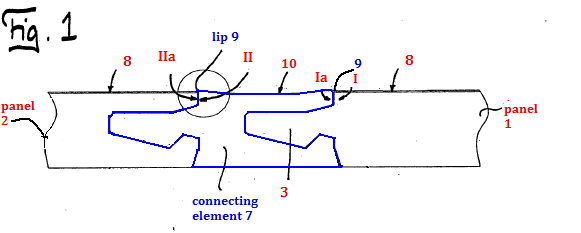
The Examiner's Answer reiterated that the claim recited a singular panel with lips bearing on the singular panel, yet the figures showed each lip bearing on a separate panel. The Answer also stated that "it is unclear if the claim is reciting a singular flooring panel or more than one flooring panel."
The Applicant filed a Reply Brief with a lengthy rebuttal. The Applicant explained why a claim to a single panel nonetheless recited plural panels.
Claim 15 recites, in part:
... the connecting element further comprising, in an area of the side edges, lips configured to be a sole sealing mechanism and to bear on a top side of the at least one flooring panel and overlap a butt joint between panels of the at least one flooring panel and the connecting element.
... That is, a lip on each panel can overlap with an adjacent panel. This language is clearly described in the specification. The claims do not recite that more than one lip is configured to bear on the singular at least one flooring panel. The Examiner is misreading the claims and taking the claim language out of context.
Also, Appellants submit that although one lip is shown in FIG. 1 and FIG. 2 for each panel, ... two lips can be required so that the lips can provide the sealing mechanism for two, adjacent panels. Additionally, in the context of the claims, the lips are used so that they can provide sealing between at least one panel (e.g., "singular"). ...
Lastly, for claim 15 to read correctly and for it to be understandable, it is necessary to place the claimed elements in the proper environment. For this reason, although claim 15 is directed to at least one panel, the claim uses the terminology "panels" in order to show how the lips are used with adjacent panels. This is clear from the record and the specification.
The Board affirmed the indefiniteness rejection, focusing on the inconsistency between "at least one panel" and "panels of the at least one flooring panel."
The broadest reasonable interpretation of the term “at least one panel” is that the term is sufficiently broad to encompass a single panel. On the other hand, the recitation of “panels of the at least one flooring panel and the connecting element” implies that the at least one flooring element must include a plurality of panels. The use of two different terms to identify the “at least one panel” and the “connecting element” implies that the connecting element is not a panel.
Therefore, the broadest reasonable interpretation of claims 15-20 and 23 is indefinite. Depending on which interpretation of the term “at least one flooring panel” one adopts, claims 15 and 23 may be sufficiently broad to encompass systems having only a single floor panel or may be limited to systems each having a plurality of panels. The disclosure of paragraph [0016] and Figure 1 of the Specification, cited by the Appellant at page 6 of the Appeal Brief, does not resolve this ambiguity.
(Emphasis added.)
My two cents: The Applicant really stuck to his guns here, and seemed unwilling to claim two panels – even though the novelty seemed to lie in the interactions between the connector and the two panels (i.e., tongue and groove). I don't get this reluctance.
What infringement scenario was the Applicant concerned about giving up by claiming two panels? Sure, such a claim would require a flooring manufacturer to sell two panels and a connecting element, even though the connector did provide a benefit (sealing) when used with only a single panel. But is that really giving up that many infringers? Won't a large number of flooring systems be sold with pairs of panels and a connector in between? Yeah, it's great to have a claim that catches every infringement scenario. But the Applicant here put the entire patent at risk by refusing to rewrite the claim in a way that made sense.
This very issue was explored a bit during oral arguments. The Applicant's representative stated that "a flooring system would ordinarily have more than one panel" and that the tongue and groove of the connecting element would be "connected to a groove and a tongue of respective flooring panels." The judge then asked: "If that's the case, then why not just recite flooring panels?" To which the Applicant's representative responded: "The client had decided that we want to say 'at least one' in this particular case to make it broader."
Monday, August 27, 2012
BPAI affirms obviousness of substituting parallel connector for serial even if reference did not teach equivalence
Takeaway: A Patentee in an inter partes reexamination appealed an obviousness rejection of a dependent claim. The Examiner used the substitution rationale from KSR, substituting a Firewire connector for a USB connector. The Applicant argued that "[the reference] does not disclose that the pin configuration, the wiring scheme required or operation of the two [connectors] are equivalent." The Board affirmed the rejection since the Examiner made the requisite findings of fact discussed in MPEP § 214(B), and the Patentee did not show error in these findings. The Board explained that a teaching of equivalence is not required support a rejection under the KSR substitution rationale. (Milan v. Apple, BPAI 2012.)
Details:
Milan v. Apple
Appeal 2012008569; Reexamination No. 95/001,083; Tech. Center 3900
Decided Aug. 7, 2012
The patent under reexamination described a flash memory device designed for use with a set of converter plugs. As shown in the figures below, the pin configuration (416) on the flash memory device (400) was configured to mate with several different converter plugs, including a 4-pin USB plug (FIGs. 12A-C) and a 5-pin mini-USB plug (FIGs. 12A-C).


The Patentee appealed various rejections, including independent claim 1 as obvious over two non-patent references ("Palm V Handbook Travel Kit" and "Handbook for Palm Tungsten Handhelds"), and dependent claim 3 as obvious over Palm, Tungsten, and Sirichai.
After rejecting independent claim 1 as obvious over the combination of Palm and Tungsten, the Examiner added Sirichai and used the substitution rationale to reject dependent claim 3. In rejecting claim 3, the Examiner made several findings of fact, including the ones discussed in MPEP § 2143(B) for the substitution rationale:
The Patentee attacked the obviousness rejection of claim 3 by disagreeing with the Examiner's finding that Sirichai taught the equivalence of USB and Firewire connectors. According to the Patentee, Sirichai's discussion of lighted electrical connectors instead taught that:
The Patentee then concluded that "simply substituting the USB connector of Tungsten with the connector body for a firewire connector will not result in functionality of the resulting connector" and as a result, the combination would not result in claim 3.
The Board was not persuaded by the Patentee's "no equivalence" argument. According to the Board, "a teaching of such equivalence is not required" to support the substitution rationale described in KSR. The Board found that the Examiner had made the requisite findings of fact for a substitution rationale, and the Patentee had not demonstrated error in these findings. The Board therefore affirmed the rejection of dependent claim 3.
My two cents: The Board reached the right result -- at the level of detail expressed in the claim, it is obvious to substitute a USB (serial) connector for a Firewire (parallel) connector. Yes, the operation of a serial bus and a parallel bus is different. But none of those differences have anything to do with what's in the claims. Yes, the pin configurations and wiring schemes are different. Nonetheless, substituting one connector for the other is within the knowledge of a POSITA, and the Applicant didn't argue otherwise.
I do have a problem with the Board's statement about findings of equivalence, because I think it's misleading. Of course the claimed feature and the substituted feature from the reference aren't required to be equivalent in every way. But the two must be equivalent at some level, otherwise you couldn't substitute one for the other, right?
And you can fight an obviousness rejection on this point, i.e., by explaining the differences and why the reference feature wouldn't act as a substitute for the claimed feature. Maybe the lesson here is not to characterize such an argument as being about equivalence, but instead to couch it in terms of "results would not have been predictable" (i.e., the third finding mentioned in the MPEP discussion of substitution)?
I have a problem with this too, however, as the results of a badly-conceived substitution are probably quite predictable: the combination doesn't work as intended, or work as well, or too many modifications are needed to consider it obvious.
So to me, it is about equivalence, not predictability. Because it makes sense to argue that a POSITA would not substitute a blodget for a widget because they are not equivalent in these specific ways which relate to what is claimed. The Patentee here didn't win because he didn't (or couldn't convincingly) explain why the differences matter for what is claimed, and/or why the differences were too great for a POSITA to handle.
Details:
Milan v. Apple
Appeal 2012008569; Reexamination No. 95/001,083; Tech. Center 3900
Decided Aug. 7, 2012
The patent under reexamination described a flash memory device designed for use with a set of converter plugs. As shown in the figures below, the pin configuration (416) on the flash memory device (400) was configured to mate with several different converter plugs, including a 4-pin USB plug (FIGs. 12A-C) and a 5-pin mini-USB plug (FIGs. 12A-C).


The Patentee appealed various rejections, including independent claim 1 as obvious over two non-patent references ("Palm V Handbook Travel Kit" and "Handbook for Palm Tungsten Handhelds"), and dependent claim 3 as obvious over Palm, Tungsten, and Sirichai.
1. A flash memory device comprising:
a housing having opposed first and second ends;
a flash memory drive enclosed in said housing; and
a quick connector mounted in said housing and having a plurality of pins exposed at said second end, said pins being configured for electrical connection to a selected one of at least a first interchangeable connector and a second interchangeable connector ...
3. The flash memory device according to claim 1 wherein said plurality of pins is six female pins arranged in two parallel rows of three pins each.
After rejecting independent claim 1 as obvious over the combination of Palm and Tungsten, the Examiner added Sirichai and used the substitution rationale to reject dependent claim 3. In rejecting claim 3, the Examiner made several findings of fact, including the ones discussed in MPEP § 2143(B) for the substitution rationale:
- One type of Firewire connector is known to have a six pin configuration arranged in two parallel rows of three pins each.
- The prior art (Palm combined with Tungsten) contained a device which differed from the claimed device by the substitution of one component (Sirichai's connector) for another component (Palm's connector).
- Sirichai disclosed USB connectors and Firewire connectors, and described them as known equivalents.
- A POSITA could have substituted one known element (Sirichai's Firewire connector) for another (Palm's USB connector), and the results of the substitution would have been predictable.
The Patentee attacked the obviousness rejection of claim 3 by disagreeing with the Examiner's finding that Sirichai taught the equivalence of USB and Firewire connectors. According to the Patentee, Sirichai's discussion of lighted electrical connectors instead taught that:
... the connector tip is a USB connector tip and in another embodiment the connector tip may be a firewire connector tip. The connector tip 150 of Sirichai is simply referring to "an opaque metal shell[.]" Sirichai only provides that both USB and firewire connector tips could utilize the light source disclosed; it does not disclose that the pin configuration, the wiring scheme required or operation of the two are equivalent.
(Emphasis added.)
The Patentee then concluded that "simply substituting the USB connector of Tungsten with the connector body for a firewire connector will not result in functionality of the resulting connector" and as a result, the combination would not result in claim 3.
The Board was not persuaded by the Patentee's "no equivalence" argument. According to the Board, "a teaching of such equivalence is not required" to support the substitution rationale described in KSR. The Board found that the Examiner had made the requisite findings of fact for a substitution rationale, and the Patentee had not demonstrated error in these findings. The Board therefore affirmed the rejection of dependent claim 3.
My two cents: The Board reached the right result -- at the level of detail expressed in the claim, it is obvious to substitute a USB (serial) connector for a Firewire (parallel) connector. Yes, the operation of a serial bus and a parallel bus is different. But none of those differences have anything to do with what's in the claims. Yes, the pin configurations and wiring schemes are different. Nonetheless, substituting one connector for the other is within the knowledge of a POSITA, and the Applicant didn't argue otherwise.
I do have a problem with the Board's statement about findings of equivalence, because I think it's misleading. Of course the claimed feature and the substituted feature from the reference aren't required to be equivalent in every way. But the two must be equivalent at some level, otherwise you couldn't substitute one for the other, right?
And you can fight an obviousness rejection on this point, i.e., by explaining the differences and why the reference feature wouldn't act as a substitute for the claimed feature. Maybe the lesson here is not to characterize such an argument as being about equivalence, but instead to couch it in terms of "results would not have been predictable" (i.e., the third finding mentioned in the MPEP discussion of substitution)?
I have a problem with this too, however, as the results of a badly-conceived substitution are probably quite predictable: the combination doesn't work as intended, or work as well, or too many modifications are needed to consider it obvious.
So to me, it is about equivalence, not predictability. Because it makes sense to argue that a POSITA would not substitute a blodget for a widget because they are not equivalent in these specific ways which relate to what is claimed. The Patentee here didn't win because he didn't (or couldn't convincingly) explain why the differences matter for what is claimed, and/or why the differences were too great for a POSITA to handle.
Tuesday, August 21, 2012
BPAI decides whether limitation refers to final state of disconnection or action of disconnecting
Takeaway: An Applicant appealed a written description rejection of a claim for a device used in rock drilling. The rejection hinged on the interpretation of "device is loaded .... only when said rock bolt is disconnected from said coupling sleeve by rotation of the rock drilling machine." The Examiner interpreted this to exclude loading after disconnection, while the Applicant asserted that the phrase excluded loading during disconnection. The Board found that the proper interpretation was "during disconnection," since "disconnected" must be read in conjunction with the modifier "by rotation." (Ex parte Kanflod, BPAI 2012)
Details:
Ex parte Kanflod
Appeal 2012005389; Appl. No. 10/539,148; Tech. Center 3600
Decided August 14, 2012
The application on appeal related to drilling machines. The independent claim on appeal was directed to a sleeve that couples a rock bolt (1) to a rock drilling machine (2). (See figure below.)
The limitation at issue read:
During prosecution, the Applicant added the qualifier "only" in response to a prior art rejection. The Examiner then rejected the amended claim under § 112 First ¶, as lacking written description. The Office Action explained the problem with the phrase "only when ... disconnected" as follows:
The Applicant submitted an expert declaration from the inventor to address the written description rejection. The declaration also explained the meaning of the limitation at issue. Referring to this declaration, the Applicant argued that the "only when ... disconnected" phrase should be read in conjunction with the "rotation" phrase:
The declaration, and the argument, then went on to reference portions of the specification that described this loading behavior in conjunction with the rotating.
The Applicant went to appeal on the written description, indefiniteness, and prior art rejection, with both sides essentially repeating the above written description arguments.
The Board found that the written description rejection was based on an improper claim interpretation, one which read the first portion of the wherein clause in isolation from the remainder of the claim.
The Board reversed the written description rejection, finding that the Applicant's specification did convey possession of the properly interpreted claim.
My two cents: Once again, the real issue is claim construction. It seemed to me that both sides recognized this, but could have done a better of job of explaining exactly how they were interpreting the claim. I had to keep reading the claim, and the arguments, over and over again.
The Examiner apparently read "disconnected" as referring to the bolt's final state, so that the phrase "only when" was interpreted to exclude loading with the bolt disconnected. On the other hand, the Applicant apparently read "only when ... disconnected" to refer to the action of disconnecting the bolt, or perhaps the bolt's intermediate state of being disconnected.
The choice of tense in "when disconnected" definitely sounds like a state rather than an action. It's only when the "by rotation" portion of the claim is considered that it even becomes possible to understand "disconnected" as an action. Still, I think the phrasing "only when said rock bolt is being disconnected" does a better job of conveying the Applicant's apparent intent.
My sense is that the issue of what tense to use comes up more in mechanical cases where you focus on describing structure first, and then on associating actions and states with the structure. Whereas action and state are more central to the claims I deal with every day in computer and electronics applications. Even so, I can think of instances where I've had to think about how to properly convey state, action, or a combination of the two – and it can be a challenge.
Details:
Ex parte Kanflod
Appeal 2012005389; Appl. No. 10/539,148; Tech. Center 3600
Decided August 14, 2012
The application on appeal related to drilling machines. The independent claim on appeal was directed to a sleeve that couples a rock bolt (1) to a rock drilling machine (2). (See figure below.)
The limitation at issue read:
a locking device (7) ... said locking device is loaded to retain the rock drilling machine connected to the coupling sleeve only when said rock bolt is disconnected from said coupling sleeve by rotation of said rock drilling machine in a direction for disconnecting said first part of said coupling sleeve from said rock bolt for reinforcing a rock with said rock bolt.
(Emphasis added.)
During prosecution, the Applicant added the qualifier "only" in response to a prior art rejection. The Examiner then rejected the amended claim under § 112 First ¶, as lacking written description. The Office Action explained the problem with the phrase "only when ... disconnected" as follows:
[T]here is no structure to prevent the loading of locking device (7) to retain the rock drilling machine (2) connected to the coupling sleeve (3, 5) regardless of whether or not rock bolt (I) is connected or disconnected, since rock bolt (I) has no contact with either of locking device (7) or drilling machine (2) (even when the bolt is installed) and thus cannot prevent relative loading between device (7) and machine (2).
(Emphasis added.)
The Applicant submitted an expert declaration from the inventor to address the written description rejection. The declaration also explained the meaning of the limitation at issue. Referring to this declaration, the Applicant argued that the "only when ... disconnected" phrase should be read in conjunction with the "rotation" phrase:
[T]he locking device is loaded (locked) to lock the drilling machine to the coupling sleeve only when the drilling device is rotated in a direction to separate the rock bolt from the coupling sleeve, and not during a percussion operation.
The declaration, and the argument, then went on to reference portions of the specification that described this loading behavior in conjunction with the rotating.
The Applicant went to appeal on the written description, indefiniteness, and prior art rejection, with both sides essentially repeating the above written description arguments.
The Board found that the written description rejection was based on an improper claim interpretation, one which read the first portion of the wherein clause in isolation from the remainder of the claim.
A person skilled in the art would understand the above limitation to mean that the locking device is loaded just prior to disconnection of the rock bolt from the sleeve, i.e., when the rock bolt is still connected to the coupling sleeve. The Examiner improperly interprets the limitation to mean that the locking device is loaded only after disconnection of the rock bolt from the sleeve.
The Board reversed the written description rejection, finding that the Applicant's specification did convey possession of the properly interpreted claim.
The specification as originally filed explains that (1) during drilling the locking device 7 is unloaded (Spec. at 2:13-14) and (2) after drilling the locking device is loaded to disconnect the rock bolt from the coupling sleeve (Spec. at 2:14-19).
My two cents: Once again, the real issue is claim construction. It seemed to me that both sides recognized this, but could have done a better of job of explaining exactly how they were interpreting the claim. I had to keep reading the claim, and the arguments, over and over again.
The Examiner apparently read "disconnected" as referring to the bolt's final state, so that the phrase "only when" was interpreted to exclude loading with the bolt disconnected. On the other hand, the Applicant apparently read "only when ... disconnected" to refer to the action of disconnecting the bolt, or perhaps the bolt's intermediate state of being disconnected.
The choice of tense in "when disconnected" definitely sounds like a state rather than an action. It's only when the "by rotation" portion of the claim is considered that it even becomes possible to understand "disconnected" as an action. Still, I think the phrasing "only when said rock bolt is being disconnected" does a better job of conveying the Applicant's apparent intent.
My sense is that the issue of what tense to use comes up more in mechanical cases where you focus on describing structure first, and then on associating actions and states with the structure. Whereas action and state are more central to the claims I deal with every day in computer and electronics applications. Even so, I can think of instances where I've had to think about how to properly convey state, action, or a combination of the two – and it can be a challenge.
Friday, August 10, 2012
BPAI provides concise summary of how to rebut an Examiner's claim interpretation
Takeaway: In an appeal involving a cartridge for caulking compound, the main issue was the meaning of of the term "punch" in claim limitations such as “punching an opening in the tubular container.” The BPAI explained that the Applicant's mere assertion that claim language did not encompass the teaching of the reference was not sufficient to rebut the Examiner's interpretation. To rebut, an Applicant should point to "precise
meaning" in the specification, to a dictionary definition, or to a statement by a
POSITA. (Ex parte Longo, BPAI 2012.)
Details:
Ex parte Longo
Appeal 2009014183; Appl. No. 11/328,537; Tech. Center 3700
Decided: May 23, 2012
The subject matter on appeal was a cartridge for caulking compound. The main issue on appeal was the meaning of the term "punch" in claim limitations such as “punching an opening in the tubular container.”
For the "punching" limitations, the Examiner relied on a reference teaching of a "rapidly actuatable tool for making cuts" which "deforms the cylinder wall to form catches 17 as it cuts." The Applicant argued that the cutting described in the reference was not the same as punching.
The Board presented a dictionary definition ("to cut, stamp, pierce, perforate, form, or drive with a tool or machine that punches") to show that the Examiner's interpretation (punching" includes "cutting") was reasonable. The Board found that the Examiner's interpretation was "essentially unrebutted" by the Applicant.
My two cents: I picked this decision not because it was controversial in any way, but because it included a clear and concise statement of what the Board is looking for in an argument about claim construction. A mere assertion in the Appeal Brief that a widget is not a blodget probably won't be convincing. Instead, you should refer to a "precise meaning" in the spec, to a dictionary definition, or to a statement by a expert about what the term means to a hypothetical POSITA.
On this last point, the Board's phrasing suggests that an Applicant statement in the Brief about what the term means to a hypothetical POSITA would be sufficient. However, other decisions I've read suggest instead that you need evidence. This evidence can take the form of another reference that uses the term, or a § 1.132 declaration from a person of ordinary skill in the art about the meaning of the term.
Details:
Ex parte Longo
Appeal 2009014183; Appl. No. 11/328,537; Tech. Center 3700
Decided: May 23, 2012
The subject matter on appeal was a cartridge for caulking compound. The main issue on appeal was the meaning of the term "punch" in claim limitations such as “punching an opening in the tubular container.”
For the "punching" limitations, the Examiner relied on a reference teaching of a "rapidly actuatable tool for making cuts" which "deforms the cylinder wall to form catches 17 as it cuts." The Applicant argued that the cutting described in the reference was not the same as punching.
The Board presented a dictionary definition ("to cut, stamp, pierce, perforate, form, or drive with a tool or machine that punches") to show that the Examiner's interpretation (punching" includes "cutting") was reasonable. The Board found that the Examiner's interpretation was "essentially unrebutted" by the Applicant.
Appellant, however, points to no specific wording in the specification that shows a precise meaning given to the term “punching” or to any related terms such as “punch” that would amount to interpretive guidance. Appellant also fails to provide support for this argument by pointing to any type of general purpose or technical dictionary as interpretive guidance that punching would not encompass the cutting performed in van Manen, nor does Appellant state that this is a term of art known to those of ordinary skill to exclude van Manen’s cutting. Appellant merely provides attorney argument against the Examiner’s interpretation with nothing further.Based on this claim interpretation, the Board affirmed the prior art rejections of the independent claims.
My two cents: I picked this decision not because it was controversial in any way, but because it included a clear and concise statement of what the Board is looking for in an argument about claim construction. A mere assertion in the Appeal Brief that a widget is not a blodget probably won't be convincing. Instead, you should refer to a "precise meaning" in the spec, to a dictionary definition, or to a statement by a expert about what the term means to a hypothetical POSITA.
On this last point, the Board's phrasing suggests that an Applicant statement in the Brief about what the term means to a hypothetical POSITA would be sufficient. However, other decisions I've read suggest instead that you need evidence. This evidence can take the form of another reference that uses the term, or a § 1.132 declaration from a person of ordinary skill in the art about the meaning of the term.
Subscribe to:
Comments (Atom)