Showing posts with label prior art. Show all posts

Tuesday, February 3, 2015

PTAB not persuaded that reference disclosing non-elected species is improper

Takeaway: In appealing an obviousness rejection, the Applicant attacked the availability of a reference on the grounds that this contradicted an Election of Species requirement. More specifically, the Applicant argued that since the Applicant chose not to elect claims to a window refrigerator in combination with freezers and air conditioners, the Examiner was precluded from using a reference to a central air conditioner, which was even further removed than was the non-elected combination. The Board was not persuaded, noting that the only preclusive effect of a Restriction/Election was on divisional applications. (Ex parte Arjomand, PTAB 2014.) 

Details:
Ex parte Arjomand
Appeal 2012-008435; Appl. No. 11/474,530; Tech. Center 3700
Decided:  Nov. 3, 2014

The Application on appeal was titled "Window Refrigerator." According to the Specification, "during the hot summer months, this device can be used as both a refrigerator/freezer (R/F) and an indoor cooling and de-humidifying device; and in winter as an indoor heating-humidifying device."

At the start of prosecution, the Examiner issued an Election of Species Requirement, identifying species A, B, and C corresponding to Figures 1, 4, and 9. The Applicant filed a Response electing Group B (Fig. 4) and asserting that the elected group covered claims 24-37. The Response also stated:
Applicant thanks the examiner for recognizing the patentable distinctness of the subject matter of [elected] claims 24-37 over the subject matter of the other grouped claims. Clearly, claims 24-37 would be patentable over any prior art which is further removed from these claims than is the subject matter of [independent] claims 23 or 38.
(Emphasis added.)
In the first Action on the merits, the Examiner rejected all claims as obvious over Lukas, Metcalfe and Maeda. In the Response to this first Office Action, the Applicant argued, i.a., that this § 103 rejection was "improper for procedural reasons" because it was contradictory to the restriction/election requirement:
The examiner [through the Restriction/Election Requirement], in effect, held that a claim directed to a combination of a freezer and a refrigerator was patentable over a combination of an air conditioner and a cooling area for food (refrigerator), as see Section 802.01 of the MPEP. The examiner should not now be heard to say that the combination of a freezer and a refrigerator is unpatentable over the combination of an air conditioner and a refrigerator.
The Examiner issued a new ground of rejection in the next Office Action and did not comment on the Applicant's "contradictory" argument.

After several more rounds of prosecution , the Applicant appealed. By the time of appeal, the obviousness rejection had evolved to include a different set of references: Wertheimer, Maekawa (from the first Office Action) and Shavit. In the Appeal Brief, the Applicant renewed the "contradictory" argument and used it to challenge whether Shavit was a proper reference under § 103.
     The examiner's reliance upon Shavit and Wertheimer raises an issue that was decided early on in the prolonged prosecution of this application. Prior to a first action on the merits the examiner required an election of species between Fig. 1, Fig. 4, and Fig. 9. Fig. 1 is related to a window air conditioner. Fig. 4 is related to a window refrigerator. Fig. 9 is related to a window refrigerator associated with a freezer and a heat pump (air conditioner).
     Section 802.01 II of the M.P.E.P. states in part: "Related inventions are distinct if the inventions as claimed are not connected in at least one of design, operation, or effect (e.g., can be made by, or used in, a materially different process) and wherein at least one invention is PATENTABLE (novel and nonobvious) OVER THE OTHER (though they may each be unpatentable over the prior art)." (Capitals in original.)
     [During prosecution] the examiner acknowledged the election of claims 24-29 [Fig. 4 (window refrigerator)]. At that time he could have withdrawn the requirement, had he considered that window refrigerators were not patentable over window refrigerators associated with freezers and air conditioners. By maintaining the [restriction/election] requirement the examiner confirmed that window refrigerators are considered to be patentable over window refrigerators associated with freezers and air conditioners. This being the case, it is quite clear that window refrigerators are [also] patentable over central air conditioners. It is appellant's position that the use of a reference drawn to a central air conditioning system is improper and contrary to the examiner's [initial] position that window refrigerators are patentable over window refrigerators associated with freezers and air conditioners.
The claim groups resulting from the Restriction/Election were as follows:
STATUS FIGURE FIGURE DESCRIPTION CLAIM
Unelected Fig. 1 "thermos attached to the front of a window A/C" 23. A combination of a window .... a device comprising an air conditioner passing through the window having a front side ... with a control panel, and a thermos attached to the front of the air conditioner ...
Elected Fig. 4 "standalone small size window R/F" 24. A combination of a window ... and a window refrigerator/freezer device, which device has a motor, a compressor, an evaporator, and a condenser coil and at least one of a refrigerator compartment and a freezer compartment..
Unelected Fig. 9 "full-size window R/F having an auxiliary heat pump on top of it" 38. A combination of a window .... ; a window refrigerator/freezer device having a motor, a compressor, an evaporator, and a condenser coil ..and a heat pump device

The Board was not persuaded that Shavits was an improper reference. The Board explained that there is no connection between restriction/election and availability of a reference:
     Appellant further argues that the Examiner’s reliance on Shavit to remedy this deficiency is improper because, before beginning examination on the merits, the Examiner issued an Election of Species Requirement dividing the Application into three species, and one of the non-elected species relates to air conditioners, as does Shavit. ....
     We do not agree with Appellant’s position on this point. The Election of Species Requirement was issued based on the content of the Application, and any preclusive effect of the Election of Species Requirement with respect to rejections of the elected claims extends only to divisional applications directed to the non-elected species, not to other references. See 35 U.S.C. § 121.
My two cents: I had a hard time following the Applicant's own argument, but I understood the Board's characterization. I thought the Applicant's argument was creative, but also completely off-base.

The Applicant relied on a (mis)reading of the MPEP's definition of the term "distinct" used in the divisional statute. The crux of the Applicant's argument seemed to hinge on this phrase:  "PATENTABLE (novel and nonobvious) OVER THE OTHER."

Applicant's reasoning appeared to be:
  • Examiner said window refrigerators are distinct from window refrigerators in association with freezers and air conditioners.
  • According to the definition of distinct, window refrigerators are therefore Patentable Over window refrigerators in association with freezers and air conditioners
  • Window refrigerators are therefore Non-Obvious over window refrigerators in association with freezers and air conditioners
  • A reference disclosing a window refrigerator associated with freezers and air conditioners is therefore improper in an Obviousness rejection of a window refrigerator (one without freezers and air conditioners?)
  • A central air conditioners is even further removed from a window refrigerator (one without freezers and air conditioners?) than are freezers and air conditioners
  • CONCLUSION: A reference disclosing a central air conditioner associated with freezers and air conditioners is therefore improper in an Obviousness rejection of a window refrigerator (one without freezers and air conditioners?)
What baffles me is that the Applicant argued this as a matter of law, when the argument at best had a sort of intuitive appeal, as a matter of logic. But the logic falls apart pretty fast, because the Applicant ignored the magic word "claims": the comparison in the PATENTABLE OVER clause is to claims. So a claim to a window refrigerator is PATENTABLE OVER a claim to a window refrigerator in association with with freezers and air conditioners.

So, we're talking about claims, not disclosure. Moreover, we're talking about groups of claims in the same application.

Monday, January 20, 2014

Board decisions involving the Wayback Machine to show status as prior art (Part II)

In my last post (here), I discussed Examiner usage of an archived web page as a reference, and noted that the Board generally finds this usage acceptable. That post also illustrated a few unsuccessful arguments against this use of archived web pages in a rejection.

Today's post deals with the relationship between the actual reference, as identified by the Examiner, and the archive pages produced by the Examiner. In today's cases, the Board focused on corroboration between the archive pages and the asserted reference -- in other words, did the evidence show that the pages from the archive (dated before the critical date) actually correspond to the reference identified in the rejection (dated after the critical date). The Board upheld prior art status only when the archive pages in the record were identifiable as earlier versions of the reference page.


In Ex parte Benveniste, the Board reversed because the Examiner had not shown corroboration between the web page retrieved during examination and the archived version. During prosecution, the reference was referred to as "http://www.motivators.com/Promotional-Custom-SafetyConeStressball-6143.html#Tab12." The List of References Cited listed two non-patent documents:
  • "Internet Wayback Machine" [online] Retrieved on 2012-03-13 [during examination]. Retrieved From: http://web.archive.org/web/20050430223104/http://www.motivators.com/6143-promotional-item.html
  • "Motivators Promotional Products" [online] retrieved on 2012-03-13 [during examination]. Retrieved from http://www.motivators.com/Promotional-Custom-ConstructionConeStressReliever-6143.html.   Tab12.

On appeal, the Applicant argued public dissemination. ("The Examiner has not shown that a person in the field of emergency repair plugs for boat hulls would have come across the cited reference prior to the critical date.") The Applicant acknowledged the Examiner's reliance on the Wayback Machine (rather than the current Motivators page) to show prior art status, but noted that "Appellants have not been successful at accessing the web page address provide by the Examiner."

The Board reversed on the basis of a lack of corroboration between the web page retrieved during examination and the web page retrieved via the Wayback Machine. The Board explained:
The page cited to by the Examiner in the Final Office action currently redirects to: http://www.motivators.com/Promotional-Custom-ConstructionConeStressReliever-6143.html. The Examiner cites http://web.archive.org/web/20050430223104/http://www.motivators.com/6143-promotional-item.html as evidence of the effective date of the www.motivators.com page entered into the file wrapper Mar. 23, 2012. There is nothing corroborating the page copied by the Examiner with the date of the page provided by the Wayback Machine.
(Emphasis Added.)
The Board found that without such corroboration, the Examiner had not shown that the Motivator reference was prior art.


The Applicant in Ex parte Aguilera tried to use date information in the footer of the archive print out to show a lack of corroboration, but the Board found the Applicant had misunderstood the date. During prosecution, the reference was first identified in the Office Action as "Minwen Ji, 'Instant Snapshots in a Federated Array of Bricks,' Internet Systems and Storage Laboratory, HP Lab, Palo Alto, January 28, 2005." The Applicant traversed, noting that Ji itself referred to the date as an "internal accession date," and while Ji indicated that the publication was "approved for external publication," Ji did not give a publication date.

The next Office Action updated the list of References Cited to include "Internet Archive Wayback Machine April 20, 2005" and included 2 pages from the Wayback Machine. The Response to Arguments section then explained that the Wayback Machine showed that the reference was available on the HP Technical Reports website in Feb. 2005 (before the critical date).

The Applicant filed an appeal and repeated earlier arguments. Notably, the Appeal Brief did not address the Wayback Machine evidence.

The rejection in the Examiner's Answer once again identified the reference using a Jan. 2005 date, but the Response to Arguments section "reiterated" that "the HP website and the Internet Archive Wayback Machine both provide evidence that Ji's  reference was available to the public during the year of 2005." The Answer also included a page from the Wayback Machine, listing bibilographic information and an abstract for the Ji publication. The footer on this page identified the source (a Wayback Machine URL) and also a current date (2009).

Finally, the Answer also included a "HP Technical Reports" page showing a list of technical reports, including "HPL-2005-15 - Instant Snapshots in a Federated Array of Bricks ; Ji, Minwen." According to the Examiner, the presence of "2005" in the document name  indicated that "Ji's reference was available to the public as shown by the HP website in 2005." The Examiner further asserted that the Technical Reports page was obtained using the link http://www.hpl.hp.com/techreports/2005, and the presence of "2005" in the URL was a further indication of the prior art status of the Ji publication. 


The Applicant filed a Reply Brief addressing both the Wayback Machine evidence and the HP Technical Reports page. According to the Applicant, the current date (2009) on the Wayback Machine print-out "indicates the publication date of the version being shown". Finally, the Applicant argued that the presence of the year 2005 in a URL does not show the reference was publically available in 2005, but showed only that certain references that available at the time of examination had a "written date" of 2005.

The Board found that the Examiner's use of the Wayback Machine was enough evidence that the Ji reference was prior art:
We find the Appellants’ arguments unpersuasive regarding the Wayback Machine evidence as one of ordinary skill in the art would understand that the date highlighted by Appellants in the bottom right hand corner, i.e., 12/22/2009, merely indicates a date of printing a hardcopy, not the date of publication. Furthermore, the Archive evidence presented by the Examiner clearly shows dates as early as 2005.


In Ex parte Rowse, the Board found that the URL of the archived pages identified those pages as earlier version of the reference. The rejection identified the web page reference as "Xactware.com, retrieved from the Internet Archive Wayback Machine <archive.com>, 6/29/1998." The Applicant traversed the rejection by arguing that "the Internet Archive is not prior art" because "the 'Internet Archive Wayback Machine' from which the Xactware reference was taken was not publicly available until [after Applicant's filing date.]" In the next Office Action, the Examiner clarified that "the web page (and date published) is meant to serve as prior art -- not the internet archive."

On appeal, the Board analyzed the Examiner's prima facie showing of Xactware as prior art. The Board first noted the reference identified by the Examiner was the archived Xactware web pages, not the pages retrieved from the Xactware site at the time of examination. The Board further noted that the pages themselves showed an archive date:
Based on the Uniform Resource Locator (URL) content at the bottom of each page, pages 1 through 15, as numbered by the Examiner, appear to represent web pages that were published (publicly available) on the “xactware.com” site in the year 1998.
In view of this prima facie showing that the reference was prior art, the Board looked to the Applicant for a rebuttal and found none:
     In the instant case, Appellants have not provided any evidence to show that the website from which Xactware was retrieved is not reliable as to presumed dates of publication. Nor have Appellants provided any other evidence tending to show that the content described by Xactware was not publicly available on the presumed dates.
.... On this record, we conclude that the Examiner properly considered Xactware to represent prior art with respect to the invention of the rejected claims.

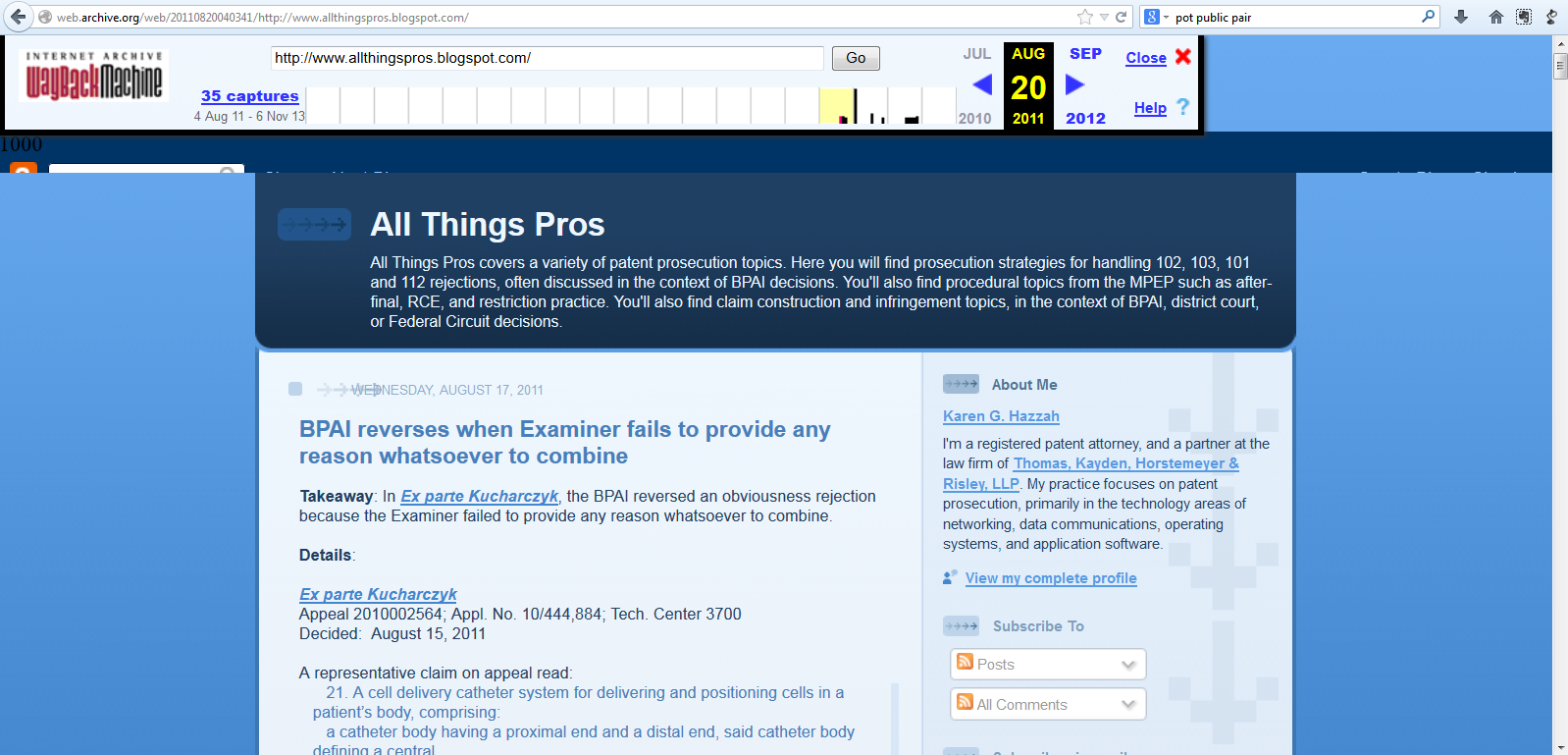
My two cents: If you're not familiar with the Wayback Machine, here's a very brief explanation of the interface.

Typing in a web address from the main page (internetarchive.org) gives you a timeline/calendar view of all the archived pages for that site.


Clicking on a specific date retrieves the page as it existed on that past date:

Note that the URL of the retrieved page in the browser address bar
https://web.archive.org/web/20110820040341/http://www.allthingspros.blogspot.com/
encodes the name of the archived site and the archive date.

Sunday, December 29, 2013

Board decisions involving the Wayback Machine to show status as prior art (Part I)

Long ago I wrote a series of post discussing the use of web pages as prior art. In one of those posts (here), I mentioned the use of www.archive.org  (a.k.a. the "Wayback Machine"), which is an archive site of web pages as they existed in the past. An Examiner can't allege that a web page was available as of your application's past filing date if all he has is the page retrieved as of the examination date, However, he can use the Wayback Machine to navigate to that same web page, retrieve a copy as it existed as of a particular past date, and use the page retrieved via the Wayback Machine as the reference.

Since my original post back in 2009, I've come across a few more cases where the Applicant tried to disqualify a reference on the basis of its retrieval via the Wayback Machine. Generally, it's a losing battle: as long as the Examiner identifies the page and retrieval date in the proper manner, the Board views such references as "printed publications" under § 102(b) or § 102(a).  In today's post, I'll discuss a few of these Board decisions, and highlight some unpersuasive arguments made by Applicants.

To qualify as a "printed publication," case law requires that the reference be disseminated to persons in the art. For example, MPEP § 2128 states that "[a] reference is proven to be a 'printed publication' 'upon a satisfactory showing that such document has been disseminated or otherwise made available to the extent that persons interested and ordinarily skilled in the subject matter or art, exercising reasonable diligence, can locate it. In re Wyer, 655 F.2d 221, 210 USPQ 790 (CCPA 1981)."

In Ex parte Rowse, the Applicant attacked the Examiner's use of the Wayback Machine on this basis. The Applicant argued that "the Examiner has provided no evidence that the Xactware reference qualifies as a printed publication other than asserting that 'the Internet Archive is a tool used to access internet pages that were published and publicly accessible in the well-documented past.' " Next, the Applicant referred to the "dissemination" requirement in MPEP § 2128, and then continued as follows:
Regarding "public dissemination," pages on the World Wide Web are not "disseminated" - they are "browsed" using a "Web browser" - the antithesis of dissemination. Many web pages are never even browsed. Regardless, the Examiner has submitted no evidence to show that the Xactware reference was ever "disseminated" to members of the public, or "browsed" by members of the public, prior to the applicants' date of invention. Regarding "public availability," the Examiner has made no showing that the Xactware reference was catalogued, indexed or searchable in any publically-available database prior to the applicants' date of invention.
(Emphasis added.)
The Board in Rowse found that the Examiner had made a prima facie case of the reference's status as prior art. The Board did not specifically address the dissemination argument, addressing instead the general argument that the Examiner had not provided evidence of publication. The Board first noted that in an ex parte proceeding, the rules of evidence are relaxed when demonstrating prima facie unpatentability. The Board then explained that
Appellants have not provided any evidence to show that the website from which Xactware was retrieved is not reliable as to presumed dates of publication. Nor have Appellants provided any other evidence tending to show that the content described by Xactware was not publicly available on the presumed dates.
(Emphasis added.)
The Board has also been unpersuaded by Applicant arguments that the Wayback Machine is not appropriate to show prior art status because it's not reliable. In Ex parte Hicks, the Applicant argued that “per the explicit terms of use for the Internet Archive Wayback Machine [mentioned on the archive site itself], the January 21, 2005 archive is not guaranteed to be accurate, current, complete, reliable, secure or error-free.” (Emphasis added.) The Applicant further asserted that "the Internet Archive does not guarantee that the data listed for January 21, 2005 is what was actually archived or if anything at all was even archived for that date." The Applicant concluded that the Wayback Machine is therefore "not a valid or reliable resource for establishing prior art."

The Examiner's Answer noted that Applicant had not provided any evidence to demonstrate that the archive date was invalid or that the web page was not accessible to persons of skill in the art. The Applicant filed a Reply Brief stating that:
Notwithstanding the well-recognized difficulty of proving a negative, Appellants' representative has performed an Internet search and has been unable to locate any other evidence indicating that the FFHD reference was  published  prior  to Appellants'  filing date. The only evidence of record in support of a prior publication date is from a single third party source that per it's own terms of use may not be accurate.
The Board in Hicks appeared to address the Applicant's unreliability argument by shifting the burden to the Applicant:
Electronic documents are archived on the Wayback Machine and are dated as of the archived date of the website. Appellants do not indicate that the archive date provided for FFHD by the Wayback Machine was generated other than in the normal course of operation of this site. There is no indication that this date was arbitrarily assigned or that the origin of document itself is suspect.
The Applicant in Hicks also tried another argument, characterizing the "URL date indicated by the Internet Archive Wayback Machine" as "nothing more than a third party assertion."
A publication date cannot be established based on an uncorroborated third party assertion unsupported by any affidavit or declaration. If all that was required to establish a publication date was a third party assertion unsupported by any affidavit or declaration, then any reference could be turned into prior art merely by finding a third party willing to place a prior publication date on the document. Such uncorroborated third party assertions unsupported by any affidavit or declaration are not sufficient evidence.  If an Applicant  wishes  to  submit an assertion by a third  party as evidence, e.g., in support of a Rule 131 or 132 submission, then the third party assertion is required to be supported by an affidavit or declaration. The Examiner should be held to no less of a standard. Here, the Examiner has not obtained any affidavit or declaration from the Internet Archive Wayback Machine supporting the publication date of  the FFHD reference. Nor has any other corroborating evidence been supplied by the Examiner despite repeated challenges  by the Applicant.
The Board in Hicks was not persuaded by this argument either. After noting that a PTO proceeding is not bound by the stricter rules of evidence of a judicial proceeding, the Board concluded that "without more, we decline to agree with Appellants that reliance by the Examiner on FFHD was improper."

As noted above, the Board generally allows the use of the Wayback Machine to show prior art status,
as long as the Examiner identifies the page and retrieval date in the proper manner. In a future post, I'll discuss a few cases where proper identification was at issue.

Friday, April 5, 2013

Follow-up to Ex parte Cogdill - Examiner introduces "equivalent" circuit diagram

Last week I posted here about Ex parte Cogdill, a case in which the Examiner relied on an "equivalent' circuit diagram for anticipation. My post resulted in a fair amount of reader comments, and the issues brought up in the comment thread inspired me to do this follow-up post. I don't have a strong opinion about the right answer to most of these issues. (Many of those who commented did have strong opinions about the rightness of their position.) I do think the issues are interesting to explore.

Though the Applicant in Ex parte Cogdill didn't identify it as such, the threshold legal issue here is whether or not an Examiner-introduced diagram can be used in a rejection – even if is equivalent. As commenters pointed out, such a diagram is not prior art under § 102 or § 103.

I haven't run across this sort of "drawing equivalence" before. I have run across plenty of cases where the Examiner has annotated a drawing, but that's usually about further explaining what's already in the drawing, e.g., by adding the text "lever" to show that reference number 42 allegedly corresponds to the claimed lever. Is this sort of annotated drawing also prohibited because it's not prior art? I don't see it that way. I view this drawing-plus-added-text as the Examiner's assertions about the teachings of the reference.

I've also seen a few cases where the Examiner annotates with something like a box around something in the drawing in order to explain that, e.g., the components within the box allegedly correspond to claimed assembly 42. Once again, I see this as an Examiner assertion about the teachings of the reference. 

So maybe what happened in Cogdill's equivalent circuit drawing is analogous to the Examiner asserting that the "lever" in the reference corresponds to the "member" in the claim. It's well-settled law that the reference doesn't have to use the same terminology as the claim in order to anticipate. Is redrawing the circuit diagram that much different than substituting the term "lever" in the reference with the word "member"?

That sounds weird, because Examiners don't literally introduce paragraph [0043B] with the substituted text in order to make this point. Instead, an Examiner writes something like
Johnson anticipates claim 1 as follows: a member (lever 42 in FIG. 1);  ...
Is the Examiner-created Fig. 3B in the Cogdill case just a way for the Examiner to better illustrate how he was reading Johnson's Fig. 3? In other words, is Fig. 3B an Examiner finding about the teachings of the reference rather than a type of evidence that is inadmissible because it doesn't qualify as prior art?

Could the Examiner have introduced Fig. 3B as evidence through a personal affidavit? Surely an Applicant could introduce an equivalent circuit diagram as declaration evidence, along with an explanation of how the claim limitation at issue is not disclosed by the diagram. So could the Examiner do the same thing through a personal affidavit?

If we get past the threshold legal issue, then the next issue might be the burden of proof on the equivalence of the circuit diagrams. Does a mere assertion of equivalence by the Examiner shift the burden to the Applicant to explain why they are not equivalent? Can the Applicant attack the asserted equivalence with attorney argument, or is real evidence required?

If we get past all that, we reach the questions of fact as to whether Figs. 3 and 3B in Ex parte Cogdill really were equivalent and whether the limitation at issue was disclosed. I'm not a EE, so I'll refrain from expressing an opinion on that ultimate question. I will, however, ask a few questions about the issue. 

As far as circuits go, the claim and the diagrams in Cogdill look pretty simple. You have to understand the difference between parallel and serial. But that's covered in a basic physics class, so I'm not convinced you need to be a EE to interpret this aspect of the circuit. (And yeah, you also have to understand what impedance is, but that doesn't appear to be at issue).

The rest of the claim appears to describe how the impedance elements are connected, using terms such as "between," "one end" and "branch points." With all this talk about connections, it this more of a mechanical-type claim? Or do we need to understand something about circuits in order understand what those positional relationships mean in a circuit context?

Wednesday, April 3, 2013

Board affirms anticipation rejection based on an Examiner-provided circuit diagram that was equivalent to reference diagram


Takeaway: In an anticipation rejection of a claim to an electrical circuit, the Examiner relied on a circuit diagram and asserted it to be equivalent to the diagram used in the reference. The Applicant appealed and argued that the Examiner's reliance on this figure was improper. The Board affirmed the anticipation rejection after finding that the Examiner's diagram was equivalent and disclosed the claim limitation at issue. (Ex parte Cogdill, PTAB 2010.)

Details:
Ex parte Cogdill
Appeal 2010005510; Appl. No. 10/655,964; Tech. Center 2800
Decide  June 27, 2010

The application was directed to circuitry for memory modules. A representative claim on appeal read:
     1.  A circuit for a memory module address bus comprising:
     a transmission line comprising a dampening impedance between a driver and a branch point of said transmission line; and
     a parallel termination impedance having one end coupled to said transmission line between said series dampening impedance and said branch point,
     wherein said parallel termination impedance is on the same side of any memory module as said driver;
     said transmission line having branches from said branch point,
     wherein ones of said branches are coupled to at least one memory module interface.
(Emphasis added.)
The Examiner rejected the originally filed claims as anticipated by Figure 3 of the Johnson reference (shown below).
Johnson Fig. 3

In response, the Applicant amended to further describe the two claimed impedance element as "series"  and "parallel" and also added the "same side" limitation. The Applicant argued that Fig. 3 of Johnson did not disclose the parallel impedance as claimed.

The Examiner maintained the rejection in a Final Office Action, and provided a "Fig. 3b" (shown below) which the Examiner described as an "equivalent circuit."
"Fig. 3B"
According to the Examiner, "it is irrelevant how these schematics are drawn as long as the connections/nodes are the same, since it is merely a matter of drawing choice." The Examiner then explained the rejection as follows: 
The parallel termination impedance (326) is between the series dampening impedance and the branch point (star node) and the parallel termination impedance (326 - where 326 is parallel in reference to Vtt and star node) is on the same side (below memory modules 302-308) as the driver (312).
The Applicant appealed. In the Appeal Brief, the Applicant acknowledged that the rejection was based on the Examiner's "Fig 3b," allegedly an equivalent circuit. But the Applicant's argument addressed only Johnson's Fig. 3.

More specifically, the Applicant argued that Johnson's Fig. 3 disclosed a termination impedance that was NOT located as claimed, since that diagram showed "a parallel terminal impedance 326 having one end coupled to a branch point, while the other end is coupled to the termination voltage" (emphasis in original). In contrast, the Applicant argued, the appealed claim required the parallel termination impedance to have "one end coupled to a transmission line between said series dampening impedance and said branch point, wherein said parallel termination impedance is on the same side of any memory module as said driver" (emphasis in original).

In the Answer, the Examiner maintained his position. He also noted that the rejection relied on the Fig. 3b equivalent circuit rather than Fig. 3 in Johnson.

The Applicant filed a Reply Brief. In the Reply Brief, the Applicant argued that the Fig. 3b used by the Examiner was not part of the Johnson reference, and was also missing lead-in transmission line 314. The Applicant also pointed to statements in Johnson about an advantage of the relative position of the series impedance and the terminating impedance's branch point. The Applicant then argued that the configuration in the Examiner's Fig. 3b would defeat Johnson's objective.

The Board affirmed the rejection, based on a finding that the Examiner's reliance on the "equivalent circuit" of Fig. 3b was appropriate.
We agree with the Ex that this depiction of Johnson's Fig 3 is electrically equivalent to Johnson's description. Appellant's argument that Fig. 3b is not part of Johnson's disclosure may be literally accurate but is not relevant. Fig 3b is merely another way of drawing the components of Johnson's  invention, electrically connected identically to the manner shown in Johsnon Fig 3. Electrical circuit diagrams are intended to illustrate the manner in which electrical and electronic components are connected to one another. They are not necessarily intended as an exact, to-scale representaiton of the layout of the actual circuit.
My two cents: I haven't run across this sort of "drawing equivalence" before. I have run across plenty of cases where the Examiner has annotated a drawing, but that's usually about further explaining what's already in the drawing, e.g., by adding the text "lever" to show that reference number 42 allegedly corresponds to the claimed lever. I've seen a few cases where the Examiner draws a box around something in the drawing in order to explain that, e.g., the components within the box allegedly correspond to claimed assembly 42.

Maybe what happened here with the "equivalent" drawing is more like an Examiner asserting that the "lever" in the reference corresponds to the "member" in the claim. It well-settled law that the reference doesn't have to use the same terminology as the claim in order to anticipate. Is redrawing the circuit diagram much different than substituting the term "lever" in the reference with the word "member"? That sounds weird, because Examiners don't literally introduce paragraph [0043B] with the substituted text in order to make this point. Instead, the Examiner writes something like
Johnson anticipates claim 1 as follows: a member (lever 42 in FIG. 1);  ...
Was the Examiner's made up Fig. 3B just a way for him to better explain how he was reading Johnson's Fig. 3?

In the end, the Applicant here didn't hit the Examiner's findings/assertions head on, and would have been better served by clearly taking one of three positions. One, argue that, as a point of law, the Examiner is not allowed to introduce his own "equivalent" drawing. Two, explain why the Examiner's figure was not in fact equivalent. Three, argue why the equivalent circuit did not teach the claimed element. Not hitting the Examiner's position head on was a fatal mistake here.

Perhaps the Applicant's argument in the Reply Brief about Johnson's objective was meant to be an argument against equivalence. If so, the Applicant should have made that more clear, because an argument about objectives of the reference may go to non-obviousness, but is irrelevant to an anticipation rejection.

Friday, November 4, 2011

BPAI finds Examiner improperly shifted the burden to Patentee to show date that material was added to standards document

Takeaway: In an inter partes reexamination proceeding, the Examiner relied on a product safety standard (UL 588) as a reference. The standard included several different copyright dates, the latest of which was in 2001, after the Patentee's effective filing date. The Examiner took the position that the post-filing date was "only the most recent update to otherwise older prior art content" and that "the entire contents of this reference clearly did not first appear in August 2000. The UL reference therefore cannot be dismissed as available prior art." The BPAI reversed, finding that the Examiner had improperly shifted the burden to the Patentee to show when the material relied upon by the Examiner was added to the standard.(Fiber Optic Designs v. Seasonal Specialties, BPAI 2011.)

Details:

Fiber Optic Designs v. Seasonal Specialties
Appeal 2011007195; Reexam. No. 95/000,137; Tech. Center 3900
Decided  July 29, 2011

This inter partes reexamination involved strings of LED lights. The Patentee appealed a number of prior rejections, including an obviousness rejection that used a product safety standard published by Underwriters Laboratory (UL), referred to as "UL 588." ("Standard for Safety for Seasonal/Holiday Decorative Products, Eighteenth Edition). UL 588 included several different copyright dates, including 1921, 1974, and 2001.

The effective filing date of the patent was in 1999. Thus, material in UL 588 dating back to 1921 or 1974 was properly prior art, but material with a date of 2001 was not prior art. The obvious rejection relied on a particular figure, Figure 7.2, which illustrated a set of LED lights connected in parallel.

Before appeal, the Examiner explained why Figure 7.2 of UL 588 was properly prior art, as follows:
The sixth page' of UL Standard 588 refers to "Copyright 1974" which indicates the presence of content within the standard dating back more than 20 years to 1974. Additional references on this page indicate that content in the standard date back to the year 1921. The date of August 21, 2000 and the Fig. 7.2 from this reference, showing nothing more than parallel light connections cannot be dismissed as having first been taught in August 2000. The UL reference is therefore retained as available prior art.

In response, the  Patentee argued that the publication date for Figure 7.2 could not be 1921 or 1974 because "the LED lights as set forth in [Patentee's] '754 patent did not even exist in 1974, much less 1921." The Patentee offered several types of evidence to support the argument. One such piece of evidence was a Request for Comments (RFC) document which described the purpose of the UL 588 Standard. The RFC contained this statement:
The requirements in the Standard for Seasonal and Holiday Decorative Products, UL 588, were developed prior to the existence of light-emitting diode (LED) lamps and based on recent submittal of these products it has been determined that the requirements need to be revised to reflect this new technology.

Thus, according to the Patentee, "clearly this Underwriters Laboratories document shows that the UL Standard 588 cannot and does not disclose LED standards dating before August 1998 because the LEDs at issue did not exist in 1974 or prior to 2000."

As additional evidence as to why the LEDs discussed in UL 588 dated back to 2002 rather than 1974 or 1921, the Patentee offered declarations describing the UL approval process for the Patentee's LED light string product:
Patentee submitted its product for UL approval in 1999 and received UL approval in March 2001. Exhibit 2, David R. Allen Decl., 7 2. Exhibit 2 provides additional evidence that the invention of the '358 patent is new and non-obvious since even Underwriters Laboratories  recognized that LEDs used in seasonal lighting products were "new technology" in 2001 several years after the invention of the 758 Patent. Indeed, when the Patentee submitted the invention for approval to Underwriters Laboratories, UL tested this patented product as a "new and unusual'' product. Exhibit 2, David R. Allen Decl., 11.2. UL polled its offices worldwide and concluded that none of its employees had ever tested a product similar to the invention. Id.

In summary, the Patentee argued that the Examiner erred in relying on a date of 1974 for Figure 7.2 of UL 588.

On appeal, the Board found that the Examiner had improperly shifted the burden to the Patentee to show that the relied upon portion of the document was not prior art.
The page bearing Figure 7.2 lists a date of August 21, 2000. The Examiner‟s attempt to shift the burden to Appellant to show when Figure 7.2 was added as an update to UL Standard 588 under these facts is improper. It would constitute speculation to determine such a date. See In re Lister, 583 F.3d 1307, 1317 (2009) (“We surely would not view the mere existence of the reference . . . as prima facie evidence that it was available prior to the applicant‟s critical date.”).

Because the Examiner had not made a prima facie showing that the reference was prior art, the Board did not reach the issue of whether the Patentee's rebuttal evidence was convincing.

My two cents: A good illustration of how to handle a scenario where the Examiner relies on a copyright date as the publication date of a reference.

Seems like the Examiner was really overreaching here, since the particular page relied on (Figure 7.2) had its own date of August 21, 2000, a date after Patentee's effective filing date. So doesn't this, by itself, say that the Examiner had not made a prima facie case that Fig. 7.2 was prior art?

The Patentee's statement that "the LED lights as set forth in [Patentee's] '754 patent did not even exist in 1974" needed some sort of evidentiary foundation, since the basic LED was invented in the 1960's. The Patentee lucked out in finding a standards-related document which stated that the standards were developed before decorative LED light strings and were then updated to cover LED strings. Without this type of document, the Patentee could maybe offer evidence dicussing the history of LED products, showing when LED holiday lights became commercially available. The Patentee's evidence showing their product was UL tested as a "new and unusual product" was an interesting way of getting to the same conclusion.

Monday, September 5, 2011

BPAI finds it proper to use corresponding US application as translation of foreign patent application


Takeaway: The Examiner rejected claims under § 102(b) as being anticipated by a WIPO publication in French, as evidenced by a US patent publication by the same inventor. On appeal, the Applicant argued that the rejection was improper because the Examiner did not provide a translation of the WIPO publication nor show that the US patent publication was the same as the WIPO publication. In the Answer, the Examiner explained that the US patent publication was the national stage entry of the WIPO international publication. The Board found the rejection was proper because the Examiner had shown that both publications corresponded to the same document, and the Applicant did not refute this finding. The Board then affirmed the anticipation rejection on the merits.


Details:
Ex parte Kornfalt
Appeal 2010008703; Appl. No. 10/581,261; Technology Center 1700
Decided  August 30, 2011

In a non-final Office Action, the Examiner rejected a set of claims under § 102(b) as anticipated by a French language publication, WO 03/060256 to Grau, "with evidence by Grau (U.S. 2005/0115181) and Bollinger [a 2003 publication of the periodical Hardwood Floors." The Examiner further indicated that "Grau '181 is interpreted as the English equivalent to [French] Grau '256."

In response, the Applicant distinguished the claims from Grau. However the Applicant also questioned the use of an anticipation rejection using multiple references, and the use of Grau '181 in particular. The Applicant cited to MPEP 2131.01, which explains three scenarios in which multiple references are proper. The Applicant argued that the Examiner "did not identify any of these purposes [in MPEP 2131.01] in the citation of the additional two documents." The Applicant also noted that English language Grau '181 is not prior art under § 102(b), since it was published after Applicant's priority date. As such, the Applicant concluded that "Grau '181 cannot be used as 'evidence' for the teaching of [French language] Grau '256."

In the subsequent final Office Action, the Examiner maintained the anticipation rejection and explained why the Applicant's arguments were not persuasive. The Examiner did remove Bollinger from the rejection, but maintained "Grau (WO 03/060256) evidence by Grau (US 2005/0115181)." The Examiner explained that "Grau '181 is not cited as prior art but rather as the English translation of Grau '256." The Examiner noted that the burden had shifted to the Applicant: "If Applicant believes that the translation of Grau '256 is not accurate as relied on the Applicant is requested to point out any such material discrepancy."

The Applicant filed an After Final Response which corrected a typographical error in the claims. The Applicant continued to argue that the anticipation rejection was not proper because Grau '256 "is not prior art under any applicable section of USC 102." The Applicant argued that the Examiner had improperly shifted the buden:
If the examiner contends that the Grau WO reference, though in a foreign language supports his rejection, the burden is upon the examiner to obtain a translation of Grau WO and he cannot shift this burden to applicants to obtain their own translation when it is clear that Grau WO does not support the examiner's contentions as will be discussed in detail below.

The Examiner issued an Advisory Action entering the claim amendment and including a copy of the Grau '256 WO publication. The Examiner stated that "Grau '256 appears to be equivalent to Grau '181." The Advisory Action also included an explanation of how the Examiner was interpreting the claims.

The Applicant filed a Notice of Appeal. In the Appeal Brief, the Applicant made substantive arguments distinguishing the claims over Grau. But the Applicant also continued to challenge the use of the 'Grau 256 WO publication:

Initially, the Examiner states that Grau '181 is the English equivalent to Grau '256. The Examiner provides no reasoning for making a statement nor to applicant's knowledge is there evidence that Grau '256 contains the teachings relied upon by the Exanliner with reference to Grau "181. It is of course a basic concept of Patent law that the party asserting a reference as prior art has the duty to establish that it is, in fact, prior art ... [A]s Examiner has never provided applicant with an English language translation of Grau '256, Applicants submit that the Examiner has not established that Grau '256 is anticipatory of the claimed invention.

In the Answer, the Examiner backed up his assertion that Grau '181 was the English equivalent of the relied-on Grau '256 WO publication, by showing a family relationship between the two:
Grau (US 200510115181) is the national stage entry of PCTlFR03100025 filed 1/7/2003. The international application number for Grau (WO 031060256) is the same PCTlFR03100025 with filing date of 1/7/2003. Grau (WO 031060256) was published on 7/24/2003 which is before the Swedish filing date of 1211 112003 of Applicant's application.

The Board found that the Examiner had properly relied on Grau ‘181 as the English translation of Grau ‘256, since the Examiner did make the requisite factual findings:
As is apparent from pages 19 and 20 of the Answer, the Examiner has supplied a factual proof for finding that both Grau ‘256 and ‘181 correspond to the same document, PCT/FR03/00025 filed on January 7, 2003. Appellants have not disputed the accuracy of this proof. Nor have Appellants shown any inconsistencies between the disclosures of Grau ‘181 and Grau ‘256.

The Board then went on to affirm the anticipation rejection on the merits.


My two cents: I wouldn't file an appeal on this point alone, but the Applicant did have substantive arguments too. As long as you're fighting on substance, I don't see anything wrong with also arguing about "technicalities." Here. that means forcing the Examiner to thoroughly explain his use of the English language, non-prior art Grau as "evidence" of the teachings of the French language, prior-art Grau.

The most interesting thing about this case is how many rounds it took for the Examiner to explain the family relationship between the two Grau references. If the Examiner had explained that before appeal, the Applicant might have stopped insisting on a translation.

Not sure why the Applicant didn't dig up the family relationship himself, since there's enough information on the WIPO website to figure it out. So if you encounter a similar situation with a non-prior art patent publication being used as "evidence" as a prior art patent publication, you might want to see if there is an easily discoverable relationship between the two.

Wednesday, August 24, 2011

BPAI reverses § 102(b) rejection because reference did not show sale or use in United States

Takeaway: The BPAI reversed an anticipation rejection under the "use or sale" prong of § 102(b) because neither the press release nor the related online article established use or sale of the game controller in the US.  The fact that the press release stated that the game controller could be used with game titles that were available in the US did not establish that the controller was actually used in the US. (Ex parte Kislevitz, BPAI 2011.)

Details:
Ex parte Kislevitz
Appeal 2009009637; Appl. No. 10/770,344; Tech. Center 3700
Decided  January 18, 2011

The sole independent claim on appeal read:
1. A hand-held controller configured to control an operation of an amusement device,
   the controller comprising a multi-part housing including at least a left-hand grip portion and a righthand grip portion,
   wherein the left-hand grip portion and the right-hand grip portion are substantially the same size and are pivotable with respect to each other to control the operation of the amusement device.

On appeal, the independent claim stood rejected as anticipated under § 102(b) by a press release describing a game controller called the NeGcon. The press release read, in its entirety:
NeGcon Goes Black:
The NeGcon, Namco's analog controller, will be rereleased in a brand-new color.
By Yutaka Ohbuchi, GameSpot / Posted Mar 6, 1998 4: 19 pm PT
      On April 29, Namco will rerelease its NeGcon analog controller,which is used for racing titles like Rage Racer, Wipeout XL, and Ace Combat. It has the same features as the previous version, but it is smaller in size than the original and has a lower price (2,980 yen compared with the older 4,980-yen price tag). It's currently not know whether this new NeGcon color will be released in the US.

The same anticipation rejection also relied on an online publication, the Twist article, as "evidence" of various features included in the NeGcon.

In the Appeal Brief, the Applicant first argued that the press release was not prior art under the § 102(b) public use or sale prong, since the press release referred to Japan rather than the US. The Applicant then argued that even if the press release was treated as prior art under the printed publication prong, the press release did not disclose any of the claimed elements, since the only feature mentioned was the color. The Applicant further argued that the Twist article did not establish use or sale in the US because the article did not identify the location of the toy store where the author found a NeGcon controller in 1996.

In the Answer, the Examiner clarified that "the first [press release] reference was used to establish the simple fact the reference was released prior to the filing" and that "the second reference was provided to establish the structure and features of the controller." The Examiner then replied to points raised in the Appeal Brief:
However the applicant refuses to agree the article is evidence of the original NeGcon was in public use or sale in the United States. The Examiner is amazed by this argument when the article clearly states the controller is used for racing titles such as Rage Racer, Wipeout XL & Ace Combat which are video games that were on sale & in the public at the time.
...
The picture below was disclosed by the second reference [(Twist article)] and clearly demonstrates the twisting or pivotable motion with respect to the left and right portion that the NeGcon is capable of performing. However the applicant refuses to believe the reference since the blogger posted the article after the applicant's filling date. Furthermore, the applicant refuses to believe the picture below is the original NeGcon the first reference mentions, even though the controllers labels: Namco, NeGcon and PlayStation are clearly visible in the picture.

The Applicant filed a Reply Brief to respond to various points in the Examiner's Answer:
   The Examiner relies on the identification of certain video games (Rage Racer, WipeOutXL, and Ace Combat) in the GameSpot article as proof the NeGcon controller was also on sale in the U.S. But the Examiner conveniently ignores the fact that NONE of these games REQUIRED the use of a Namco NeGcon controller (or that he has failed to even prove the games themselves to have been on sale or in public use in the U.S. before the critical date). ...
   Applicants have not argued that the controllers shown in the various pictures [in the Twist article] are in some way mislabeled. What applicants argue is regardless of what is shown, the article does not prove that a Namco NeGcon controller was on sale or in public use in the United States prior to the February 2, 2003, 102(b) bar date. The article is dated 2007. The identity and location of author and those of the "local toy store" referred to in the Twist article are not identified and are simply unknown.

The Applicant then concluded the Reply Brief argument as follows:
The mere fact that people today in the United States are familiar with certain items is not proof that any of those items were on sale or in use in the United States before a specific date. The mere fact that some items might have been available or in use in the United States before the specific date is not proof that another article that might be optionally used with such item(s) was also on sale or in public use in the United States before that specific date. Finally, the mere fact that something is described in English on the internet is not proof that whatever is being described is occurring or has occurred or exists or has existed in the United States.

The Board reversed the anticipation rejection, finding that neither the press release nor the Twist article showed public use or sale in the US. With regard to the press release reference, the Board noted that the press release did not explicitly refer to sale in the US, and that a price expressed in yen suggests that the controller was expected to go on sale in Japan. Furthermore, mentioning that "the controller may be used for certain enumerated racing titles does not establish such use was within the United States." The Board further found that "while the [Twist reference] states that the author (unnamed) found a controller 'at a local toy store' in 1996, nothing in the reference establishes the location of that toy store as being within the United States."

My two cents: Looks to me like the Examiner got a little too fancy here with his rejection, without properly understanding the use/sale prong. Perhaps the Examiner was simply unfamiliar with the fine points of the use/sale rejection because they're relatively rare in prosecution. I don't see many of them on appeal. And those that I do see tend to be in reexamination, which is handled by a special reexam art unit.

I thought the Applicant did a great job in arguing, and in responding to each of the Examiner's points. Maybe the Board would have reversed even without such compelling arguments, because the Examiner's arguments were weak. But why rely on the Board to find these weaknesses – point them out yourself.

I notice that the Board didn't comment on the propriety of the Examiner combining multiple references into a single § 102, with the "Twist" article being used as "evidence" of NeGcon features. I suppose the Board didn't need to reach this question, since even when considered together the two references didn't show use or sale in the US.


Monday, January 18, 2010

Update on Web Pages as Non-Patent Prior Art

Earlier I posted (here) about the use of web pages as prior art. Typically, the Examiner uses an Internet archive as evidence of the web page's publication date. But if the web page actually lists a publication date, the Examiner might rely on that date instead of using an Internet archive. 

What if the date mentioned on the web page is not described as a "publication date," but as a "revision date"? As I mentioned in an earlier post (here) about the use of software screen shots as prior art, updates or revisions bring up another issue: it's possible that the piece of the publication relied on by the Examiner was not available until after the revision date because the revision date itself wasn't updated. In such a case, the Internet publication may not be prior art.

For software, Ex parte Martinez (discussed here) seems to say that the software copyright date is prima facie evidence, and the burden shifts to the Applicant to prove a later date. Ex parte Petculescu discusses the same update/revision issue for Internet printed publications rather than software, and shows that the same burden-shifting applies for electronic publications.

In Petculescu, the first page of the electronically published reference said "revised July 2001," and the Examiner used this as the publication date.
Appellants contend that Microsoft is not a proper § 102(b) reference because “[t]he dates of publication of allegedly relevant sections of the OLAP Article are not definable,” and because MPEP § 2128 does not allow a reliance on the revision date as the publication date (App. Br. 9-10.) The Examiner, however, contends that a publication date (“in the form of a revision date”) has been provided and Appellants provide no contradictory evidence. (Ans. 17.) We agree with the Examiner that Appellants have provided no evidence calling the revision date into question. Appellants merely speculate that this electronic document may have been altered without updating the revision date, they do not provide any evidence that Microsoft was in fact revised after the revision date (printed on Microsoft’s front page). Accordingly, we conclude that the revision date of July 19, 2001, is the date of publication of Microsoft.
Petculescu shows that you can't expect to remove the Internet publication as prior art unless you provide evidence that the portion of the publication relied on by the Examiner was actually added later.


Sunday, December 6, 2009

Fed. Cir. appeal on use of provisional date as priority date (In re Giacomini)

Last year, the BPAI issued the precedential opinion Ex parte Yamaguchi, which held that a reference is available as 102(e) prior art as of the filing date of its provisional application, as long as the provisional "supports" the subject matter used in the rejection.

I didn't even blink when I read this decision, since I see Examiners do this all the time and the MPEP specifically allows for this (see MPEP 2163.03). My impression of Yamaguchi was that the Applicant didn't understand the burden of proof: the Applicant argued that the provisional "didn't exactly track" the reference patent publication, and the Board considered this to be a conclusory statement which wasn't enough to rebut the Examiner's finding that the "provisional application 'clearly shows the same subject matter as applied from the [reference]'."

Now this issue – reaching back to the provisional filing date – is coming before the Federal Circuit in the case In re Giacomini (Fed. Cir. docket no. 2009-1400). I was surprised to learn this is the first time the Federal Circuit has considered the issue. True, the relevant language in § 102(e) is relatively recent: the 1999 "American Inventors Protection Act". But no one in the last 10 years had an infringement case or a BPAI case that hinged on a reference's provisional date that was important enough to appeal?

In re Giacomini is scheduled for oral argument in January 2010, and the briefs are available through PatentlyO (here).

Though I glanced at the briefs, I'm not interested enough in statutory construction to form an opinion on which side has the better argument. I am interested in patent prosecution, though, and found a few things in the file history that I'll comment on in a later post.

Follow up / Related Posts:
  • I blogged about the eventual Federal Circuit decision In re Giacomini here
  • I blogged about why the Applicant didn't even argue that the reference didn't deserve the provisional's filing date here.
  • I blogged about Giacomini's indefiniteness issue at the BPAI here.

Tuesday, November 3, 2009

Admitted Prior Art

I've learned to draft patent applications with Background sections that are really short and really general, with the basic rationale being "the Examiner can use statements in the Background as Admitted Prior Art."

Recently I looked into the topic of Admitted Prior Art (APA). Here's what I found. First, I'll discuss the treatment of Backgound statements as APA, and then I'll discuss the treatment of statements outside the Background as APA.

APA and the Background section 
Surprisingly, the MPEP contains no discussion of APA at all. Also, I found no per se rule in the case law that statements in the Background are prior art. However, the case law does say: when the Specification as a whole implies that a particular statement is prior art, then the Examiner has a prima facie case for the statement being APA. 
Ex parte Shirley (Appeal 2009-2352) has an in-depth discussion of Background-as-APA. In that case, the specification used the word "related art" rather than "prior art," and also contained a disclaimer that background statements are not intended to be admission of prior art. The BPAI said that it wasn't the form of the statements that mattered, but the "substantive content of the Specification as a whole" (Decision, p. 22). The BPAI then provided an in-depth explanation of the rule for determining whether statements in the specification are APA:
      When a review of the record as a whole reasonably implies that—or at least raises a reasonable question of whether—a particular disclosure or statement constitutes a prior-art admission, an Examiner may use such a disclosure or statement in formulating prior-art rejections of claims under 35 U.S.C. §§ 102 or 103. This is so even if the specific words “prior art” are not expressly used verbatim. In such circumstances though, the Examiner must set forth the underlying facts and reasoning leading to the conclusion that a disclosure or statement constitutes a prior-art admission.
      Such prior-art rejections, when supported by sufficient facts and reasoning, establish prima facie evidence of the claims’ unpatentability and shift the burden of rebuttal to the Applicant. An Applicant cannot then rebut the rejection by merely arguing that the term “prior-art” was never used verbatim. Similarly, an Applicant’s noting of the fact that the Specification includes a prior-art disclaimer, may not alone be sufficient to rebut such a rejection in those situations where an Examiner has previously provided a rationale for why the disclaimer is ineffective or unpersuasive. Of course, an Applicant may still rebut such a prior-art rejection with credible and sufficient evidence that the disclosure or statement upon which the Examiner relies does not constitute a prior-art admission. For example, an Applicant can still affirmatively state that the disclosure in question was Applicants’ own work, not publicly disclosed more than a year prior to the application’s filing.
   ...  [W]e are merely noting that the use of alternative characterizations like “related art” and prophylactic prior-art disclaimers, such as the one included in the present Specification, are commonplace in patent prosecution. We are further clarifying that these alternative characterizations and prior-art disclaimers must be reviewed on a case-by-case basis, and in light of the record as a whole, to determine which disclosures and statements, if any, actually constitute prior-art admissions.
(Ex parte Shirley, pp. 22-23 and 25.)
APA and Statements outside the Background

The rule as explained in Ex parte Shirley says the Specification must be looked at as a whole. Therefore, it's not surprising to find that statements from the Specification that are not in the Background can be used as Admitted Prior Art, depending on the circumstances. For example,
  • A product described by vendor and model number was found to be APA. (Ex parte Barr, Appeal 2006-0963.)
  • A component described as "commonly known in the industry" was found to be APA. (Ex parte Reinert, Appeal 2007-2399.)
  • A method described as "traditional" is APA, but the resulting product may not be. In Ex parte Vineis, (Appeal 2008-5873), the specification stated:
Substrate 10 may be provided with a rough edge 20, having a roughness greater than that of an edge polished substrate...The roughness of rough edge 20 is inherently present in substrate 10 when, for example, substrate 10 is cut from a boule traditionally formed by the Czochralski method, and is subjected to the conventional mechanical edge shaping process described above.
The Board said:
Although Appellants rely on techniques that are “traditionally” used or “conventional” in the course of forming their substrate, Appellants do not identify the semiconductor substrate recited in the claims as the work of another. (See FF 12). Thus, the recited semiconductor substrate is not admitted prior art.
This information about APA wasn't easy to find. However, now that I've found it, this case law provides a framework for arguing against APA, if the facts support it.

Sunday, October 4, 2009

Non-Patent Prior Art: Web Pages

Recently I posted (here) about the use of software screen shots of as prior art, under the "known or used by others" prong of 102(a). Web pages are another kind of prior art which I see a lot. Pages from a website are considered publications and thus also available under 102(b). What sort of evidence of a publication date is an Examiner required to provide for a web page?

In most of the cases I've seen involving a web page as prior art, the Examiner used an Internet archive website (such as www.archive.org) to obtain evidence of the publication date. An archive site works as follows: type in a website URL, and the archive provides a list of dates for which past pages from that site are available; choose a date, and the archive serves up the website as it existed on that particular date; thus, you can browse to a copy of a particular page as it appeared on the website in the past.

The MPEP does not mention Internet archives, but does state that the critical date is "the date the item was publicly posted:"

Prior art disclosures on the Internet or on an on-line database are considered to be publicly available as of the date the item was publicly posted. Absent evidence of the date that the disclosure was publicly posted, if the publication itself does not include a publication date (or retrieval date), it cannot be relied upon as prior art under 35 U.S.C. 102(a) or (b). 
(MPEP 2128.)

The BPAI appears to approve of the use of archived web pages as evidence of an electronic publication date. I found two decisions in which the Board found an archive date to be sufficient evidence, and I found no decisions to the contrary.

In Ex parte Shaouy, the Examiner indicated that the web page was available in "internet archive 'wayback machine' " and provided a copy of the web page as retrieved from the archive. The copy contained the following URL at the top of the page: "http://web.archive.org/web/20001209085500/http://www.forecastpro.com/". The Board noted that the numbers encoded in this URL correspond to the date the Examiner used as a publication date (December 9, 2000). The Board found that the Examiner's reference to "internet archive 'wayback machine' " in the Advisory Action, in combination with the date stamp encoded in the URL, was sufficient evidence of a publication date. 

Ex parte Molander contained a similar fact pattern. The Examiner referred to the archive site and the archive date in the rejection. The print out of the archived web page included the URL of the archive site, and that URL encoded the date relied on by the Examiner. The Board once again found that this was sufficient evidence of a publication date for the web page.

So if the rejection isn't very clear about the date relied on for a web page reference, it's probably a good idea to look at the print out of the archived web page, and to check the encoded archive date for yourself.

Thursday, October 1, 2009

Non-Patent Prior Art: Screen Shots of Software

I prosecute a lot of software patent applications, and it's not uncommon in my cases for Examiners to use a screen shot of software as prior art. A screen shot isn't a publication, but it is evidence of "known or used by others" under 102(a).

Software typically has a copyright notice with a date, so it's not surprising that an Examiner might rely on that copyright date as the date of public use. But a given version of software has a range of copyright dates. Which date(s) can the Examiner use?

The BPAI discussed this issue in Ex Parte Martinez. The application in that case had a filing date in 2001, and the Examiner presented screen shots of Microsoft Word 2000. One of these screen shots include a copyright message "© 1983-1999". The Board ruled that this copyright notice "provides prima facie evidence that the features of [Microsoft Word] were at least known in the United States in 1999." (Decision, p. 7.)

Note that the Board used the latest date in the copyright range, and not the earliest. Though the Board didn't make this point explicit, it's important. The earliest copyright date tells us nothing, since a copyright date range provides no information  about which particular features of the software were present in which version/at which date.

So if an Examiner uses a screen shot as a reference, the first thing to check is that he/she is relying on the latest date in the copyright range. But you may want to dig further, because sometimes software is released without updating the copyright date. For example, it's common for intermediate releases of software to be updated via a download, and that update doesn't necessarily include a revision of the copyright string. In that case, it's possible that the feature relied upon by the Examiner was added (via the update) after the latest copyright date.

If you have reason to believe that an update was applied after the latest copyright date, does the burden shift back to the Examiner to provide evidence that the feature was present before the update? Another BPAI decision, Ex parte Chen, appears to say Yes.

In Ex parte Chen, the software at issue was Microsoft Word, and instead of deciding on the merits the Board remanded the application to the Examiner to find corroborating evidence of the relevant date of the Word feature at issue. 

We note that the figure 1 includes both copyright information and an indication of what “Service Pack” was present on the computer at the time of the screen shots. While difficult to read it appears that SP-3 (Service Pack 3) was in use at the time of the recordation of the screen shot. From our brief Internet search, Service Pack 1a (SR1a) was available on or about May 12, 2000, Service Pack 2 (SP-2) was available on or about November 14, 2000, and Service Pack 3 (SP-3) was available on or about October 21, 2002. Therefore, if the functionality was not added by Service Pack 3, then the date of the reference should make Microsoft Word 2000 prior art, and if Service Pack 3 added the disputed functionality described/shown, then the date is after the critical date in the instant application and is not prior art.
(Decision, p. 1.)
The Board appeared to say that because the version information indicated that an update had occurred, the burden shifts back to the Examiner. This position is consistent with the idea that a copyright date is prima facie evidence.

What if the screen shot did not indicate that an update had been applied? Could the Applicant still shift the burden back to the Examiner by simply providing evidence that updates were available for that software?

This appears to be the Appellant's position in this case, since the Appellant never mentioned the presence of the Service Pack 3 string in the screen shot. Instead, the Appellant basically argued that online updates to software are common, that the Examiner had not "fully documented the history" of the software relied on, and that the the Examiner bore the burden of establishing that a reference is prior art. (Reply Brief, pp. 15-16.)

The Board didn't comment on the Appellant's arguments, so we don't know the minimum showing required to shift the burden back to the Examiner for better evidence of a "known or used" date. Therefore, it's probably best to do a little digging on your own and see if you can find evidence that an update was applied after the copyright date. For example, the About box in my Mozilla Firefox® browser includes a version number, and the Mozilla® website has a list of all versions and their release dates.