Today's post deals with the relationship between the actual reference, as identified by the Examiner, and the archive pages produced by the Examiner. In today's cases, the Board focused on corroboration between the archive pages and the asserted reference -- in other words, did the evidence show that the pages from the archive (dated before the critical date) actually correspond to the reference identified in the rejection (dated after the critical date). The Board upheld prior art status only when the archive pages in the record were identifiable as earlier versions of the reference page.
In Ex parte Benveniste, the Board reversed because the Examiner had not shown corroboration between the web page retrieved during examination and the archived version. During prosecution, the reference was referred to as "http://www.motivators.com/Promotional-Custom-SafetyConeStressball-6143.html#Tab12." The List of References Cited listed two non-patent documents:
- "Internet Wayback Machine" [online] Retrieved on 2012-03-13 [during examination]. Retrieved From: http://web.archive.org/web/20050430223104/http://www.motivators.com/6143-promotional-item.html
- "Motivators Promotional Products" [online] retrieved on 2012-03-13 [during examination]. Retrieved from http://www.motivators.com/Promotional-Custom-ConstructionConeStressReliever-6143.html. Tab12.
On appeal, the Applicant argued public dissemination. ("The Examiner has not shown that a person in the field of emergency repair plugs for boat hulls would have come across the cited reference prior to the critical date.") The Applicant acknowledged the Examiner's reliance on the Wayback Machine (rather than the current Motivators page) to show prior art status, but noted that "Appellants have not been successful at accessing the web page address provide by the Examiner."
The Board reversed on the basis of a lack of corroboration between the web page retrieved during examination and the web page retrieved via the Wayback Machine. The Board explained:
The page cited to by the Examiner in the Final Office action currently redirects to: http://www.motivators.com/Promotional-Custom-ConstructionConeStressReliever-6143.html. The Examiner cites http://web.archive.org/web/20050430223104/http://www.motivators.com/6143-promotional-item.html as evidence of the effective date of the www.motivators.com page entered into the file wrapper Mar. 23, 2012. There is nothing corroborating the page copied by the Examiner with the date of the page provided by the Wayback Machine.The Board found that without such corroboration, the Examiner had not shown that the Motivator reference was prior art.
(Emphasis Added.)
The Applicant in Ex parte Aguilera tried to use date information in the footer of the archive print out to show a lack of corroboration, but the Board found the Applicant had misunderstood the date. During prosecution, the reference was first identified in the Office Action as "Minwen Ji, 'Instant Snapshots in a Federated Array of Bricks,' Internet Systems and Storage Laboratory, HP Lab, Palo Alto, January 28, 2005." The Applicant traversed, noting that Ji itself referred to the date as an "internal accession date," and while Ji indicated that the publication was "approved for external publication," Ji did not give a publication date.
The next Office Action updated the list of References Cited to include "Internet Archive Wayback Machine April 20, 2005" and included 2 pages from the Wayback Machine. The Response to Arguments section then explained that the Wayback Machine showed that the reference was available on the HP Technical Reports website in Feb. 2005 (before the critical date).
The Applicant filed an appeal and repeated earlier arguments. Notably, the Appeal Brief did not address the Wayback Machine evidence.
The rejection in the Examiner's Answer once again identified the reference using a Jan. 2005 date, but the Response to Arguments section "reiterated" that "the HP website and the Internet Archive Wayback Machine both provide evidence that Ji's reference was available to the public during the year of 2005." The Answer also included a page from the Wayback Machine, listing bibilographic information and an abstract for the Ji publication. The footer on this page identified the source (a Wayback Machine URL) and also a current date (2009).
Finally, the Answer also included a "HP Technical Reports" page showing a list of technical reports, including "HPL-2005-15 - Instant Snapshots in a Federated Array of Bricks ; Ji, Minwen." According to the Examiner, the presence of "2005" in the document name indicated that "Ji's reference was available to the public as shown by the HP website in 2005." The Examiner further asserted that the Technical Reports page was obtained using the link http://www.hpl.hp.com/techreports/2005, and the presence of "2005" in the URL was a further indication of the prior art status of the Ji publication.
The Applicant filed a Reply Brief addressing both the Wayback Machine evidence and the HP Technical Reports page. According to the Applicant, the current date (2009) on the Wayback Machine print-out "indicates the publication date of the version being shown". Finally, the Applicant argued that the presence of the year 2005 in a URL does not show the reference was publically available in 2005, but showed only that certain references that available at the time of examination had a "written date" of 2005.
The Board found that the Examiner's use of the Wayback Machine was enough evidence that the Ji reference was prior art:
We find the Appellants’ arguments unpersuasive regarding the Wayback Machine evidence as one of ordinary skill in the art would understand that the date highlighted by Appellants in the bottom right hand corner, i.e., 12/22/2009, merely indicates a date of printing a hardcopy, not the date of publication. Furthermore, the Archive evidence presented by the Examiner clearly shows dates as early as 2005.
In Ex parte Rowse, the Board found that the URL of the archived pages identified those pages as earlier version of the reference. The rejection identified the web page reference as "Xactware.com, retrieved from the Internet Archive Wayback Machine <archive.com>, 6/29/1998." The Applicant traversed the rejection by arguing that "the Internet Archive is not prior art" because "the 'Internet Archive Wayback Machine' from which the Xactware reference was taken was not publicly available until [after Applicant's filing date.]" In the next Office Action, the Examiner clarified that "the web page (and date published) is meant to serve as prior art -- not the internet archive."
On appeal, the Board analyzed the Examiner's prima facie showing of Xactware as prior art. The Board first noted the reference identified by the Examiner was the archived Xactware web pages, not the pages retrieved from the Xactware site at the time of examination. The Board further noted that the pages themselves showed an archive date:
Based on the Uniform Resource Locator (URL) content at the bottom of each page, pages 1 through 15, as numbered by the Examiner, appear to represent web pages that were published (publicly available) on the “xactware.com” site in the year 1998.In view of this prima facie showing that the reference was prior art, the Board looked to the Applicant for a rebuttal and found none:
In the instant case, Appellants have not provided any evidence to show that the website from which Xactware was retrieved is not reliable as to presumed dates of publication. Nor have Appellants provided any other evidence tending to show that the content described by Xactware was not publicly available on the presumed dates.
.... On this record, we conclude that the Examiner properly considered Xactware to represent prior art with respect to the invention of the rejected claims.
My two cents: If you're not familiar with the Wayback Machine, here's a very brief explanation of the interface.
Typing in a web address from the main page (internetarchive.org) gives you a timeline/calendar view of all the archived pages for that site.

Clicking on a specific date retrieves the page as it existed on that past date:
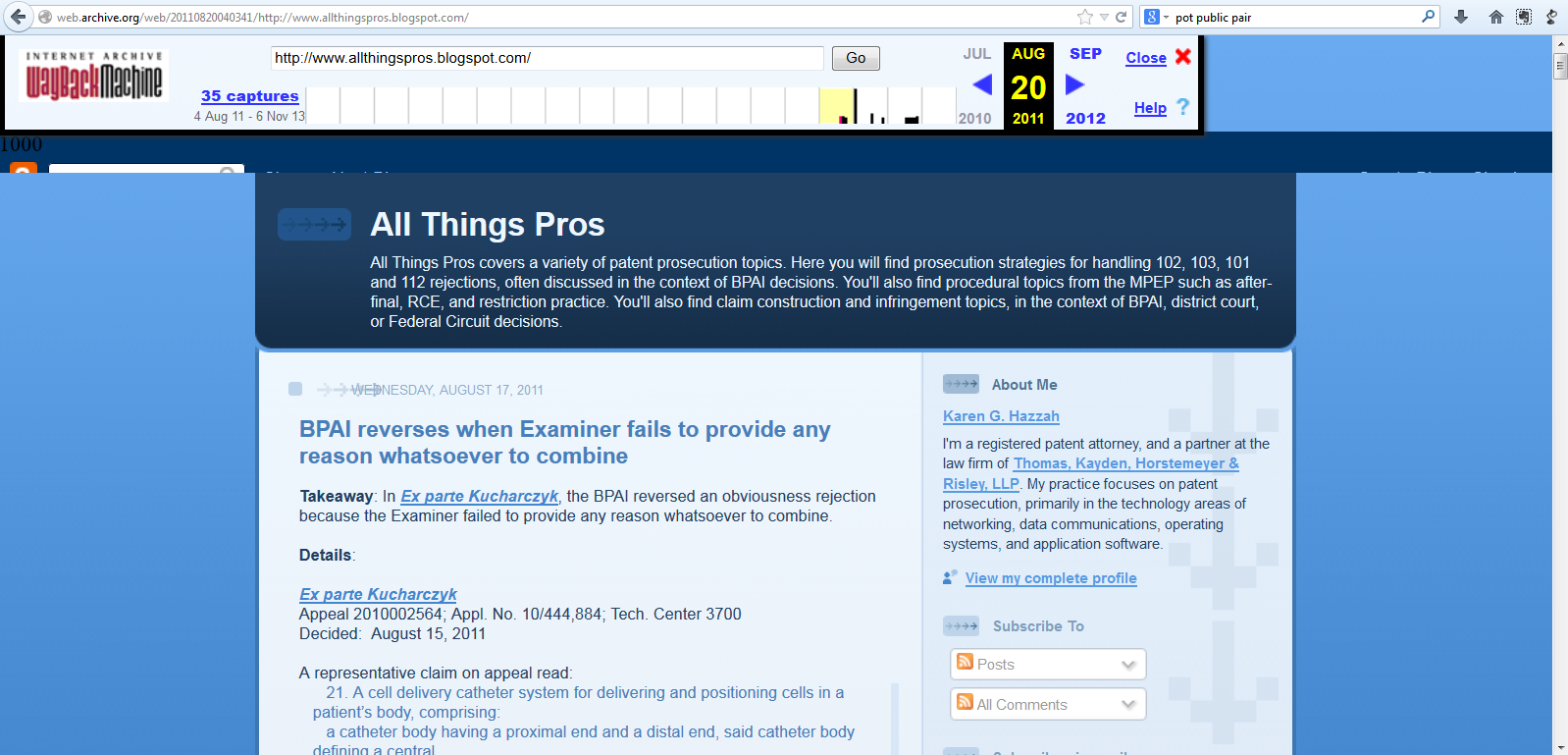
Note that the URL of the retrieved page in the browser address bar
https://web.archive.org/web/20110820040341/http://www.allthingspros.blogspot.com/
encodes the name of the archived site and the archive date.

