Showing posts with label declaration. Show all posts
Showing posts with label declaration. Show all posts
Tuesday, November 11, 2014
Board finds swear-behind declaration to be insufficient for lack of explanation
Takeaway: The Applicant attempted to remove a reference with a § 1.131 (swear-behind) declaration. The two-page declaration referred to an Appendix A included in the provisional application but did not comment or explain on the Appendix. The Board found that the Applicant had not provided any of the evidence needed to show conception, reduction to practice, or diligence. "[T]here is no explanation of what the document in Appendix A is; whether it purports to establish conception or actual reduction to practice; what diligence, if any, the inventors can show in reducing the invention to practice; and how it discloses the claimed invention." (Ex parte Schmidt, PTAB 2014.)
Details:
Ex parte Schmidt
Appeal 2012005120; Appl. No. 10/156,131; Tech.Center 2600
Original Decision: May 29, 2014; Rehearing Decision: Sept. 12, 2014
In response to a prior art rejection in a Non-Final Office Action, the Applicant attempted to remove a reference with this § 1.131 (swear-behind) declaration:


Sunday, July 7, 2013
Board reverses when Examiner ignored merits of expert declaration
Takeaway: An Applicant submitted declaration evidence to rebut an inherency assertion about a commonly owned reference. The Examiner said the declaration wasn't persuasive because it was conclusory, lacked evidentiary support, and was submitted by an interested party (an inventor). On appeal, the Board reversed because the "Examiner’s response to the Declaration does not focus on the merits of the statements provided in the Declaration." The Board noted that the declarant's relationship with the common assignee put him in the "best position to provide statements regarding the properties of the products described in the Randall reference." (Ex parte Currier, PTAB 2010.)
Details:
Ex parte Currier
Appeal 2009011735; Appl. No. 10/957,745; Tech. Center 1700
Decided: May 27, 2010
The application on appeal was directed to wallboard. A representative claim on appeal read:
The Examiner originally rejected the claims as obvious over a combination of references, and relied on Jaffee for teaching a glass fiber mat having the claimed fiber parameters. The Examiner asserted that level 4 finishing was "a latent property to the board rendered obvious by the prior art" and "Applicant has not made any showing to the contrary."
The Applicant argued that the fiber diameters and lengths disclosed in Jaffee (15-16 microns and 3/4 to 1 inch) were outside the claimed ranges. With respect to Level 4 finishing, Applicant asserted that "Jafee is also completely silent about the surface morphology of the mat ... Jaffee does not mention the prospect of coating the mat at all. Unquestionably, the preparation of a coated mat suitable for Level 4 finishing is not inherent to any of the embodiments disclosed or suggested by the Jaffee patent. "
The Applicant submitted an expert declaration under § 1.132 to support these arguments. The Declarant, Currier, was one of the inventors and was employed by the assignee. The declaration explained how the properties of glass fibers in the mat affect the level of finishing, and described the use of coatings to smooth the mat surface. The declaration then went into some detail about the problems faced in reducing fiber size and in achieving a proper amount of coating.
The Declarant specifically disagreed with the Examiner's characterization of Level 4 finishing as being a "latent property to the board rendered obvious by the prior art." The Declarant attested that the claimed combination of fiber parameters and adhesive binder led to a mat that was suitable for Level 4 finishing. "It is the combination of these elements that is important and isolated disclosures of these elements in separate disclosures does not suggest the surprising benefit obtained by their combination." (Emphasis added.)
The declaration also referred to "a family of gypsum board faced with non-woven glass mat facing material" ("the DENS products"), and stated that none of these products had a surface "suitable for level 4 finishing." The declaration also specifically stated that level 4 finishing was not present in the the product described in a commonly owned patent to Randall ('354 Patent).
In the next Office Action, the Examiner withdrew the previous rejection in favor of a different § 103 rejection. As the primary reference, the Examiner used another Randall reference – a continuation of the Randall patent discussed in the expert declaration. The rejection relied on Randall for a coated non-woven glass fiber mat having a fiber diameter in the claimed range. The rejection relied on Jaffee for the claimed fiber length. The rejection also asserted Randall's coating was "inherently suitable for level 4 finishing since it is compositionally identical to the claimed coating."
The Office Action commented on the Currier Declaration as follows:
My two cents: The Examiner implied that the inventor's declaration wasn't credible because he was an interested party. What does "interested" mean here? The vast majority of inventors don't have a financial interest in the patent itself because they assign their rights to their employer. Some percentage of inventors get a monetary reward when the patent issues, but not all do.
Is the Examiner's concern actually that an inventor is still "interested" simply because his name is on the patent, and ...what ... it makes him feel good to have the application issue? Is the concern instead that an employee is expected to sign whatever his boss or legal department tells him to?
The Examiner said Currier's opinions weren't supported by "factual evidence." Currier unequivocally stated that Randall's wallboard didn't have a Level 4 finish. Does this need to be supported by evidence? [The Board didn't seem to think so.] Presumably there is a product information sheet for the Randall wallboard that describes its finishing level as something other than Level 2. Perhaps this could have been submitted with the declaration as factual evidence to address this sort of concern.
Or maybe Currier's statement about the Randall wallboard should be viewed as a factual statement by one who knows about the products in question. Currier was a Director of R&D and "responsible for all product development in the Gypsum Division."
The Board didn't specifically say whether they viewed Currier's statements as opinions or fact. However, where the Examiner focused on Currier being an inventor with an "interest", the Board instead looked at it from a different angle: since Currier worked for the same corporation that owned the Randall patent, he was in a position to know the technology described in Randall. In the Board's eyes, this made him a knowledgeable declarant rather than a too-interested-to-be-believeable declarant.
Finally, in the real world the § 1.132 Declarant will often be the inventor, or maybe another employee of the assignee. After all, it's probably simpler, faster, and/or cheaper to get an employee involved than an outside consultant of some kind. And while those consultants don't typically have a financial interest in the patent application, they are often paid for their time in working on the declaration. To me, this would seems to make the credibility of the paid expert more suspect that that of the corporate employee. So who is a better pick for a § 1.132 declaration
Details:
Ex parte Currier
Appeal 2009011735; Appl. No. 10/957,745; Tech. Center 1700
Decided: May 27, 2010
The application on appeal was directed to wallboard. A representative claim on appeal read:
1. A gypsum wallboard comprising:
a gypsum core having a planar first face and a planar second face;
a coated non-woven glass fiber mat facing material suitable for level 4 finishing adhered to and covering at least one of the planar first face and the planar second face of the gypsum core,
said coated non-woven glass fiber mat facing material having been contacted (i) on a non-coated side and (ii) during preparation of the wallboard with an aqueous gypsum slurry that sets to form the gypsum core,
wherein the non-woven glass fiber mat facing material comprises a majority of glass fibers of a fiber diameter between about 8 and about 11 microns and a fiber length between 1/4 and 3/4 inch,
the glass fibers of the non-woven glass fiber mat facing material being bound together with an adhesive binder comprising an acrylic adhesive binder and
wherein the non-woven glass fiber mat facing material has a coating comprising a dried aqueous mixture comprising (i) a mineral pigment, (ii) a polymer adhesive binder and optionally (iii) an inorganic adhesive binder on a free surface of said non-woven glass mat facing material and
said coated non-woven glass mat facing material has a porosity which allows water to evaporate through said coated non-woven glass fiber mat from the gypsum core during the preparation of the wallboard.
(Emphasis added.)
The Examiner originally rejected the claims as obvious over a combination of references, and relied on Jaffee for teaching a glass fiber mat having the claimed fiber parameters. The Examiner asserted that level 4 finishing was "a latent property to the board rendered obvious by the prior art" and "Applicant has not made any showing to the contrary."
The Applicant argued that the fiber diameters and lengths disclosed in Jaffee (15-16 microns and 3/4 to 1 inch) were outside the claimed ranges. With respect to Level 4 finishing, Applicant asserted that "Jafee is also completely silent about the surface morphology of the mat ... Jaffee does not mention the prospect of coating the mat at all. Unquestionably, the preparation of a coated mat suitable for Level 4 finishing is not inherent to any of the embodiments disclosed or suggested by the Jaffee patent. "
The Applicant submitted an expert declaration under § 1.132 to support these arguments. The Declarant, Currier, was one of the inventors and was employed by the assignee. The declaration explained how the properties of glass fibers in the mat affect the level of finishing, and described the use of coatings to smooth the mat surface. The declaration then went into some detail about the problems faced in reducing fiber size and in achieving a proper amount of coating.
The Declarant specifically disagreed with the Examiner's characterization of Level 4 finishing as being a "latent property to the board rendered obvious by the prior art." The Declarant attested that the claimed combination of fiber parameters and adhesive binder led to a mat that was suitable for Level 4 finishing. "It is the combination of these elements that is important and isolated disclosures of these elements in separate disclosures does not suggest the surprising benefit obtained by their combination." (Emphasis added.)
The declaration also referred to "a family of gypsum board faced with non-woven glass mat facing material" ("the DENS products"), and stated that none of these products had a surface "suitable for level 4 finishing." The declaration also specifically stated that level 4 finishing was not present in the the product described in a commonly owned patent to Randall ('354 Patent).
In the next Office Action, the Examiner withdrew the previous rejection in favor of a different § 103 rejection. As the primary reference, the Examiner used another Randall reference – a continuation of the Randall patent discussed in the expert declaration. The rejection relied on Randall for a coated non-woven glass fiber mat having a fiber diameter in the claimed range. The rejection relied on Jaffee for the claimed fiber length. The rejection also asserted Randall's coating was "inherently suitable for level 4 finishing since it is compositionally identical to the claimed coating."
The Office Action commented on the Currier Declaration as follows:
The Currier declaration has been fully considered but is not considered persuasive. To the contrary, the declaration seems to support the conclusion that the board taught in Randall is suitable for level 4 finishing because the glass fibers taught therein are not exposed through the coating. The declaration states level 4 finishing is usually not obtainable because of the glass fibers' surface properties (paragraph 11). Furthermore, the selection of fiber sizes is considered to be obvious in view of the teachings of Randall with respect to surface finish, porosity, etc.On appeal, the Applicant argued that Randall did not explicitly disclose the mat's surface characteristics or its suitability for Level 4 finishing. The Applicant also argued against inherency, as follows:
The Final Office Action also contended that the Randall coating, being "compositionally identical to the claimed coating" is inherently suitable for Level 4 finishing. That conclusion is simply wrong. What the Final Office Action ignored is that attaining a surface suitable for Level 4 finishing is not just a function of the coating formulation, but is a function of a non-obvious relationship among the coating formulation, basis weight of the coating and the characteristics of the mat being coated (fiber diameter, fiber length, mat binder adhesive and mat basis weight). In its attempt to find the necessary interrelationship obvious, the Office Action ignores the evidence provided by the Currier Declaration and then engages in a hindsight selection and evaluation of the teachings of Randall and Jaffee.The Examiner maintained his position in the Answer, and commented on the declaration as follows:
Alan Currier's opinions are noted that are not persuasive in overcoming the examiner's inherency position because the opinion (a) is not supported by factual evidence, (b) is merely conclusory and fails to address the examiner's logic in concluding level 4 finishing is inherent to Randall, and because (c) Mr. Currier is a party interested in the outcome of the application.The Board found the Applicant's arguments about Randall to be persuasive, and so reversed.The Board also commented specifically on the Examiner's treatment of the declaration evidence:
The Examiner’s conclusion regarding the Declaration did not appear to account for the fact that the Randall reference and the present application share a common assignee. Thus, the Declarant is in the best position to provide statements regarding the properties of the products described in the Randall reference. The Declarant Currier indicated that the invention of U.S. Patent 6,770,354 [the parent of the Randall reference] did not have a surface suitable for Level 4 finishing. The Examiner’s response to the Declaration does not focus on the merits of the statements provided in the Declaration. Thus, the evidence presented in the present record does not support the Examiner's position that the claimed characteristics are inherent in the product of Randall.Since the Examiner has not properly considered the submitted evidence, the rejection cannot be sustained.
My two cents: The Examiner implied that the inventor's declaration wasn't credible because he was an interested party. What does "interested" mean here? The vast majority of inventors don't have a financial interest in the patent itself because they assign their rights to their employer. Some percentage of inventors get a monetary reward when the patent issues, but not all do.
Is the Examiner's concern actually that an inventor is still "interested" simply because his name is on the patent, and ...what ... it makes him feel good to have the application issue? Is the concern instead that an employee is expected to sign whatever his boss or legal department tells him to?
The Examiner said Currier's opinions weren't supported by "factual evidence." Currier unequivocally stated that Randall's wallboard didn't have a Level 4 finish. Does this need to be supported by evidence? [The Board didn't seem to think so.] Presumably there is a product information sheet for the Randall wallboard that describes its finishing level as something other than Level 2. Perhaps this could have been submitted with the declaration as factual evidence to address this sort of concern.
Or maybe Currier's statement about the Randall wallboard should be viewed as a factual statement by one who knows about the products in question. Currier was a Director of R&D and "responsible for all product development in the Gypsum Division."
The Board didn't specifically say whether they viewed Currier's statements as opinions or fact. However, where the Examiner focused on Currier being an inventor with an "interest", the Board instead looked at it from a different angle: since Currier worked for the same corporation that owned the Randall patent, he was in a position to know the technology described in Randall. In the Board's eyes, this made him a knowledgeable declarant rather than a too-interested-to-be-believeable declarant.
Finally, in the real world the § 1.132 Declarant will often be the inventor, or maybe another employee of the assignee. After all, it's probably simpler, faster, and/or cheaper to get an employee involved than an outside consultant of some kind. And while those consultants don't typically have a financial interest in the patent application, they are often paid for their time in working on the declaration. To me, this would seems to make the credibility of the paid expert more suspect that that of the corporate employee. So who is a better pick for a § 1.132 declaration
Tuesday, January 29, 2013
Board of Appeals discusses §1.132 derivation declaration and rejection under §102(f)
Takeaway: An Applicant attempted to disqualify, as prior art, a publication listing two of the four inventors as authors. In a §1.132 declaration, the four inventors stated that the publication was derived from the work of the two author inventors. The Examiner found the declaration insufficient to overcome the §102(a) rejection because it did not attest to derivation from all of the inventors. The Examiner then added a rejection under §102(f) ("did not invent"). The Applicant appealed, arguing that a derivation declaration was only required to attest to derivation from at least one inventor, and that the §102(f) rejection was in error since the Examiner had not identified an inventor not named on the application. The Board affirmed the §102(a) rejection, holding that the declaration must attest to derivation from the entire inventive entity in order to show the publication was not "by another." However, the Board reversed the §102(f) rejection, finding that the statement in the declaration which referred to "our invention" provided enough evidence of correct inventorship to overcome the rejection.
Details:
Ex parte Abe
Appeal 2010000029; Serial No. 10/128,474; Tech. Center 2400
Decided: June 28, 2012
The Examiner rejected all claims under §102(a) by a publication ("XPath") authored by two of the four inventors and submitted in an IDS. The Applicant attempted to disqualify the Xpath publication as prior art by filing a derivation declaration under §1.132. The Examiner found the declaration insufficient, since MPEP §716.10 "requires that the relevant portions of the reference originated with or were obtained from applicant (i.e., inventive entity)" (emphasis added). However, the Applicant's declaration merely stated that the reference was derived from the work of only two out of the four inventor.
The Examiner also added a rejection under §102(f) ("did not invent"). The Examiner explained as follows:
The Applicant turned to the §102(f) rejection. The Applicant first addressed the Examiner's statement implying the inventive entity must be incorrect by noting that inventorship was on record in the executed Declaration and Power of Attorney. According to the Applicant, the §102(f) rejection was in error because the Examiner had not identified any inventor not named on the declaration.
In the Answer, the Examiner handled the §102(a) rejection by simply stating that the declaration did not overcome the rejection. As to §102(f), the Examiner explained:
The Board clarified that attesting to derivation from a subset of the inventors was sufficient not remove the reference as "by another" under §102(a). "By another" means any difference in inventive entity, so the fact that only two inventors were listed as authors of the Xpath publication indicated that the publication was "by another." A §1.132 declaration attesting to derivation from all the inventors would thus disqualify the reference, by showing that the inventive entity is the same. However, derivation from only a subset of the inventors means the reference is still "by another" and is thus prior art.
In reversing the §102(f) rejection, the Board explained that designation of the authors of a publication not raise a presumption of inventorship with respect to the subject matter disclosed in the article so as to justify a rejection under §102(f). (MPEP §715.01(c)). Such a rejection does require the Applicant to "provide a satisfactory showing by way of affidavit under 37 CFR 1.132 that the inventorship of the application is correct." (MPEP §715.01(c)). The Board found the Applicant did exactly that, by submitting a declaration signed by all inventor stating "the disclosure found in the [Xpath publication] is our own invention."
My two cents: Reading in between the lines, the Board's brief opinion suggests that the Applicant had simply misinterpreted the law on §1.132 derivation declarations. Yet the Applicant fought long and hard for its position, when it seems that the problem could be taken care of by rewording the declaration. Unless, factually, the Applicant simply couldn't make the statement that the two author inventors derived from the work of the other two (non-author) inventors? The Applicant's arguments suggested that inventorship may have varied from claim to claim. So maybe another approach would be to split the application into two, with different inventive entities? I gotta admit, I got a headache thinking about this one.
Was the Examiner off base in giving the §102(f) rejection? Essentially, the §102(f) rejection seemed to be the result of a discrepancy between Abe, Hori, Dewitt & Topol being named the inventive entity and a finding that a publication authored by Abe & Hori alone disclosed all claim limitations.
Details:
Ex parte Abe
Appeal 2010000029; Serial No. 10/128,474; Tech. Center 2400
Decided: June 28, 2012
The Examiner rejected all claims under §102(a) by a publication ("XPath") authored by two of the four inventors and submitted in an IDS. The Applicant attempted to disqualify the Xpath publication as prior art by filing a derivation declaration under §1.132. The Examiner found the declaration insufficient, since MPEP §716.10 "requires that the relevant portions of the reference originated with or were obtained from applicant (i.e., inventive entity)" (emphasis added). However, the Applicant's declaration merely stated that the reference was derived from the work of only two out of the four inventor.
The Examiner also added a rejection under §102(f) ("did not invent"). The Examiner explained as follows:
Applicant has declared that only two of the four inventors have derived the relevant portions of the [Xpath reference]. Given the reference teaches all the claimed limitations, it is apparent that the inventive entity (Mari Abe, Scott D. Dewitt, Masahiro Hori, and Brad B. Topol) are not the sole inventors of the claimed invention.In an Appeal Brief, the Applicant continued to argue that the §1.132 declaration had removed Xpath as prior art. The Appeal Brief also specifically addressed various dependent claims, arguing that the Xpath did not teach all the limitations of those claims. In explaining why Xpath had been removed as prior art, the Applicant asserted that a §1.132 declaration disqualified the reference as long as the reference was "derived from at least one Applicant," as opposed to the Examiner's requirement that the derivation be from the work of all inventors. The Applicant explained that the Examiner's reading led to the "anomalous result" that §1.132 declarations could be used when "all possible inventors (as described in the article) may not have been named as inventors" yet could not be used when "all possible inventors (as described in the article) have been named as inventors."
The Applicant turned to the §102(f) rejection. The Applicant first addressed the Examiner's statement implying the inventive entity must be incorrect by noting that inventorship was on record in the executed Declaration and Power of Attorney. According to the Applicant, the §102(f) rejection was in error because the Examiner had not identified any inventor not named on the declaration.
In the Answer, the Examiner handled the §102(a) rejection by simply stating that the declaration did not overcome the rejection. As to §102(f), the Examiner explained:
Example 2 of MPEP 716.10 requires that the relevant portions of the reference originated with or were obtained from applicant (i.e. inventive entity). Applicant has declared that the reference "A Visual Approach to Authoring XPath Expressions" is derived from the work of only two out of the four inventors. Therefore, it raises a question as to whether the inventive entity (i.e. Abe, Hori, Dewitt and Topol) are the sole inventors since the claimed subiect matter was only derived from Abe and Hori. The Examiner requested it be made clear that Dewitt and Topol did not contribute to the claimed invention (e.g. they only contributed to a portion of the specification that was not claimed) in order to rule out the possibility that the inventive entity are not the sole inventors of the claimed subject matter.The Applicant filed a Reply Brief noting that the Examiner's Answer amounted to a request to remove inventors, while inventorship is a question of fact and cannot be manipulated for the convenience of the Examiner. Moreover, the Applicant explained, inventorship is determined on a claim by claim basis:
Dewitt and Topol may be inventors of only some of the claims. Similarly, Abe and Hori may be inventors of only some of the claims. The fact that certain claims were not identically disclosed by the prior art article by Abe and Hori evidences that additional contribution was made to the claimed invention.On appeal, the Board affirmed-in-part. The §102(a) rejection of the independent claims was affirmed, but the §102(f) rejection was reversed. The Board also reversed the §102(a) rejection of some of the dependent claims, finding that various features in dependent claims were not disclosed by the Xpath reference.
The Board clarified that attesting to derivation from a subset of the inventors was sufficient not remove the reference as "by another" under §102(a). "By another" means any difference in inventive entity, so the fact that only two inventors were listed as authors of the Xpath publication indicated that the publication was "by another." A §1.132 declaration attesting to derivation from all the inventors would thus disqualify the reference, by showing that the inventive entity is the same. However, derivation from only a subset of the inventors means the reference is still "by another" and is thus prior art.
In reversing the §102(f) rejection, the Board explained that designation of the authors of a publication not raise a presumption of inventorship with respect to the subject matter disclosed in the article so as to justify a rejection under §102(f). (MPEP §715.01(c)). Such a rejection does require the Applicant to "provide a satisfactory showing by way of affidavit under 37 CFR 1.132 that the inventorship of the application is correct." (MPEP §715.01(c)). The Board found the Applicant did exactly that, by submitting a declaration signed by all inventor stating "the disclosure found in the [Xpath publication] is our own invention."
My two cents: Reading in between the lines, the Board's brief opinion suggests that the Applicant had simply misinterpreted the law on §1.132 derivation declarations. Yet the Applicant fought long and hard for its position, when it seems that the problem could be taken care of by rewording the declaration. Unless, factually, the Applicant simply couldn't make the statement that the two author inventors derived from the work of the other two (non-author) inventors? The Applicant's arguments suggested that inventorship may have varied from claim to claim. So maybe another approach would be to split the application into two, with different inventive entities? I gotta admit, I got a headache thinking about this one.
Was the Examiner off base in giving the §102(f) rejection? Essentially, the §102(f) rejection seemed to be the result of a discrepancy between Abe, Hori, Dewitt & Topol being named the inventive entity and a finding that a publication authored by Abe & Hori alone disclosed all claim limitations.
Tuesday, November 20, 2012
Guest Post: A Cautionary Tale Relating to Use of Declarations Under 37 C.F.R. § 1.132
[Guest Post by Tracey Harrach, a registered patent attorney at Maschoff Gilmore & Israelsen. Tracey's practice includes all aspects of trademark and patent prosecution. She practices in a variety of technology areas, including: chemical
formulations, processes, and syntheses; semiconductor processing and fabrication;
biotechnology; and material science.]
Takeaway: In a post-Therasense decision, a district court granted summary judgment on inequitable conduct stemming from declarations submitted in a reexamination proceeding (Reexam Control No. 90/010,874). Therefore, before submitting a declaration to the PTO, ensure: (1) any past or present financial relationships between the declarant and the patentee are fully disclosed, (2) declarations are provided only by individuals having skill in the relevant art, and (3) representations relating to distinctions over prior art are based on the personal knowledge of the declarant. (Caron et al. v. QuicKutz, Inc., 2:09-cv-02600-NVW (D.Ariz. Nov. 13, 2012.)
Details:
Declarations can provide an expeditious way to advance prosecution; however, declarations may also be fertile ground for charges of inequitable conduct. While Therasense has significantly raised the bar for a party asserting inequitable conduct based on the patentee’s failure to submit a prior art reference, Therasense recognizes an exception to the “but-for” standard of materiality in connection with the filing of a “false affidavit.” Therasense, Inc. v. Becton, Dickinson & Company, 649 F.3d 1276, 1292-93 (Fed. Cir. 2011).
A scathing opinion entered by the District Court in Arizona provides a reminder of the dangers associated with the use of declarations in practice before the PTO. In Caron et al. v. QuicKutz, Inc., Case No. 2:09-cv-02600-NVW, the Court granted summary judgment of unenforceability due to inequitable conduct relating to U.S. Patent No. 7,469,634. The Court identified three separate acts of inequitable conduct involving declarations submitted to the PTO by the plaintiffs.
First, the Court found that plaintiffs committed inequitable conduct by submitting three declarations under 37 C.F.R. § 1.132 by individuals who had undisclosed prior financial relationships with the plaintiffs. Order, at page 15. See Declarations under 37 C.F.R. § 1.132 submitted on July 5, 2011 in Reexam. Control No. 90/010,874 (available on Public PAIR). These declarations were submitted by the plaintiffs in order to establish that the plaintiffs’ products were unique in the marketplace. Specifically, the plaintiffs argued to the PTO that “each declarant identifies that these die features and benefits are novel in their opinion and have never been commercialized in the scrapbooking industry before Spellbinders introduced this invention.” See Office Action Response dated July 5, 2011, submitted in Reexam. 90/010,874.
The Court cited Ferring B.V. v. Barr Laboratories, Inc. for the proposition that “the inventor must disclose the known relationships and affiliations of the declarants so that those interests can be considered in weighing the declarations.” 437 F.3d 1181, 1187 (Fed. Cir. 2006). The Court rejected the plaintiffs’ arguments that the prior relationships were minimal, and accordingly, did not need to be disclosed. Specifically, the Court found:
This issue can be avoided by directly communicating to a declarant the importance of full disclosure of prior and current relationships and ensuring that those relationships are clearly recited in the declaration. The PTO does not prohibit submission of declarations by declarants with relationships with the patentee. On the contrary, the Federal Circuit explained in Ferring:
Second, the Court found that the plaintiffs committed inequitable conduct by submitting declarations from two individuals who based their declarations solely on experience with the plaintiffs’ product as end users. Order, at pages 14-15. The Court found “[h]ad the PTO known that [the declarants] did not have professional experience in the relevant industry, it would have given little or no weight to their opinions, particularly regarding the novelty of Spellbinders’ dies.” Id., at page 15. In reaching this conclusion, the Court noted the plaintiffs’ representation that the declarations were provided by individuals with “experience in the arts and crafts and scrapbooking industry that are familiar in some way with the [plaintiffs’ products].” Id., at page 14. The Court found that the two individuals “[b]oth provided opinions using technical language that implied professional experience in the relevant industry rather than merely experience as a customer….” Id.
A practical way to avoid this issue is to have a declarant prepare his or her own declaration and to include in the declaration a description of the declarant’s relevant experience. This approach ensures that the language used by the declarant is commensurate with the declarant’s experience. Further, by relying on the declarant to describe his or her qualifications, the PTO will have relevant information available to gauge the declarant’s competence to reach the conclusions recited in the declaration.
Third, the Court found that the submission of a declaration by the inventor and one of the plaintiffs, Jeff Caron, constituted “an affirmative act of egregious misconduct” due to unfounded and unsupported characterizations in the declaration of the prior art reference upon which the PTO relied. Id., at page 21. The declaration in question was filed by the Plaintiffs on October 24, 2011, in Reexam. 90/010,874, and purported to describe the teachings of International Publication No. WO 03/016035. The Court found that the declarant lacked personal knowledge relating to the assertions made in his affidavit.
The Court’s finding that the declaration constituted “an affirmative act of egregious misconduct” was based upon a finding that the declaration “misrepresented that it conveyed information that the declarant knew to be true and was submitted to the PTO with the misrepresentation that the declarant had firsthand knowledge about the subject of the declaration.” Id. The Court also found that Mr. Caron’s deposition testimony was inconsistent with his declaration. According to the Court, “his deposition testimony was more than evasive; it was false or misleading. If his deposition testimony was true and responsive, then his 2011 representations to the PTO are, at the least, misleading.” Id., at page 20.
A similar scenario could plausibly occur when an attorney, and not the declarant, formulates the content of the declaration and presents the finished declaration to a declarant for signature. In such a scenario, the declarant may not take the time to fully understand an argument prepared by the attorney, believing that the attorney’s understanding is sufficient. As noted by the Court, however, declarations must be based on declarant’s personal knowledge. In other words, it may not be sufficient to merely have sound technical arguments. Rather, the arguments must be sound and the arguments must be based on personal knowledge of the declarant. Again, this issue may be avoided by having a declarant prepare his or her own declaration.
Takeaway: In a post-Therasense decision, a district court granted summary judgment on inequitable conduct stemming from declarations submitted in a reexamination proceeding (Reexam Control No. 90/010,874). Therefore, before submitting a declaration to the PTO, ensure: (1) any past or present financial relationships between the declarant and the patentee are fully disclosed, (2) declarations are provided only by individuals having skill in the relevant art, and (3) representations relating to distinctions over prior art are based on the personal knowledge of the declarant. (Caron et al. v. QuicKutz, Inc., 2:09-cv-02600-NVW (D.Ariz. Nov. 13, 2012.)
Details:
Declarations can provide an expeditious way to advance prosecution; however, declarations may also be fertile ground for charges of inequitable conduct. While Therasense has significantly raised the bar for a party asserting inequitable conduct based on the patentee’s failure to submit a prior art reference, Therasense recognizes an exception to the “but-for” standard of materiality in connection with the filing of a “false affidavit.” Therasense, Inc. v. Becton, Dickinson & Company, 649 F.3d 1276, 1292-93 (Fed. Cir. 2011).
A scathing opinion entered by the District Court in Arizona provides a reminder of the dangers associated with the use of declarations in practice before the PTO. In Caron et al. v. QuicKutz, Inc., Case No. 2:09-cv-02600-NVW, the Court granted summary judgment of unenforceability due to inequitable conduct relating to U.S. Patent No. 7,469,634. The Court identified three separate acts of inequitable conduct involving declarations submitted to the PTO by the plaintiffs.
First, the Court found that plaintiffs committed inequitable conduct by submitting three declarations under 37 C.F.R. § 1.132 by individuals who had undisclosed prior financial relationships with the plaintiffs. Order, at page 15. See Declarations under 37 C.F.R. § 1.132 submitted on July 5, 2011 in Reexam. Control No. 90/010,874 (available on Public PAIR). These declarations were submitted by the plaintiffs in order to establish that the plaintiffs’ products were unique in the marketplace. Specifically, the plaintiffs argued to the PTO that “each declarant identifies that these die features and benefits are novel in their opinion and have never been commercialized in the scrapbooking industry before Spellbinders introduced this invention.” See Office Action Response dated July 5, 2011, submitted in Reexam. 90/010,874.
The Court cited Ferring B.V. v. Barr Laboratories, Inc. for the proposition that “the inventor must disclose the known relationships and affiliations of the declarants so that those interests can be considered in weighing the declarations.” 437 F.3d 1181, 1187 (Fed. Cir. 2006). The Court rejected the plaintiffs’ arguments that the prior relationships were minimal, and accordingly, did not need to be disclosed. Specifically, the Court found:
Although Plaintiffs contend that the compensation each received was minimal, the evidence shows a basis for possible bias by each declarant. Clear and convincing evidence shows each declarant had motivation to provide an opinion favorable to Plaintiffs’ patent application. The PTO was deprived of evidence that it needed to determine the weight it should give to the declarations….
Order, at page 15.
This issue can be avoided by directly communicating to a declarant the importance of full disclosure of prior and current relationships and ensuring that those relationships are clearly recited in the declaration. The PTO does not prohibit submission of declarations by declarants with relationships with the patentee. On the contrary, the Federal Circuit explained in Ferring:
In coming to this conclusion, we fully recognize that inventors often consult their colleagues or other persons skilled in the art whom they have met during the course of their professional life. Accordingly, when an inventor is asked to provide supportive declarations to the PTO, it may be completely natural for the inventor to recommend, and even contact, his own colleagues or people who are, or who have been, affiliated with his employer and to submit declarations from such people. Nothing in this opinion should be read as discouraging such practice. Rather, at least where the objectivity of the declarant is an issue in the prosecution, the inventor must disclose the known relationships and affiliations of the declarants so that those interests can be considered in weighing the declarations.
437 F.3d at 1194-95.
Second, the Court found that the plaintiffs committed inequitable conduct by submitting declarations from two individuals who based their declarations solely on experience with the plaintiffs’ product as end users. Order, at pages 14-15. The Court found “[h]ad the PTO known that [the declarants] did not have professional experience in the relevant industry, it would have given little or no weight to their opinions, particularly regarding the novelty of Spellbinders’ dies.” Id., at page 15. In reaching this conclusion, the Court noted the plaintiffs’ representation that the declarations were provided by individuals with “experience in the arts and crafts and scrapbooking industry that are familiar in some way with the [plaintiffs’ products].” Id., at page 14. The Court found that the two individuals “[b]oth provided opinions using technical language that implied professional experience in the relevant industry rather than merely experience as a customer….” Id.
A practical way to avoid this issue is to have a declarant prepare his or her own declaration and to include in the declaration a description of the declarant’s relevant experience. This approach ensures that the language used by the declarant is commensurate with the declarant’s experience. Further, by relying on the declarant to describe his or her qualifications, the PTO will have relevant information available to gauge the declarant’s competence to reach the conclusions recited in the declaration.
Third, the Court found that the submission of a declaration by the inventor and one of the plaintiffs, Jeff Caron, constituted “an affirmative act of egregious misconduct” due to unfounded and unsupported characterizations in the declaration of the prior art reference upon which the PTO relied. Id., at page 21. The declaration in question was filed by the Plaintiffs on October 24, 2011, in Reexam. 90/010,874, and purported to describe the teachings of International Publication No. WO 03/016035. The Court found that the declarant lacked personal knowledge relating to the assertions made in his affidavit.
The Court’s finding that the declaration constituted “an affirmative act of egregious misconduct” was based upon a finding that the declaration “misrepresented that it conveyed information that the declarant knew to be true and was submitted to the PTO with the misrepresentation that the declarant had firsthand knowledge about the subject of the declaration.” Id. The Court also found that Mr. Caron’s deposition testimony was inconsistent with his declaration. According to the Court, “his deposition testimony was more than evasive; it was false or misleading. If his deposition testimony was true and responsive, then his 2011 representations to the PTO are, at the least, misleading.” Id., at page 20.
A similar scenario could plausibly occur when an attorney, and not the declarant, formulates the content of the declaration and presents the finished declaration to a declarant for signature. In such a scenario, the declarant may not take the time to fully understand an argument prepared by the attorney, believing that the attorney’s understanding is sufficient. As noted by the Court, however, declarations must be based on declarant’s personal knowledge. In other words, it may not be sufficient to merely have sound technical arguments. Rather, the arguments must be sound and the arguments must be based on personal knowledge of the declarant. Again, this issue may be avoided by having a declarant prepare his or her own declaration.
Wednesday, September 19, 2012
BPAI affirms anticipation based on reasoning that performing action on whole implies peforming action on all parts
Takeaway: In a reexamination appeal, the BPAI considered the Patentee's arguments that a reference did not disclose "monitoring the operating system for an event". The Board first found that the reference taught monitoring a computer system for an event and also taught that the computer system included an operating system. The Board then affirmed the rejection since "Appellant does not sufficiently demonstrate any differences between ... continuously monitoring the computer system (including the operating system contained therein) for an event ... and the claimed feature of monitoring the operating system for an event. Nor do we identify any differences since in both cases, a computer system and operating system of the computer system are being monitored for an event." The Board's reasoning thus appeared to be that since the whole (computer system) was monitored, any included component (operating system) was also monitored.
Details:
Ex parte Finjan, Inc.
Appeal 2011003035; Reexam 90/008,684; Tech. Center 3900
Decided June 6, 2011
The patent under ex parte reexamination involved virus protection software. A representative independent claim read:
During the reexam, the Examiner rejected claim 1 as anticipated by a non-patent reference (Rx PC - The Anti-Virus Handbook) which described a software package ("Virex PC") containing two anti-virus programs, VPCScan and VirexPro. The Patentee responded by arguing that several of the claim elements were not taught by the reference – and submitted declaration evidence to supplement these arguments.
One of the elements argued on appeal by the Patentee was the "monitoring" element. The Patentee argued in the Appeal Brief that Virex monitored a user-selected target file rather than the operating system. More specifically, the Patentee argued that Virex "sat in front of" a user-selected target file to intercept all requests associated with this file – regardless of which executable made the request. The Patentee contrasted this with claim 1, which described "monitoring all requests from Downloadable [files] to the operating system, not just requests to particular files." (Emphasis in original.) The Patentee then referred to the expert declaration to provide more technical detail about the workings of Virex:
In the Answer, the Examiner responded to the Patentee's arguments. In response to the Patentee's assertion that Virex did not monitor the operating system, the Examiner cited to teachings in the Handbook that Virex monitored requests for disk formatting and requests for disk reads and write. According to the Examiner, "detecting these activities requires that Virex monitor subsystems of the operating system such as the file system, memory system, network system, and run-time execution system." In response to the Patentee's assertion that Virex monitored only user-selected files, the Examiner clarified that the rejection relied on teachings about installation. The Examiner explained that Virex's installation options allowed the user to select all files (via a wildcard ). With this option chosen, Virex would then monitor all files, i.e. "an entire operating system", at runtime.
The Patentee filed a Reply Brief to rebut points in the Examiner's Answer. According to the Patentee, "protecting every file on the computer is not the same as monitoring the operating system." Having the user "manually select every file or extension" is "incredibly inefficient and substantively different from monitoring the operating system" since "if any new files or extensions are added to the computer then the user would need to manually select those files."The Patentee then characterized user selection of every file on the computer as "a construction of the Examiner" that is "not mentioned in [the Handbook]." As for the Examiner's reliance on the teachings about disk formatting and disk reads/writes, "the 'features' are never described in any detail and [the Handbook] does not disclose anything about how these features are performed."
The Board affirmed the anticipation rejection. With regard to the Patentee's "monitoring" argument, the Board referred to the Handbook in making these findings of fact: Virex continuously monitored a computer system which included an operating system; and Virex created an alert when an attempt was made to perform tasks such as executing a program. The Board then drew the following conclusion:
The Board explained why the Patentee's arguments were unpersuasive:
Postscript: The Patentee appealed to the Federal Circuit. But the appeal involved another issue (whether or not the Virus Handbook was an enabling reference) so that Fed. Cir. stayed the appeal pending decision on another case on the presumption of enablement for non-patent references, In re Antor Media. Antor was decided in Aug. 2012, but no decision has been issued yet in In re Finjan.
My two cents: Right result. Bad reasoning.
The Board's simplistic reasoning was based on the unsupportable premise that performing an action on a whole implies performing the action on the components of the whole. Probably true in some contexts, but it's hardly a general truth. Does "painting a house" mean painting: 1) the exterior; 2) the exterior and the interior; 3) exterior, interior, and contents of the house; 4) exterior including the window panes and shingles on the roof? Generally, we mean #1. Maybe #2. #3 and #4 are unlikely choices.
In this case, "monitoring a computer system" might mean monitoring only the hardware components, or might mean monitoring only the software application components, or might mean monitoring only the operating system. I'm inclined to say that the Virus Handbook was talking about monitoring the operating system, since the entity that provides services for detecting actions like file access and program execution is usually referred to as an "operating system." But my point is that I reached that conclusion from the specific teachings of the reference, as understood by a POSITA –not from a premise that actions on a system applying to all components of the system.
Details:
Ex parte Finjan, Inc.
Appeal 2011003035; Reexam 90/008,684; Tech. Center 3900
Decided June 6, 2011
The patent under ex parte reexamination involved virus protection software. A representative independent claim read:
1. A computer-based method, comprising:
monitoring the operating system during runtime for an event caused from a request made by a Downloadable;
interrupting processing of the request;
comparing information pertaining to the Downloadable against a predetermined security policy; and
performing a predetermined responsive action based on the comparison, the predetermined responsive action including storing results of the comparison in an event log.
(Emphasis added.)
During the reexam, the Examiner rejected claim 1 as anticipated by a non-patent reference (Rx PC - The Anti-Virus Handbook) which described a software package ("Virex PC") containing two anti-virus programs, VPCScan and VirexPro. The Patentee responded by arguing that several of the claim elements were not taught by the reference – and submitted declaration evidence to supplement these arguments.
One of the elements argued on appeal by the Patentee was the "monitoring" element. The Patentee argued in the Appeal Brief that Virex monitored a user-selected target file rather than the operating system. More specifically, the Patentee argued that Virex "sat in front of" a user-selected target file to intercept all requests associated with this file – regardless of which executable made the request. The Patentee contrasted this with claim 1, which described "monitoring all requests from Downloadable [files] to the operating system, not just requests to particular files." (Emphasis in original.) The Patentee then referred to the expert declaration to provide more technical detail about the workings of Virex:
In order to monitor the operating system for events caused by requests from Downloadables as required by the claims, requests to both selected and non-selected files and file types must be monitored. Per the expert affidavit of Dr. Giovanni Vigna (Paragraph 4), file-based Virex and VirexPRO did not and could not monitor an entire operating system for a requested action or resulting event from a requesting file or program (hereafter "virus file"), the Virex programs could only monitor actions to be taken on pre-determined target files. More particularly, the Virex programs hijack the response routine of specific software interrupts. By doing this, they are able to monitor only a subset of the operations that can be performed by a program (that is, those that are associated with the software interrupt), and, as a result, they are not capable of monitoring the operating system in a comprehensive fashion.
In the Answer, the Examiner responded to the Patentee's arguments. In response to the Patentee's assertion that Virex did not monitor the operating system, the Examiner cited to teachings in the Handbook that Virex monitored requests for disk formatting and requests for disk reads and write. According to the Examiner, "detecting these activities requires that Virex monitor subsystems of the operating system such as the file system, memory system, network system, and run-time execution system." In response to the Patentee's assertion that Virex monitored only user-selected files, the Examiner clarified that the rejection relied on teachings about installation. The Examiner explained that Virex's installation options allowed the user to select all files (via a wildcard ). With this option chosen, Virex would then monitor all files, i.e. "an entire operating system", at runtime.
The Patentee filed a Reply Brief to rebut points in the Examiner's Answer. According to the Patentee, "protecting every file on the computer is not the same as monitoring the operating system." Having the user "manually select every file or extension" is "incredibly inefficient and substantively different from monitoring the operating system" since "if any new files or extensions are added to the computer then the user would need to manually select those files."The Patentee then characterized user selection of every file on the computer as "a construction of the Examiner" that is "not mentioned in [the Handbook]." As for the Examiner's reliance on the teachings about disk formatting and disk reads/writes, "the 'features' are never described in any detail and [the Handbook] does not disclose anything about how these features are performed."
The Board affirmed the anticipation rejection. With regard to the Patentee's "monitoring" argument, the Board referred to the Handbook in making these findings of fact: Virex continuously monitored a computer system which included an operating system; and Virex created an alert when an attempt was made to perform tasks such as executing a program. The Board then drew the following conclusion:
Since [Virex] continuously monitors a computer system that includes an operating system for an “event” (e.g., an attempt to run a program or an attempt to terminate and stay resident – the attempt being a “request” for an event), we agree with the Examiner that Endrijonas discloses monitoring the operating system of the computer system for the event as recited in claim 1.
The Board explained why the Patentee's arguments were unpersuasive:
Appellant does not sufficiently demonstrate any differences between the [Virex program] continuously monitoring the computer system (including the operating system contained therein) for an event (e.g., an attempt to run a program or an attempt to terminate and stay resident) and the claimed feature of monitoring the operating system for an event. Nor do we identify any differences since in both cases, a computer system and operating system of the computer system are being monitored for an event.
Postscript: The Patentee appealed to the Federal Circuit. But the appeal involved another issue (whether or not the Virus Handbook was an enabling reference) so that Fed. Cir. stayed the appeal pending decision on another case on the presumption of enablement for non-patent references, In re Antor Media. Antor was decided in Aug. 2012, but no decision has been issued yet in In re Finjan.
My two cents: Right result. Bad reasoning.
The Board's simplistic reasoning was based on the unsupportable premise that performing an action on a whole implies performing the action on the components of the whole. Probably true in some contexts, but it's hardly a general truth. Does "painting a house" mean painting: 1) the exterior; 2) the exterior and the interior; 3) exterior, interior, and contents of the house; 4) exterior including the window panes and shingles on the roof? Generally, we mean #1. Maybe #2. #3 and #4 are unlikely choices.
In this case, "monitoring a computer system" might mean monitoring only the hardware components, or might mean monitoring only the software application components, or might mean monitoring only the operating system. I'm inclined to say that the Virus Handbook was talking about monitoring the operating system, since the entity that provides services for detecting actions like file access and program execution is usually referred to as an "operating system." But my point is that I reached that conclusion from the specific teachings of the reference, as understood by a POSITA –not from a premise that actions on a system applying to all components of the system.
Friday, September 7, 2012
New rules for inventor declaration and power of attorney
Heads up: Big changes to patent practice starting September 16, 2012. Several new rules packages to implement various provisions of the America Invents Act (AIA) take effect on that date. The only rules package I'll talk about here relates to inventor declaration and power of attorney. The Federal Register Notice can be found here. PharmaPatents has a nice overview of these rules here. IP boutique Oblon Spivak has a FAQ here.
The new rules affect both the procedures for filing declarations and the substance of the declaration itself. Carl Oppedahl, an experienced practitioner who has studied the new rules extensively, says "it is not much of an exaggeration to say that they change everything about the Oath and Declaration of the inventor."
Carl's guest post on Patently-O explains the importance of using the "old" declaration for "old" applications and the "new" declaration for "new applications". Sounds like transitional practice in the days leading up to September 16 changeover will be tricky -- you don't want to send out the old declaration for signature before September 16 and then end up filing it after September 16. To get all the gory details without reading the 52 page notice in the Federal Register, you can purchase Carl's webinar "What will change about the oath or declaration on September 16?"
One far-reaching change in the AIA is that inventors are no longer required to be “applicants” on patent applications. To implement this change, the same rules package taking effect on September 16 allows assignees to not merely prosecute applications, but to actually file in the name of the applicant.
Assignees will probably be glad to hear that the onerous procedures for handling missing or non-signing inventors have been replaced by a much simpler procedure. Under the new rules, you file a much simpler "substitute statement."
The new rules affect both the procedures for filing declarations and the substance of the declaration itself. Carl Oppedahl, an experienced practitioner who has studied the new rules extensively, says "it is not much of an exaggeration to say that they change everything about the Oath and Declaration of the inventor."
Carl's guest post on Patently-O explains the importance of using the "old" declaration for "old" applications and the "new" declaration for "new applications". Sounds like transitional practice in the days leading up to September 16 changeover will be tricky -- you don't want to send out the old declaration for signature before September 16 and then end up filing it after September 16. To get all the gory details without reading the 52 page notice in the Federal Register, you can purchase Carl's webinar "What will change about the oath or declaration on September 16?"
One far-reaching change in the AIA is that inventors are no longer required to be “applicants” on patent applications. To implement this change, the same rules package taking effect on September 16 allows assignees to not merely prosecute applications, but to actually file in the name of the applicant.
Assignees will probably be glad to hear that the onerous procedures for handling missing or non-signing inventors have been replaced by a much simpler procedure. Under the new rules, you file a much simpler "substitute statement."
Tuesday, August 21, 2012
BPAI decides whether limitation refers to final state of disconnection or action of disconnecting
Takeaway: An Applicant appealed a written description rejection of a claim for a device used in rock drilling. The rejection hinged on the interpretation of "device is loaded .... only when said rock bolt is disconnected from said coupling sleeve by rotation of the rock drilling machine." The Examiner interpreted this to exclude loading after disconnection, while the Applicant asserted that the phrase excluded loading during disconnection. The Board found that the proper interpretation was "during disconnection," since "disconnected" must be read in conjunction with the modifier "by rotation." (Ex parte Kanflod, BPAI 2012)
Details:
Ex parte Kanflod
Appeal 2012005389; Appl. No. 10/539,148; Tech. Center 3600
Decided August 14, 2012
The application on appeal related to drilling machines. The independent claim on appeal was directed to a sleeve that couples a rock bolt (1) to a rock drilling machine (2). (See figure below.)
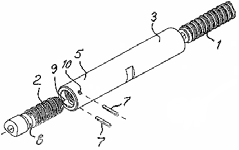
The limitation at issue read:
During prosecution, the Applicant added the qualifier "only" in response to a prior art rejection. The Examiner then rejected the amended claim under § 112 First ¶, as lacking written description. The Office Action explained the problem with the phrase "only when ... disconnected" as follows:
The Applicant submitted an expert declaration from the inventor to address the written description rejection. The declaration also explained the meaning of the limitation at issue. Referring to this declaration, the Applicant argued that the "only when ... disconnected" phrase should be read in conjunction with the "rotation" phrase:
The declaration, and the argument, then went on to reference portions of the specification that described this loading behavior in conjunction with the rotating.
The Applicant went to appeal on the written description, indefiniteness, and prior art rejection, with both sides essentially repeating the above written description arguments.
The Board found that the written description rejection was based on an improper claim interpretation, one which read the first portion of the wherein clause in isolation from the remainder of the claim.
The Board reversed the written description rejection, finding that the Applicant's specification did convey possession of the properly interpreted claim.
My two cents: Once again, the real issue is claim construction. It seemed to me that both sides recognized this, but could have done a better of job of explaining exactly how they were interpreting the claim. I had to keep reading the claim, and the arguments, over and over again.
The Examiner apparently read "disconnected" as referring to the bolt's final state, so that the phrase "only when" was interpreted to exclude loading with the bolt disconnected. On the other hand, the Applicant apparently read "only when ... disconnected" to refer to the action of disconnecting the bolt, or perhaps the bolt's intermediate state of being disconnected.
The choice of tense in "when disconnected" definitely sounds like a state rather than an action. It's only when the "by rotation" portion of the claim is considered that it even becomes possible to understand "disconnected" as an action. Still, I think the phrasing "only when said rock bolt is being disconnected" does a better job of conveying the Applicant's apparent intent.
My sense is that the issue of what tense to use comes up more in mechanical cases where you focus on describing structure first, and then on associating actions and states with the structure. Whereas action and state are more central to the claims I deal with every day in computer and electronics applications. Even so, I can think of instances where I've had to think about how to properly convey state, action, or a combination of the two – and it can be a challenge.
Details:
Ex parte Kanflod
Appeal 2012005389; Appl. No. 10/539,148; Tech. Center 3600
Decided August 14, 2012
The application on appeal related to drilling machines. The independent claim on appeal was directed to a sleeve that couples a rock bolt (1) to a rock drilling machine (2). (See figure below.)
The limitation at issue read:
a locking device (7) ... said locking device is loaded to retain the rock drilling machine connected to the coupling sleeve only when said rock bolt is disconnected from said coupling sleeve by rotation of said rock drilling machine in a direction for disconnecting said first part of said coupling sleeve from said rock bolt for reinforcing a rock with said rock bolt.
(Emphasis added.)
During prosecution, the Applicant added the qualifier "only" in response to a prior art rejection. The Examiner then rejected the amended claim under § 112 First ¶, as lacking written description. The Office Action explained the problem with the phrase "only when ... disconnected" as follows:
[T]here is no structure to prevent the loading of locking device (7) to retain the rock drilling machine (2) connected to the coupling sleeve (3, 5) regardless of whether or not rock bolt (I) is connected or disconnected, since rock bolt (I) has no contact with either of locking device (7) or drilling machine (2) (even when the bolt is installed) and thus cannot prevent relative loading between device (7) and machine (2).
(Emphasis added.)
The Applicant submitted an expert declaration from the inventor to address the written description rejection. The declaration also explained the meaning of the limitation at issue. Referring to this declaration, the Applicant argued that the "only when ... disconnected" phrase should be read in conjunction with the "rotation" phrase:
[T]he locking device is loaded (locked) to lock the drilling machine to the coupling sleeve only when the drilling device is rotated in a direction to separate the rock bolt from the coupling sleeve, and not during a percussion operation.
The declaration, and the argument, then went on to reference portions of the specification that described this loading behavior in conjunction with the rotating.
The Applicant went to appeal on the written description, indefiniteness, and prior art rejection, with both sides essentially repeating the above written description arguments.
The Board found that the written description rejection was based on an improper claim interpretation, one which read the first portion of the wherein clause in isolation from the remainder of the claim.
A person skilled in the art would understand the above limitation to mean that the locking device is loaded just prior to disconnection of the rock bolt from the sleeve, i.e., when the rock bolt is still connected to the coupling sleeve. The Examiner improperly interprets the limitation to mean that the locking device is loaded only after disconnection of the rock bolt from the sleeve.
The Board reversed the written description rejection, finding that the Applicant's specification did convey possession of the properly interpreted claim.
The specification as originally filed explains that (1) during drilling the locking device 7 is unloaded (Spec. at 2:13-14) and (2) after drilling the locking device is loaded to disconnect the rock bolt from the coupling sleeve (Spec. at 2:14-19).
My two cents: Once again, the real issue is claim construction. It seemed to me that both sides recognized this, but could have done a better of job of explaining exactly how they were interpreting the claim. I had to keep reading the claim, and the arguments, over and over again.
The Examiner apparently read "disconnected" as referring to the bolt's final state, so that the phrase "only when" was interpreted to exclude loading with the bolt disconnected. On the other hand, the Applicant apparently read "only when ... disconnected" to refer to the action of disconnecting the bolt, or perhaps the bolt's intermediate state of being disconnected.
The choice of tense in "when disconnected" definitely sounds like a state rather than an action. It's only when the "by rotation" portion of the claim is considered that it even becomes possible to understand "disconnected" as an action. Still, I think the phrasing "only when said rock bolt is being disconnected" does a better job of conveying the Applicant's apparent intent.
My sense is that the issue of what tense to use comes up more in mechanical cases where you focus on describing structure first, and then on associating actions and states with the structure. Whereas action and state are more central to the claims I deal with every day in computer and electronics applications. Even so, I can think of instances where I've had to think about how to properly convey state, action, or a combination of the two – and it can be a challenge.
Thursday, June 21, 2012
Prosecution tip: Using an RCE to suspend prosecution
Takeaway: An Applicant filed an RCE to pull from appeal in order to file declaration evidence of non-obviousness. While doing so, the Applicant took advantage of a little-used rule (§ 1.103(c)) to request suspension of prosecution for three months, thus giving the Applicant time to obtain the declaration. The Applicant then filed expert evidence under § 1.132 before the close of the suspension period. (Application of Hermann, Appl. No. 09/817,797, Tech. Center 2800, available on Public PAIR.)
Details: There are two mechanisms by which an Applicant can request suspension of prosecution. You can file a petition under § 1.103(a), which requires a showing good and sufficient cause. Or you can request suspension under § 1.103(c) by simply checking a box on the RCE transmittal. No reason for the suspension is required. However, note that the request for suspension does not itself serve as the "submission" required to be filed with an RCE. Therefore, you should also file a response to the Final Office Action or refer to a previously filed After Final.
My two cents: I think this route sounds like a very useful option once you decide to file declaration evidence. Typically, you're at final when you realize that declaration evidence is what you need to beef up your position. That means you're already going to need to file an RCE. So for a relatively small fee (currently $130), you can buy yourself an extra three months to obtain the declaration from the inventor or other expert. That's way cheaper than paying EOTs.
Postscript: Unfortunately, the declaration evidence didn't work for the Applicant in 09/817,797. The Examiner not only found the declaration unpersuasive, the Examiner stated that "the declaration fails to teach why the device recited in the claims of the instant application is workable" and then gave a new enablement rejection. The Applicant submitted another declaration to address both the enablement and prior art rejections. The application is currently on appeal.
Details: There are two mechanisms by which an Applicant can request suspension of prosecution. You can file a petition under § 1.103(a), which requires a showing good and sufficient cause. Or you can request suspension under § 1.103(c) by simply checking a box on the RCE transmittal. No reason for the suspension is required. However, note that the request for suspension does not itself serve as the "submission" required to be filed with an RCE. Therefore, you should also file a response to the Final Office Action or refer to a previously filed After Final.
My two cents: I think this route sounds like a very useful option once you decide to file declaration evidence. Typically, you're at final when you realize that declaration evidence is what you need to beef up your position. That means you're already going to need to file an RCE. So for a relatively small fee (currently $130), you can buy yourself an extra three months to obtain the declaration from the inventor or other expert. That's way cheaper than paying EOTs.
Postscript: Unfortunately, the declaration evidence didn't work for the Applicant in 09/817,797. The Examiner not only found the declaration unpersuasive, the Examiner stated that "the declaration fails to teach why the device recited in the claims of the instant application is workable" and then gave a new enablement rejection. The Applicant submitted another declaration to address both the enablement and prior art rejections. The application is currently on appeal.
Tuesday, September 27, 2011
Can a draft application serve as evidence of conception in a swear-behind declaration?
In prosecution, a reference that is dated a few days or weeks before your application's filing date may provide an opportunity to swear behind the reference. But if you follow the conventional approach of using an invention disclosure document as evidence of conception, that may involve showing diligence for a long period up to filing of the application. What if you could use a draft of your patent application as evidence of conception? Now the diligence period would probably be much shorter. [If you need a refresher on swear-behind declarations, conception, and diligence, see my posts here, here, and here.]
I think using a draft application as evidence of conception is a viable strategy, given the right facts. I ran across a file history and corresponding BPAI opinion where the Applicant tried something like this, but blew it by not submitting the right documents as evidence of conception until it was too late. In a future post, I'll explain what went wrong in that case, and some lessons to be learned. This post will explain when and how to use a draft patent application as evidence of conception. I can't promise you this strategy will work -- I haven't run across any another file histories where this came up. So read through my explanation and decide for yourself.
A draft application is great evidence of conception in that – unlike an invention disclosure or technical paper – it's specifically written to describe and enable the claims. However, unlike an invention disclosure or technical paper, it's not written by the inventor. So on its face, an unfiled application may not appear to show conception by the inventor. This is the first obstacle to be addressed in using a draft application as evidence of conception.
I think inventor approval can provide this missing link. If the inventor approved the application for filing before the effective reference date, then I think we have conception by the inventor before the critical date. Along the same lines, an executed declaration of inventorship can provide the missing link. An inventorship declaration that is executed by at least one inventor before the effective reference date shows conception by the inventor.
If you don't have inventor approval/execution before the effective reference date, is the game over? Maybe not. If you can show that the application actually filed has no significant differences as compared to a draft application in existence before the critical date, doesn't that also provide the missing link? Doesn't that also show that the draft application reflects the inventor's conception? After all, the inventor later signed an inventorship declaration attesting that a very similar document described his invention.
So I think that under any of these fact scenarios, you have evidence of conception before the critical date. Of course, you still need evidence of diligence in filing, even if it's only for a few days or weeks. But that's going to be easier to deal with than the typical diligence period, because that starts much earlier when an invention disclosure is filed with the employer.
As with any swear-behind declaration, a swear-behind relying on a draft patent application as evidence of conception should explain the correspondence between sections of the relied-upon document (in this situation, the draft patent application) and the elements of the pending claims. (See my previous posts mentioned above for more information.) The swear-behind declaration should also include an affirmative statement by the inventors that the draft application describes the claims. You should submit the draft application, as supporting evidence, along with the swear-behind declaration. You should also submit evidence that the draft was in existence as of the effective reference date.
Finally, you must comply with all the formalities of a swear-behind (e.g., signed by all inventors) and follow the rules to get the evidence entered (e.g., on non-final, with an RCE, or with a "good and sufficient" showing after final).
What do you think? Creative thinking? Or am I way off base?
I think using a draft application as evidence of conception is a viable strategy, given the right facts. I ran across a file history and corresponding BPAI opinion where the Applicant tried something like this, but blew it by not submitting the right documents as evidence of conception until it was too late. In a future post, I'll explain what went wrong in that case, and some lessons to be learned. This post will explain when and how to use a draft patent application as evidence of conception. I can't promise you this strategy will work -- I haven't run across any another file histories where this came up. So read through my explanation and decide for yourself.
A draft application is great evidence of conception in that – unlike an invention disclosure or technical paper – it's specifically written to describe and enable the claims. However, unlike an invention disclosure or technical paper, it's not written by the inventor. So on its face, an unfiled application may not appear to show conception by the inventor. This is the first obstacle to be addressed in using a draft application as evidence of conception.
I think inventor approval can provide this missing link. If the inventor approved the application for filing before the effective reference date, then I think we have conception by the inventor before the critical date. Along the same lines, an executed declaration of inventorship can provide the missing link. An inventorship declaration that is executed by at least one inventor before the effective reference date shows conception by the inventor.
If you don't have inventor approval/execution before the effective reference date, is the game over? Maybe not. If you can show that the application actually filed has no significant differences as compared to a draft application in existence before the critical date, doesn't that also provide the missing link? Doesn't that also show that the draft application reflects the inventor's conception? After all, the inventor later signed an inventorship declaration attesting that a very similar document described his invention.
So I think that under any of these fact scenarios, you have evidence of conception before the critical date. Of course, you still need evidence of diligence in filing, even if it's only for a few days or weeks. But that's going to be easier to deal with than the typical diligence period, because that starts much earlier when an invention disclosure is filed with the employer.
As with any swear-behind declaration, a swear-behind relying on a draft patent application as evidence of conception should explain the correspondence between sections of the relied-upon document (in this situation, the draft patent application) and the elements of the pending claims. (See my previous posts mentioned above for more information.) The swear-behind declaration should also include an affirmative statement by the inventors that the draft application describes the claims. You should submit the draft application, as supporting evidence, along with the swear-behind declaration. You should also submit evidence that the draft was in existence as of the effective reference date.
Finally, you must comply with all the formalities of a swear-behind (e.g., signed by all inventors) and follow the rules to get the evidence entered (e.g., on non-final, with an RCE, or with a "good and sufficient" showing after final).
What do you think? Creative thinking? Or am I way off base?
Thursday, September 15, 2011
BPAI reminds Applicant that formalities of swear-behind declaration are important
Takeaway: In evaluating a declaration under § 1.131 (swear-behind), the BPAI noted that the declaration did not comply with the required formalities. Specifically, the declaration named a single inventor as declarant but was signed by all four inventors. The Board went on to find that the declaration lacked sufficient evidence of both conception and diligence, and then affirmed the prior art rejection since the Applicant made no substantive arguments against obviousness.
Details:
Ex parte Bianchi
Appeal 200702938; Appl. No. 10/327,489; Tech. Center 3600
Decided January 28, 2008
The Examiner rejected as obvious over a combination of references. In response, the Applicant swore behind the secondary reference by filing a declaration under § 1.131. The Examiner did not withdraw the rejection, and the Applicant appealed. In the Appeal Brief, the Applicant made no substantive arguments but instead argued that the rejection was deficient because the swear-behind declaration removed the secondary reference as prior art.
The Board affirmed the rejections, finding that the Applicant had not submitted sufficient evidence of conception and/or diligence. The Board also noted that the declaration did not comply with formalities required by § 1.131. Specifically, the declaration named a single inventor as declarant but was signed by all four inventors.


The Board indicated that
My two cents: Like the declaration of inventorship filed with an application, a § 1.131 declaration must be signed by all the inventors (with a few specific exceptions). But where the declaration of inventorship usually takes the form of a single document that names all inventors and is signed by all inventors, all the § 1.131 declarations I see use a different format. Specifically, a § 1.131 declaration is typically submitted as multiple documents, each signed by one inventor. All the documents include the same facts being attested to, and the same "information and belief" language. They differ only in the identification of the declarant/signatory.
As far as I know, you could submit a single document for a § 1.131, like a declaration of inventorship, as long as each declarant was named separately. The problem here was that one declarant was named as making the statements yet all inventors signed.
In an upcoming post, I'll discuss the sufficiency of the evidence and the timing of the declaration.
Details:
Ex parte Bianchi
Appeal 200702938; Appl. No. 10/327,489; Tech. Center 3600
Decided January 28, 2008
The Examiner rejected as obvious over a combination of references. In response, the Applicant swore behind the secondary reference by filing a declaration under § 1.131. The Examiner did not withdraw the rejection, and the Applicant appealed. In the Appeal Brief, the Applicant made no substantive arguments but instead argued that the rejection was deficient because the swear-behind declaration removed the secondary reference as prior art.
The Board affirmed the rejections, finding that the Applicant had not submitted sufficient evidence of conception and/or diligence. The Board also noted that the declaration did not comply with formalities required by § 1.131. Specifically, the declaration named a single inventor as declarant but was signed by all four inventors.

...

The Board indicated that
If the Appellants pursue the removal of Goodman as prior art by submitting an affidavit or declaration that fully complies with the requirements of 37 C.F.R. § 1.131, they should observe that the existing declaration ambiguously states that only one of the inventors is making the declaration in the text, while all inventors are signatories (FF 03 & 04). All of the inventors of the subject matter claimed must make the declaration. The Appellants should resolve this ambiguity by stating which of the inventors are actually making the declaration in any subsequent affidavit or declaration.
My two cents: Like the declaration of inventorship filed with an application, a § 1.131 declaration must be signed by all the inventors (with a few specific exceptions). But where the declaration of inventorship usually takes the form of a single document that names all inventors and is signed by all inventors, all the § 1.131 declarations I see use a different format. Specifically, a § 1.131 declaration is typically submitted as multiple documents, each signed by one inventor. All the documents include the same facts being attested to, and the same "information and belief" language. They differ only in the identification of the declarant/signatory.
As far as I know, you could submit a single document for a § 1.131, like a declaration of inventorship, as long as each declarant was named separately. The problem here was that one declarant was named as making the statements yet all inventors signed.
In an upcoming post, I'll discuss the sufficiency of the evidence and the timing of the declaration.
Monday, August 29, 2011
Applicant requests BPAI rehearing and receives new Office Action because Request introduced new evidence
Takeaway: In Ex parte O'Neill, the Board "procedurally reversed" the Examiner's obviousness rejections and instead entered a new ground of rejection for indefiniteness. The Applicant filed a Request for Rehearing by the BPAI under § 41.50(b)(2). The Request included arguments against the new indefiniteness rejection and was accompanied by an expert declaration under § 1.132 to "provide evidentiary support" for these new arguments. However, the BPAI did not act on the Request. Instead, the Examiner responded by issuing a non-final Office Action which included the Board-entered indefiniteness rejection as well as the previously-entered obviousness rejection. The Office Action noted that a Rehearing by the BPAI was not appropriate, since a Rehearing is limited to the same record, while the Applicant had submitted new evidence.
My two cents: The rules which cover post-appeal processing (37 CFR § 41.50) are complicated, so you should read them carefully when you get a BPAI decision back. A Rehearing by the BPAI is strictly limited to the existing record — unless the Board enters a new ground of rejection, in which case arguments against the new rejection are allowed. But new evidence supporting those arguments is not allowed in a Rehearing.
Monday, August 8, 2011
BPAI gives expert testimony little weight, for discussing state of the art before filing date and admitting no knowledge of reference before litigation
Takeaway: In an appeal from an ex parte reexamination, the patentee submitted a number of expert depositions from related litigation in support of various non-obviousness arguments. In affirming the Examiner's obviousness rejections, the BPAI suggested that the expert testimony was not probative because the testimony related to the state of the art at a time well before the filing date. The BPAI also suggested that the testimony had little value because the experts admitted they were not even aware of the prior art systems at the time of filing. (Ex parte Baxter International, Inc., BPAI 2010.)
Details:
Ex parte Baxter International, Inc.
Informative Opinion
Appeal 2009006493; Reexamination No. 90/007,751; Patent 5,247,4341; Tech. Center 3900
Decided March 18, 2010
This was an appeal in an ex parte reexam. The patent relates to a touch screen user interface for a kidney dialysis machine. A representative claim on appeal read:
During the reexam, the Examiner rejected the claims as obvious. As a primary reference, the Examiner used "the CMS08 Handbook," a manual for a dialysis machine which used a control panel for input and a screen for display. As a secondary reference, the Examiner used a "SARNs 9000" manual describing a blood perfusion machine with a touch screen that supported both input and display. In response to the rejection, the patentee put forth various arguments of non-obviousness, and included various depositions from a related litigation to support some of these arguments.
The patentee made a number of arguments in the Appeal Brief. One of the arguments attacked the prima facie case of obviousness by explaining why a POSITA would not combine the asserted references. The patentee used the litigation depositions to provide factual support for this argument. For example:
In the Answer, the Examiner treated the patentee's "POSITA would not combine" argument as a non-analogous art argument:
The Board affirmed all of the Examiner's obviousness rejections. After making various findings of fact about the teachings of the references, the Board concluded that:
In discussing the patentee's rebuttal evidence, the Board noted that the expert testimony was not credible because it focused on the wrong time period.
The Board also discounted the expert evidence because it failed to take into account the teachings of the asserted references:
Postscript: The patentee has appealed the BPAI decision to the Federal Circuit.
Other Blog Coverage: The BPAI marked this decision "Informative," but I've no reason to think this status has anything to do with the issues discussed here. Several other bloggers have said the Informative status is due to the BPAI's discussion of the differing standards of validity applied to reexam and litigation.
See "District Court Analysis v. PTO Reexamination Analysis" at Patents Post-Grant and "BPAI Informative Opinion Underscores Different Validity Standards for Reexams" at The 271 Patent Blog.
For an explanation of precedential, informative and routine status, see my post "Meaning of BPAI Precedential and Informative Opinions."
My two cents: The Board's point about the time period considered by the experts is well taken. That is, the viewpoint for non-obviousness is the time of filing, so whether or not POSITAs would have used touch screens a full five years before filing is not very probative. Remember that when gathering your rebuttal evidence.
On the other hand, the Board took a cheap shot with the quote "not a single witness had even heard of [the prior art] Sarns machine." The evidence in question was not submitted for the purpose of distinguishing the reference. Instead, the evidence was submitted as a factual statement about why an actual person in the art did not look to prior art like the Sarns machine – because that person simply didn't think of perfusion machines when addressing a problem with a dialysis machine. So why is it a big deal that the witness was unaware of the Sarns perfusion machine?
Perhaps the Board is making a bigger point: that anyone involved in designing user interfaces for dialysis machines who isn't familiar with the touch screen interface on the Sarns perfusion machine isn't a true POSITA? If so, I'd like to hear an explanation of why the Board thinks that is the case.
The patentee offered evidence from real people involved in product development. Is the law even interested in what actual persons in the art did or didn't do, looked at or didn't look at? I appreciate that obviousness is from the viewpoint of a hypothetical POSITA. But what's wrong with using real POSITAs to inform our understanding of the hypothetical POSITA?
Sure, there may be concerns about the credibility of POSITA testimony when the POSITA has a connection to the patentee or applicant. Fair enough. The fact finder can take that into account.
But suppose you had 100 disinterested POSITAs say "I wouldn't have combined A with B and here's why." Do you ignore that information because we're only interested in what hypothetical POSITAs would do, rather than what real ones would do? Or, in the case of Baxter, did not do (look to perfusion machines).
Related Posts: I'll be doing another post about Ex parte Baxter that discusses the "skepticism of experts" doctrine in more detail. The Board didn't have much to say about the merits of this argument (only about the credibility of the testimony), but the Examiner's comments are worth discussing.
Details:
Ex parte Baxter International, Inc.
Informative Opinion
Appeal 2009006493; Reexamination No. 90/007,751; Patent 5,247,4341; Tech. Center 3900
Decided March 18, 2010
This was an appeal in an ex parte reexam. The patent relates to a touch screen user interface for a kidney dialysis machine. A representative claim on appeal read:
12. In a method of operating a hemodialysis machine, an improvement in a user/machine interfacing process, the improvement comprising:
(a) providing a touch screen operably coupled to the machine, the touch screen adapted to display an indicium soliciting a user of the machine to touch a region on the screen so as to select a machine-operation parameter;
(b) touching the region to select the machine operation parameter;
(c) in response to said touching, invoking on the screen a data-entry display associated with the machine-operation parameter, the data entry display including a display of a permissibly settable range of the machine-operation parameter, so as to allow the user to select and enter a parametric value associated with the machine-operation parameter within said range; and
(d) touching the data-entry display to select and enter the parametric value so as to cause the machine to operate in conformance with the selected machine-operation parameter and the entered parametric value.
During the reexam, the Examiner rejected the claims as obvious. As a primary reference, the Examiner used "the CMS08 Handbook," a manual for a dialysis machine which used a control panel for input and a screen for display. As a secondary reference, the Examiner used a "SARNs 9000" manual describing a blood perfusion machine with a touch screen that supported both input and display. In response to the rejection, the patentee put forth various arguments of non-obviousness, and included various depositions from a related litigation to support some of these arguments.
The patentee made a number of arguments in the Appeal Brief. One of the arguments attacked the prima facie case of obviousness by explaining why a POSITA would not combine the asserted references. The patentee used the litigation depositions to provide factual support for this argument. For example:
Finally, the Patent Owner maintains that an ordinary artisan in the field of hemodialysis would not have looked to the cardio-pulmonary bypass (CPB) field for help in solving the problems of traditional user control of hemodialysis function. Baxter (the Patent Owner) and Fresenius (the Reexamination Requestor) are the two largest dialysis companies in the world. In the nearly five-year litigation surrounding these patents, almost sixty depositions were taken, including all of the named inventors, key present and past R&D personnel for both companies, numerous senior marketing executives, nephrologists, and other third-party witnesses in the dialysis field. It is hard to imagine a more representative sample of those "skilled in the art." Yet not a single witness from either Baxter or Fresenius had even heard of the Sarns machine. This fact speaks volumes about whether one of ordinary skill in the art of hemodialysis machines would have looked to the cardio-pulmonary bypass field for inspiration or problem-solving help.
As Dr. Lee Henderson, Baxter's expert consultant in hemodialysis and nephrology, points out in his expert report: "Based on my experience during the relevant time, there was very little, if any, technical exchange between engineers designing HD equipment and those designing heart-lung machines."
(Emphasis added, internal citations omitted.)
In the Answer, the Examiner treated the patentee's "POSITA would not combine" argument as a non-analogous art argument:
Appellants argue that testimony of Dr. Dennis Brunner and Lee Henderson supports the contention that the artisan would not have knowledge, awareness nor would have looked to the prior art in design of a touch screen hernodialysis device. Such testimony, while expert opinion is an argument akin to an assertion that the references are non-analogous art. These arguments are non-persuasive [because] the substantive issue here is more basic. The artisan already possessed functional hemodialysis devices [the CMS08] with suitable controls, guidance to selectable variables and alarm limits. ... The issue before the artisan was clearly more simple, related to the ease with which the user might analyze and effect a change in certain hemodialysis parameters. The issue comes down to one of programming, and whether the artisan would be guided to the art accepted input/output device of a touch screen to effect such parameter changes.
The Board affirmed all of the Examiner's obviousness rejections. After making various findings of fact about the teachings of the references, the Board concluded that:
[T]he collective teachings of the applied prior art references would have prompted a person of ordinary skill in the art to couple a touch screen interface with a hemodialysis machine. ... The interrelatedness of the prior art teachings, coupled with the expectation that a technique used to improve one device would also improve other similar devices, amply support the Examiner’s obviousness conclusion. KSR, 550 U.S. at 417-18.
In discussing the patentee's rebuttal evidence, the Board noted that the expert testimony was not credible because it focused on the wrong time period.
We also find no error in the Examiner’s refusal to credit the testimonies of certain experts as supporting Appellant’s skepticism or lack of a reasonable expectation of success argument. As pointed out by the Examiner, these experts testified on the knowledge of a person of ordinary skill in the art at a time period significantly before the relevant filing date. We have not been directed to any evidence indicating that further advances in touch screen technology did not occur up to the relevant filing date.
The Board also discounted the expert evidence because it failed to take into account the teachings of the asserted references:
Moreover, we have not been directed to any evidence that these witnesses, before giving their testimonies, considered the teachings of the applied prior art references, which plainly disclose the successful incorporation of touch screen interfaces into critical medical systems. Indeed, Appellant has admitted that “not a single witness from either Baxter or Fresenius had even heard of the [prior art] Sarns machine.” That admission reveals the lack of any substantial value in the relied upon evidence vis-a-vis Appellant’s argument.
Postscript: The patentee has appealed the BPAI decision to the Federal Circuit.
Other Blog Coverage: The BPAI marked this decision "Informative," but I've no reason to think this status has anything to do with the issues discussed here. Several other bloggers have said the Informative status is due to the BPAI's discussion of the differing standards of validity applied to reexam and litigation.
See "District Court Analysis v. PTO Reexamination Analysis" at Patents Post-Grant and "BPAI Informative Opinion Underscores Different Validity Standards for Reexams" at The 271 Patent Blog.
For an explanation of precedential, informative and routine status, see my post "Meaning of BPAI Precedential and Informative Opinions."
My two cents: The Board's point about the time period considered by the experts is well taken. That is, the viewpoint for non-obviousness is the time of filing, so whether or not POSITAs would have used touch screens a full five years before filing is not very probative. Remember that when gathering your rebuttal evidence.
On the other hand, the Board took a cheap shot with the quote "not a single witness had even heard of [the prior art] Sarns machine." The evidence in question was not submitted for the purpose of distinguishing the reference. Instead, the evidence was submitted as a factual statement about why an actual person in the art did not look to prior art like the Sarns machine – because that person simply didn't think of perfusion machines when addressing a problem with a dialysis machine. So why is it a big deal that the witness was unaware of the Sarns perfusion machine?
Perhaps the Board is making a bigger point: that anyone involved in designing user interfaces for dialysis machines who isn't familiar with the touch screen interface on the Sarns perfusion machine isn't a true POSITA? If so, I'd like to hear an explanation of why the Board thinks that is the case.
The patentee offered evidence from real people involved in product development. Is the law even interested in what actual persons in the art did or didn't do, looked at or didn't look at? I appreciate that obviousness is from the viewpoint of a hypothetical POSITA. But what's wrong with using real POSITAs to inform our understanding of the hypothetical POSITA?
Sure, there may be concerns about the credibility of POSITA testimony when the POSITA has a connection to the patentee or applicant. Fair enough. The fact finder can take that into account.
But suppose you had 100 disinterested POSITAs say "I wouldn't have combined A with B and here's why." Do you ignore that information because we're only interested in what hypothetical POSITAs would do, rather than what real ones would do? Or, in the case of Baxter, did not do (look to perfusion machines).
Related Posts: I'll be doing another post about Ex parte Baxter that discusses the "skepticism of experts" doctrine in more detail. The Board didn't have much to say about the merits of this argument (only about the credibility of the testimony), but the Examiner's comments are worth discussing.
Monday, July 11, 2011
BPAI reminder that declaration of unexpected results must include statement that results are unexpected
Takeaway: The BPAI found that the Applicant's evidence of unexpected results was insufficient to rebut the prima facie case of obviousness because the expert declaration failed to state the results were unexpected. Arguments in the Appeal Brief did characterize the results as unexpected, but the Board pointed out that "attorney argument is not evidence." (Ex parte Uchida, Appeal 2011000486.)
Details:
Ex parte Uchida
Appeal 2011000486; Appl. No. 11/731,595; Tech. Center 1600
Decided: July 7, 2011
The claims were directed to a chemical composition. One of the limitations at issue read "the inorganic heat generating agent is magnesium sulfate having an average diameter of from about 0.01 μm to about 40 μm."
The Examiner rejected the claims as obvious. On appeal, the Applicant argued that the average diameter limitation was not taught or suggested by the combination of references. The Appeal Brief also referred to previously submitted evidence showing that the claimed particle diameter produced unexpected results.
The Board found that the claim language "to about 40 μm" was broad enough to encompass the 50 μm particle in one of the references. The Board also found that the evidence of secondary considerations was flawed:
Having found the record "devoid of evidence" that actually showed unexpected results, the Board affirmed the obviousness rejection.
My two cents: If you're spending the time and money to submit evidence of secondary considerations, do it right. Note that two of the points made by the Board apply to all types of secondary considerations:
Details:
Ex parte Uchida
Appeal 2011000486; Appl. No. 11/731,595; Tech. Center 1600
Decided: July 7, 2011
The claims were directed to a chemical composition. One of the limitations at issue read "the inorganic heat generating agent is magnesium sulfate having an average diameter of from about 0.01 μm to about 40 μm."
The Examiner rejected the claims as obvious. On appeal, the Applicant argued that the average diameter limitation was not taught or suggested by the combination of references. The Appeal Brief also referred to previously submitted evidence showing that the claimed particle diameter produced unexpected results.
The Board found that the claim language "to about 40 μm" was broad enough to encompass the 50 μm particle in one of the references. The Board also found that the evidence of secondary considerations was flawed:
Although the Uchida [expert] Declaration shows that 1 micron particles produce a slightly higher maximal temperature than 50 micron particles, neither the Specification nor the Declaration states that this result was unexpected. Cf. In re Soni, 54 F.3d 746, 751 (Fed. Cir. 1995) (“[W]hen an applicant demonstrates substantially improved results . . . and states that the results were unexpected, this should suffice to establish unexpected results in the absence of evidence to the contrary.”). Here, the only characterization of the results as unexpected is in the Appeal Brief, and attorney argument is not evidence.The Board also criticized the evidence as not being commensurate with the claim scope. "[T]he claims encompass a particle size range of about 1 μm to about 40 μm, and the evidence shows results only at the lower limit of the claimed range."
(Emphasis added.)
Having found the record "devoid of evidence" that actually showed unexpected results, the Board affirmed the obviousness rejection.
My two cents: If you're spending the time and money to submit evidence of secondary considerations, do it right. Note that two of the points made by the Board apply to all types of secondary considerations:
- In re Greenfield, 571 F.2d 1185, 1189 (CCPA 1978) (“[O]bjective evidence of non-obviousness must be commensurate in scope with the claims…”).
- Estee Lauder, Inc. v. L'Oreal, S.A., 129 F.3d 588, 595 (Fed. Cir. 1997)("However, arguments of counsel cannot take the place of evidence lacking in the record.").
- In re Baxter Travenol Labs., 952 F.2d 388, 392 (Fed. Cir. 1991)(“[W]hen unexpected results are used as evidence of nonobviousness, the results must be shown to be unexpected compared with the closest prior art.”).
Tuesday, June 7, 2011
BPAI says foreign application can be used in swear behind to show constructive reduction to practice – under some conditions
Takeaway: On appeal, the Applicant argued that a foreign filing could be used to show constructive to practice in a swear behind declaration. The BPAI said that the foreign filing was constructive reduction to practice only if the US filing occurred less than a year after the foreign filing, citing In re Mulder, 716 F.2d 1542, 1545 (Fed. Cir. 1983). If the US filing took place more than one year after the foreign filing, § 119(a) does not allow the foreign application to be used as constructive reduction to practice.
Details:
Ex parte Saito
Appeal 200805777; Appl. No. 10/800,386; Tech. Center 2800
Decided December 28, 2008
The technology in the application on appeal related to color bar codes. In the first Office Action, the Examiner rejected the independent claims as being anticipated by Ackley under § 102(e). The Applicant responded by attempting to swear behind Ackley, by showing conception before Ackley's filing date coupled with diligence from conception to the filing of Applicant's provisional (to which priority was claimed).
Specifically, the Applicant submitted evidence of conception in the form of Applicant's corresponding Japanese patent application, and a certified English translation thereof. As for diligence, the inventor's declaration included statements about preparation of the provisional application, spanning the time frame starting immediately before Ackely's filing date up to the filing of the provisional.
The Applicant explained the evidence as follows:
The Examiner maintained the rejection in a Final Office Action, explaining that the evidence was insufficient to show diligence. Specifically, the Examiner indicated that:
In the Advisory Action, the Examiner indicated that the second declaration was still ineffective to remove the Ackely reference. The Examiner took the position that filing of the Japanese application was only evidence of conception, and that diligence must be shown from the time of conception until the time of the US filing (almost a two year period). The Applicant then filed a Notice of Appeal.
In the Appeal Brief, the Applicant argued that Arkley was not prior art because the inventor "constructively reduced the claimed invention of the present application to practice by filing in Japan on November 28, 1997 before the § 102(e) date of Ackley." The Applicant also noted that although the Japanese application did publish, this was not a § 102(b) bar since the US provisional was filed less than one year before the publication.
The Examiner's Answer maintained that Arkley was prior art. The Examiner interpreted the Applicant's reference to the Japanese filing as reliance on a foreign priority date. The Examiner then cited Stevens v. Tamai (Fed. Cir 2004) for the rule that Section 119(a) prohibits reliance on a foreign filing for priority when the foreign filing is more than a year before the US filing, as was the case here. The Examiner further explained:
Having found no reduction to practice under the first prong of § 1.131(b), the Board turned to the second prong, which requires conception plus diligence. The Board acknowledged that the Japanese filing might be enough to show conception. However, the Board summarily stated that the Applicant had not provided "sufficient evidence" of due diligence during the required period (one day before the reference filing date to the filing of the Applicant's provisional). Therefore, the reference was not disqualified as prior art, and the prior art rejections were affirmed.
My two cents: The Applicant made a mistake in not making an argument on diligence using the originally submitted declaration. The Examiner said the diligence period was 2 years but the correct period was only 2 months. It's true that conception before the reference date must be shown. But the diligence period does not start at conception. The diligence period instead starts immediately before the reference date. (MPEP 715.07.) That is, unexplained gaps between conception and the reference date are allowed – just not unexpected gaps between the reference date and reduction to practice (actual or constructive).
Since the earlier "diligence" declaration was already in the record, the Applicant should have argued conception plus diligence as an alternative to the argument made (constructive reduction to practice).
Instead, the Applicant based the entire appeal on a statutory interpretation that was either creative, strained, or misguided.
The decision doesn't discuss the diligence evidence at all. So I can't tell if the Board didn't evaluate diligence (because no arguments were made on appeal) or evaluated it and found it lacking.
I wondered at first why the Board even brought up the point that a foreign filing can be used to show constructive reduction to practice, as long as the filing meets § 119(a). After all, if you meet § 119(a), you can go with a straight claim to foreign priority, in which case you don't need a swear behind. After reading the fine print in the decision, it appears to me that constructive reduction through a foreign filing could be useful if you forget to claim priority and it's too late to fix the priority claim through a petition.
Details:
Ex parte Saito
Appeal 200805777; Appl. No. 10/800,386; Tech. Center 2800
Decided December 28, 2008
The technology in the application on appeal related to color bar codes. In the first Office Action, the Examiner rejected the independent claims as being anticipated by Ackley under § 102(e). The Applicant responded by attempting to swear behind Ackley, by showing conception before Ackley's filing date coupled with diligence from conception to the filing of Applicant's provisional (to which priority was claimed).
Specifically, the Applicant submitted evidence of conception in the form of Applicant's corresponding Japanese patent application, and a certified English translation thereof. As for diligence, the inventor's declaration included statements about preparation of the provisional application, spanning the time frame starting immediately before Ackely's filing date up to the filing of the provisional.
The Applicant explained the evidence as follows:
As stated in the Declaration of Takahlro Saito, during the period of time from just before October 18, 1999 to December 15, 1999, Mr. Saito has been working with Mr. Tetsuo Wada of Ehara Patent Office to modify and finalize the specification for the base U.S. provisional application No. 601170,815. Mr. Saito exchanged opinions with Mr. Wada and modified the specification numerous times during that period of time, while both Mr. Saito and Mr. Wada fulfilled other work related duties. Exhibit C is a draft specification dated December 10, 1999, which is a modified version of the disclosure shown in Exhibit A and was finished five days before filing the provisional application No. 601170,815. As shown and evidenced above, Mr. Saito and his patent attorney(s) had worked on the present invention with due diligence from just before October 18, 1999 (the 102(e) date of Ackley) to December 15, 1999 (the date of constructive reduction to practice).
The Examiner maintained the rejection in a Final Office Action, explaining that the evidence was insufficient to show diligence. Specifically, the Examiner indicated that:
The evidence submitted is insufficient to establish diligence from a date prior to the date of reduction to practice of the Ackley reference to either a constructive reduction to practice or an actual reduction to practice since the applicant's statements are vague as to diligence. For example, applicant states on page 1, paragraph 4 of the declaration filed 4 April 2005, "As far as I can recall" and "We exchanged opinions.. ." which are not concrete declarations of an established diligence since applicant is not sure when he says "As far as I can recall" and does not pinpoint specific conversations during a 2 year time period when it is stated that "We exchanged opinions ... while both fulfill other work-related duties".The Applicant filed an After Final Response which included another swear-behind declaration. Like the first one, the second swear-behind declaration referenced the corresponding Japanese patent application. However, the second swear-behind did not include statements about, or evidence of, diligence. Instead, the Response asserted that the Japanese patent application was evidence of constructive reduction to practice before the critical date.
In the Advisory Action, the Examiner indicated that the second declaration was still ineffective to remove the Ackely reference. The Examiner took the position that filing of the Japanese application was only evidence of conception, and that diligence must be shown from the time of conception until the time of the US filing (almost a two year period). The Applicant then filed a Notice of Appeal.
In the Appeal Brief, the Applicant argued that Arkley was not prior art because the inventor "constructively reduced the claimed invention of the present application to practice by filing in Japan on November 28, 1997 before the § 102(e) date of Ackley." The Applicant also noted that although the Japanese application did publish, this was not a § 102(b) bar since the US provisional was filed less than one year before the publication.
The Examiner's Answer maintained that Arkley was prior art. The Examiner interpreted the Applicant's reference to the Japanese filing as reliance on a foreign priority date. The Examiner then cited Stevens v. Tamai (Fed. Cir 2004) for the rule that Section 119(a) prohibits reliance on a foreign filing for priority when the foreign filing is more than a year before the US filing, as was the case here. The Examiner further explained:
Appellant apparently mis-interpreted the statute to allow asserting priority benefit of the filing date of a foreign application if a later filed provisional was filed within one year of the filing date of the foreign application. This is not a proper interpretation of section 119(a) since 119(a) is available for an application for a patent and not for a provisional application which is not an application for patent.According to the Examiner, the § 119(a) prohibition against relying on the foreign filing more than a year earlier had the following effect:
[T]he affidavit may at best be sufficient to show conception as of the applicant's foreign filing date of November 28, 1997 but is not adequate to establish constructive reduction to practice. As such, in order to disqualify Ackley as a 102(e) reference, diligence must be shown from the date of conception to the filing date of the Ackley reference. ... Due to a lack of claimed diligence, the arguments are not persuasive.The Board decision first focused on "reduction to practice" in the first prong of § 1.131(b):
Thus, under the first prong of 37 C.F.R. § 1.131(b), Appellant has to establish reduction to practice prior to the effective date of the 102 (e) reference. Appellant’s declaration and arguments assume that to show reduction to practice as encompassed by “filing of the application” recited in 37 C.F.R. § 1.131(b) includes filing an application for the same invention in a foreign country.The Board found that the Applicant had not established reduction to practice. The Japanese filing did not qualify as constructive reduction to practice per se because the phrase "the application" in § 1.131(b) refers to a US application, not to a foreign application. The case law nonetheless allows constructive reduction to practice through a foreign filing – but only if that foreign filing met the requirements of § 119(a). (See In re Mulder, 716 F.2d 1542, 1545 (Fed. Cir. 1983)). But here the Applicant waited more than a year after the Japanese filing to file the US provisional application, and thus did not comply with § 119(a).
Having found no reduction to practice under the first prong of § 1.131(b), the Board turned to the second prong, which requires conception plus diligence. The Board acknowledged that the Japanese filing might be enough to show conception. However, the Board summarily stated that the Applicant had not provided "sufficient evidence" of due diligence during the required period (one day before the reference filing date to the filing of the Applicant's provisional). Therefore, the reference was not disqualified as prior art, and the prior art rejections were affirmed.
My two cents: The Applicant made a mistake in not making an argument on diligence using the originally submitted declaration. The Examiner said the diligence period was 2 years but the correct period was only 2 months. It's true that conception before the reference date must be shown. But the diligence period does not start at conception. The diligence period instead starts immediately before the reference date. (MPEP 715.07.) That is, unexplained gaps between conception and the reference date are allowed – just not unexpected gaps between the reference date and reduction to practice (actual or constructive).
Since the earlier "diligence" declaration was already in the record, the Applicant should have argued conception plus diligence as an alternative to the argument made (constructive reduction to practice).
Instead, the Applicant based the entire appeal on a statutory interpretation that was either creative, strained, or misguided.
The decision doesn't discuss the diligence evidence at all. So I can't tell if the Board didn't evaluate diligence (because no arguments were made on appeal) or evaluated it and found it lacking.
I wondered at first why the Board even brought up the point that a foreign filing can be used to show constructive reduction to practice, as long as the filing meets § 119(a). After all, if you meet § 119(a), you can go with a straight claim to foreign priority, in which case you don't need a swear behind. After reading the fine print in the decision, it appears to me that constructive reduction through a foreign filing could be useful if you forget to claim priority and it's too late to fix the priority claim through a petition.
Wednesday, June 1, 2011
BPAI reminder that silence in one reference as to what another teaches is not "teaching away"
Takeaway: In Ex parte Greve, the Applicant presented technical reasons why a POSITA would not combine the references. The Applicant concluded the argument by explaining that because the reference didn't mention a claimed feature, a POSITA would understand that the feature should be avoided. "Therefore, Gross et al. clearly teaches away from the presently claimed invention." The Board affirmed the obviousness rejection, stating that "silence in one reference as to what another teaches is not 'teaching away'. "
Details:
Ex parte Greve
Appeal 2010002433; Appl. No. 10/984,628; Tech. Center 1600
Decided April 4, 2011
The claims on appeal were directed to a drug for treating rhinitis or inflammation of the nasal cavity. A representative claim on appeal read:
The Examiner rejected as obvious over a combination of three references.The Examiner found that Greve taught a composition including (c) and a sympathomimetic in the claimed range, though not one of the two specific compounds named in (a). Moreover, Castellano taught a composition including (b) and one of the specific compounds named in (a). Furthermore, Gross taught (c) and (b). Finally, each of the compositions found in the references was described as a treatment for rhinitis or a rhinological condition.
The Examiner found that the references themselves provided the motivation to combine:
During prosecution, the Applicant argued that:
The Board appeared to ignore reasons why a POSITA would not combine the references – reasons presented in the form of expert evidence -- simply because the Applicant mischaracterized this as "teaching away." The Board should have instead weighed the expert evidence (pointing away from a combination) against the teachings of the references themselves (pointing toward a combination) to decide on obviousness/non-obviousness.
This case highlights the danger of improperly characterizing arguments. The Board should have looked beyond the label the Applicant put on the argument – but you should make their job easy, not hard.
Details:
Ex parte Greve
Appeal 2010002433; Appl. No. 10/984,628; Tech. Center 1600
Decided April 4, 2011
The claims on appeal were directed to a drug for treating rhinitis or inflammation of the nasal cavity. A representative claim on appeal read:
18. A pharmaceutical composition for the curative topical treatment of rhinitis, comprising in combination and in each case based on the pharmaceutical composition
(a) 0.001 to 1% by weight of at least one sympathomimetic selected from the group consisting of oxymetazoline hydrochloride and xylometazoline hydrochloride;
(b) 0.01 to 5 % by weight of hyaluronic acid in the form of its physiologically acceptable salts; and
(c) 0.01 to 15 % by weight of at least one of pantothenol or its esters and/or pantothenic acid or its physiologically acceptable salts,
wherein the pharmaceutical composition is formulated as a solution, a dispersion, a paste, a spray, an ointment, a cream or a gel.
The Examiner rejected as obvious over a combination of three references.The Examiner found that Greve taught a composition including (c) and a sympathomimetic in the claimed range, though not one of the two specific compounds named in (a). Moreover, Castellano taught a composition including (b) and one of the specific compounds named in (a). Furthermore, Gross taught (c) and (b). Finally, each of the compositions found in the references was described as a treatment for rhinitis or a rhinological condition.
The Examiner found that the references themselves provided the motivation to combine:
The skilled artisan would have been motivated to do so with an expectation of success because Gross et al. teach a synergistic effect with the combination of pantothenic acid [c] and hyaluronate [b] for the treatment of rhinitis; Greve et al. teach a synergistic effect with the combination of a sympathomimetic [a] and pantothenic acid [c] for the treatment of rhinitis; and Castellano et al. teach a combination of a sympathomimetic [a] and hyaluronic acid [b] for the treatment of rhinitis.
During prosecution, the Applicant argued that:
[T]he prior art documents do not teach the use of the compositions described therein each for the same purpose. Rather, each reference has its own technical solution for its own specific object, each being readily distinguishable and different, respectively, from the others. Thus, it is not believed to be obvious in any way that the ordinarily skilled person would take a combination of these documents into consideration in coming up with the present claims.The Applicant buttressed this argument by submitting an expert declaration which explained why a POSITA would not modify Gross to add sympathomimetic [a] (the compound missing from Gross).
The specific use of a sympathomimetic would be even disadvantageous with respect to the treatment of ophthalmological malfunctions especially since this reference [Gross] focuses on the treatment of the so-called "dry eye" which is linked to disturbances to wetting of the cornea and conjunctiva of the eye. Furthemore, this document also deals with the treatment of dry mucous membrane of the nose. Thus, the use of a sympathomimetic would strongly counteract these treatments since sympathomimetics as such even enhance the drying out of tissues treated therewith. Thus, it is absolutely clear to the skilled practitioner to explicitly avoid the addition of a vasoconstrictor with respect to the teaching of this reference. Consequently, the skilled practitioner would never consider this reference withThe Applicant reiterated this same argument on appeal, concluding with:
respect to the claimed invention.
To bring this clearly to the point, if the addition of a vasoconstrictor [such as a sympathomimetic] would be evident with respect to why is the complete document silent to do so? The answer for this is quite simple. The use of a vasoconstricting agent is to be completely avoided in Gross al. since it would even intensify the drying out. Therefore, Gross et al. clearly teach away from the present claimed invention as is and would be consequently not considered relevant or obvious by the ordinarily skilled person in the way alleged by the Examiner in this Action.The Board found the "teaching away" argument was misplaced:
(Emphasis added.)
The fact that one reference is silent as to what another reference teaches is not a “teaching away” within the meaning of 35 U.S.C. § 103(a). See In re Fulton, 391 F.3d 1195, 1201 (Fed. Cir. 2004) (“The prior art's mere disclosure of more than one alternative does not constitute a teaching away from any … alternatives because such disclosure does not criticize, discredit, or otherwise discourage the solution claimed.…”).The expert declaration also asserted that the claimed ternary composition provided unexpected results:
[T]he surprisingly found synergism is mainly based on the fact that the combination of the hyaluronic acid, on the one hand, and the pantothenol and/or pantothenic acid component, on the other hand, leads to a significant diminishing of the side-effects induced by the vasoconstrictor [such as a sympathomimetic].However, the Board found the evidence to be unpersuasive:
Dr. Greve provides no evidence that the result is “unexpected.” See In re Klosak, 455 F.2dMy two cents: I don't do chemical cases, but the Board's comment about teaching away caught my eye.
1077, 1080 (CCPA 1972) (“[I]t is not enough to show that results are obtained which differ from those obtained in the prior art: that difference must be shown to be an unexpected difference”). Dr. Greve does not provide, either in the Declaration or in the Specification, a comparison of the results of the ternary composition with the closest prior art with a showing of an actual difference other than an asserted “synergistic effect” (see Greve Dec. 4 ¶ 7; Spec. 13-14). See In re Baxter Travenol Labs., 952 F.2d 388, 392 (Fed. Cir. 1991) (“[W]hen unexpected results are used as evidence of nonobviousness, the results must be shown to be unexpected compared with the closest prior art.”).
The Board appeared to ignore reasons why a POSITA would not combine the references – reasons presented in the form of expert evidence -- simply because the Applicant mischaracterized this as "teaching away." The Board should have instead weighed the expert evidence (pointing away from a combination) against the teachings of the references themselves (pointing toward a combination) to decide on obviousness/non-obviousness.
This case highlights the danger of improperly characterizing arguments. The Board should have looked beyond the label the Applicant put on the argument – but you should make their job easy, not hard.
Friday, April 22, 2011
Mistake #8 when arguing at the BPAI: Using a declaration that amounts to opinion without factual support
Today I'll return to my list of Top 10 Applicant Mistakes on Appeal. The last post in this series was Mistake #7: "Using attorney argument when evidence is required". (Split into two parts: Mistake 7.0 and Mistake 7.5.)
The most common form of evidence is an expert declaration under § 1.132. Today's post on Mistake #8 is also about declarations: "Using a declaration that amounts to opinion without factual support."
Ex parte Norman was an extreme example of a § 1.132 declaration with no factual support whatsoever. The declaration, which was submitted to overcome an obviousness rejection, merely stated:
I am a co-inventor of the above-identified Application. I am familiar with the Official Action dated September 24, 2003 and have thoroughly studied the prior art used to reject the claims in the Application. As a result of my long experience in the toy industry, I can unequivocally state that the prior art utilized to reject the claims in the Application does not render those claims obvious. Rejection of the claims is based on the use of hindsight, not actual teachings or suggestions gleaned from the prior art.
The Board found that "this conclusory assertion is of little or no value because Mr. Norman fails to set forth any facts underlying the opinion."
The Applicant in Ex parte Pruitt filed a § 1.132 declaration to overcome an obviousness rejection. The declaration discussed the teachings of the prior art, and even contained references to specific passages in the prior art:
16. In the BACKGROUND portion of the Elliott et a1 patent (Col. 1, lines 44-48), the inventors confirm that a single pair of rubber conditioning rolls with a herringbone rib pattern has problems feeding extremely thick or wet hay. When the rubber rolls get wet, they become slick and can't grip the hay as well. Therefore, the inventors in this patent state that one of the objects of their invention is "to provide a hay cutting machine which is less prone to plugging than others presently available" (Col. 1, lines 66-68). These inventors suggest solving this problem by providing a second pair of rubber rolls with a herringbone rib pattern and setting the tension lighter than in a "single-roller" conditioner to accomplish the same degree of conditioning (Col. 2, lines 1-4). This patent does not disclose the use of metal conditioning rolls of any kind.
However, the Board found the declarant's statement about rubber rolls to not be credible because it contradicted the plain teachings of the prior art, and because the declarant did not explain the discrepancy:
[W]e cannot ascertain the basis for Mr. Pruitt’s statement in paragraph 16 of the declaration that Elliott discloses the use of rubber rolls. We have reviewed the passages of Elliott cited by Mr. Pruitt and find no mention that the rolls are made from rubber. Mr. Pruitt does not provide any further explanation in his declaration for the basis for this assertion.
Ex parte Tydings was a reexamination appeal with claims directed to a urine drug screening system. The patentee submitted a § 1.132 declaration to overcome an obviousness rejection, but the Board found the statements were not supported by facts:
The declarants testify that the claimed assay assembly and the assembly claimed in the 620 patent function differently. Tydings, ¶¶ 13, p. 3; Hipple, ¶ 11, p. 3. Hipple also testifies that it would not have been appreciated that the up the wick flow would function and be operable. Hipple, ¶ 11, p. 3. The declarants, however, have not provided an explanation of how the claimed and 620 assemblies in fact function differently or why one skilled in the art would not have appreciated that arranging the contact point so the urine generally flows in an upward direction would not be operable. We do not give weight to the unsupported opinions on these points. Opinions unsupported by facts are entitled to little or no weight. In re Etter, 756 F.2d 852, 860 (Fed. Cir. 1985) (en banc).
(Emphasis added.)
Ex parte Early Childhood LLC was another reexamination appeal. The patentee filed a § 1.132 declaration to show the secondary consideration of commercial success. The declarant stated that “[t]he cot which is patented in the 6,345,400 patent . . . is a principal product of ELC . . . and comprises a significant portion of the $180,000,000 annual revenue and has been a huge commercial success.” The Board found the declaration insufficient because it did not "provide a detailed analysis of how the features of the cot enjoying these sales compares to features of the claimed cot." The Board further noted that "[m]erely stating that a product, even if it is the claimed product, is a 'significant portion' of annual revenue does not establish any of these factors [required to show commercial success]." The patentee offered as additional evidence an email "which states that cot covers with Velcro® enclosures have become 'standard' in Asia," but the Board found that this email did not address the commercial success factors either.
Subscribe to:
Posts (Atom)