Showing posts with label anticipation. Show all posts

Wednesday, December 16, 2015

PTAB finds kit of chemical agents disclosed in reference renders claimed solution obvious


Takeaway: Claims to a cleaning solution excluding an oxidizing agent were rejected as obvious in view of a kit of prepackaged components for later mixing with the excluded oxidizer. On appeal, the Applicant argued that any "solution" prepared from the kit disclosed in the reference necessarily includes an oxidizing reagent because there was "no suggestion to alter the essential order of addition of its reagents, which requires mixing the oxidizing agent and the surfactant as an initial step." After performing claim construction, the Board relied on a different kit, also disclosed in the reference, to find the solution obvious. The Board noted that the Applicant and Durmowicz both contemplate mixing a oxidizing agent solution with another solution that omits the agent, producing a final solution. Thus, Durmowicz's solution [made from the components in the second kit] "reasonably renders the solution of claim 59 obvious when formulated in the first tube that will later be mixed with a second tube containing the nucleic  acid deactivating agent." (Ex parte Nelson, PTAB 2015.)

Details:

Ex parte Nelson
Appeal 2013002307; Appl. No. 11/073,085; Tech. Center 1600
Decided:  October 26, 2015

The technology on appeal involved nucleic-acid probes, used to test a biological sample for the presence of particular microorganisms. The claims on appeal were directed to cleaning agents used to avoid contamination during the testing.

A representative claim on appeal recited:
     59. A homogeneous solution for use in preventing nucleic acids from acting as templates in an amplification reaction when the solution is combined with a nucleic acid deactivating agent,
     the solution consisting essentially of
a corrosion-inhibiting agent, a wetting agent, and a solubilizing agent,
each of the agents remaining substantially in solution at 22°C,
[functional limitations related to agents],
wherein the solution does not include a nucleic acid deactivating agent.
(Emphasis added.)
Early in prosecution, the Examiner rejected the claims as anticipated by Durmowicz, relying on a discussion of agents that are pre-packaged as separate components, then mixed before use. The Applicant disputed the Examiner's reading of Durmowicz and specifically argued that Durmowicz's kit of prepackaged agents did not include a solubilizer as claimed: 

    In sum, [Durmowicz] requires the inclusion and presence of a nucleic acid oxiding agent in all contemplated embodiments (including kits), whether they are intermediate or final embodiments. In other words, at no point (even transiently) does Durmowicz contemplate a solution containing combined starting materials (e.g., surfactant + builders + solvents), but excluding  a nucleic acid oxiding agent.
Later in prosecution, the Examiner used Durmowicz in a single-reference § 103 rejection:
     Examiner recognizes that the cited art Durmowicz  et al. teaches the components of the solution recited in instant claims along with many other choices. Furthermore the cited art does not recite a single composition containing all the recited components in one place, hence an obviousness rejection over the cited art is also being made.
... Durmowicz et al. does not teach a specific composition consisting essentially of the all recited components. It would have been prima facie obvious to one of  ordinary skill in the art to make a solution containing [the three agents as claimed] wherein the solution does not include a nucleic acid deactivating agent.
As a rationale for omitting the deactivator, the Examiner relied on the (allegedly) common biochemical practice of preparing one solution with a oxidizer and a separate solution without, and then mixing the two shortly before use, because oxidizing agents become less active in storage. Finally, the Examiner asserted "a reasonable expectation that the resulting composition where oxidizing agent was freshly added prior to use would be very effective  in deactivating  nucleic acid from surfaces."

The Applicant responded by arguing that even Durmowicz's kit of prepackaged agents did not suggest the claimed solution, because Durmowicz required the presence of a nucleic acid deactivating agent in each of its solutions.

When the Examiner maintained the obviousness rejection, the Applicant appealed. The Applicant argued the Examiner had not provided sufficient evidence:
The Examiner appears to suggest that although Durmowicz fails to teach the claimed solutions, the Durmowicz teaching to prepare solutions shortly before use explicitly guides one of skill in the art to the claimed solutions. [However, this] conclusion is solely the opinion of the Examiner, with no support in the cited art. For example, no art beyond the Durmowicz reference is relied upon by the Examiner (1) for the above proposition, and (2) for the proof of what one of skill in the art was purported to know or how they would practice at the relevant time.
In addition to this attack on the Examiner's prima facie case, the Applicant also argued on the merits. Specifically, the Applicant reiterated that Durmowicz did not disclose a solution without a deactivating agent:
Thus, contrary to the limitations of the present claims, Durmowicz requires the presence of a nucleic acid deactivating agent in each of its solutions. Stated differently, no homogeneous solutions (i.e., multi-component homogeneous solutions, as required in the pending claims) are taught or suggested by Durmowicz that lack a nucleic acid deactivating agent.
(Emphasis added.)
The Applicant went on to explain the difference between the claimed homogeneous solution and Durmowicz's kit of separate components:
Importantly, these pre-packaged reagents are not identified as, nor are they, "solutions" comprising multiple agents such as the homogenous solutions of the present claims. Rather, para. 52 of Durmowicz discloses separately packaging each reagent of the future "solution" that is to be made. In other words, although Durmowicz discusses separately packaging the "surfactant" agent and the "oxidizing" agent, these individually packaged agents are not the ultimate "solution," as that term is used in the present claims. Moreover, the Durmowicz disclosure provides no suggestion to alter the essential order of addition of its reagents, which requires mixing the oxidizing agent and the surfactant as an initial step. Accordingly, any "solution" prepared according to the Durmowicz kit disclosure includes an oxidizing reagent.
The Applicant next questioned the benefit proffered by the Examiner as a reason to separate the oxidizer from the other components: 
Durmowicz, therefore, contemplates prepackaging in order to facilitate dissolution of its ingredients, and not to avoid a purported rapid decrease in activity of solutions containing oxidizing agent. As such, the basis for this proposition of the Examiner is lacking in the cited art.
Finally, the Applicant made an unexpected results argument:
In fact, those of skill in the art would have expected particulate formation if a corrosion­ inhibiting agent, wetting agent, and solubilizing agent were combined in the absence of an oxidizing agent. For example, as indicated in the present specification at para. 16, it was the present inventors who discovered that the components of the claimed solution could be combined in the absence of the nucleic acid deactivating reagent without forming a precipitate or an otherwise non-homogenous solution.

The Examiner's Answer repeated the earlier explanation about how and why a POSITA would take Durmowicz' separate components and mix them together before use to obtain the claimed solution:
Hence in biochemical arts to ensure optimal activity each time the solution containing oxidizing agent is used, one practice is to prepare two separate solutions, a solution (1) containing all the remaining components which is stable for longer period of time and the oxidizing agent is kept separate either as powder or another solution (2) which is freshly reconstituted if powder form  is used then the solution  (2) is mixed with solution (1) shortly before  use.
The Applicant filed a Reply Brief, but it was denied entry because it included amendments to the claims. 

The Board affirmed the obviousness rejection. As discussed above, the Brief had argued that each of Durmowicz's agents was separately packaged for later combination into a future solution, and these individually packaged agents were not the ultimate claimed solution. The Board viewed the teachings of Durmowicz differently.

The Board pointed out that Durmowicz taught two kits. One kit included "appropriate amounts of surfactant and oxidizing agent in separate containers for mixing prior to application." Another kit included "surfactant and organic builder salts such as phosphates or bicarbonates in one tube and the oxidizing (i.e. nucleic acid deactivating agent) in another tube." Moreover, the Board found (as a matter of claim construction) that Durmowicz's builder salts corresponded to the claimed "corrosion-inhibiting agents." The Appeal Brief discussed the first kit but not the second.

The Board concluded the properly construed claim was obvious in view of the second kit and a separate teaching about solvents:
[The second kit] solution with surfactant, organic builder salts such as phosphates and bicarbonates (Finding of Fact 7) and optionally organic solvents such as isopropanol (Finding of Fact 11) reasonably renders the solution of claim 59 obvious when formulated in the first tube that will later be mixed with a second tube containing the nucleic acid deactivating  agent  (FF 6).
The Board dismissed the Appeal Brief discussion of unexpected results (homogeneous solution rather than particulates) because the Applicant did not offer evidence. "Appellants do not identify any teaching in Durmowicz suggesting that the combination of components necessarily results in particulate formation, and indeed, Durmowicz teaches "a non-particulate solution" (see Durmowicz , para. 53).
 
My two cents: The outcome might have been different if the Applicant had been more proactive and addressed all of Durmowicz's teachings about the kit. It's true the Examiner relied exclusively on general teachings about a kit in para. 52. However paras. 53 and 54 contained more details about first and second kits, respectively, and the Board found that the second kit corresponded to a combination of a corrosion-inhibiting agent, a wetting agent, and a solubilizing agent. The Board found it obvious to combine this later with a deactivator.

I see the Board's affirmance as a new ground of rejection. MPEP 12707 says it's a new ground to "rel[y] on a different portion of a reference which goes beyond the scope of the portion that was previously relied upon" but not a new ground when "citing a different portion of a reference to elaborate upon that which has been cited previously." Relying on a different kit of reagents is "going beyond previously relied upon" than "elaborating on previously relied upon." So if the Applicant filed a Request for Rehearing asking the PTAB to designate a New Ground of Rejection, the law is on the Applicant's side. (That said, I don't think the Board actually grants many of these Requests, and the Federal Circuit has corrected the Board a number of times in the past few years on the subject of New Grounds.)
 
The way I see it, designation of a New Ground would still be a pyrrhic victory. A New Ground of Rejection in an appeal decision allows the Applicant to file post-appeal amendments and/or evidence without paying for an RCE. Which means the Applicant still waited on appeal for all those years only to lose because the PTAB decided to go farther than the Examiner did.

It's true that the law requires the Applicant only to show error in the Examiner's rejection, and not to show patentability over the cited references. Even so, a more proactive Applicant might have accounted for the two paragraphs following the one relied on by the Examiner. Perhaps that would have led to claim amendments rather than appeal.


Claim construction was also an issue in this case, though neither party appreciated it until too late. The Examiner first addressed claim construction in the Answer, and the Applicant in the Reply Brief – though the Reply wasn't entered because it also contained claim amendments. I'll discuss these claim construction issues in a future post.

Finally, it's worth mentioning that when the Examiner added the § 103 rejection for the first time, he also maintained the anticipation rejection – while at the same time acknowledging that the reference didn't describe a single composition with all the components "in one place." The  Examiner explained anticipation as follows:
[B]efore the contents of the container with oxidizing agent is mixed with the surfactant solution, the solution clearly lacks an oxidizing agent. This is the rationale because of which Examiner concludes Durmowicz et al. does teach a solution that lacks an oxidizing agent.
The Applicant traversed the § 102 rejection on the basis of the Examiner's admission, and the Examiner then withdrew it, before the Applicant appealed.

Monday, September 29, 2014

PTAB affirms anticipation of tourniquet by cable tie since tie is capable of "safe occlusive pressure"

Takeaway: The Applicant appealed a claim to a tourniquet including "the block body and cuff cooperate to provide safe occlusive pressures to both sides of the target digit." The Examiner rejected as anticipated by a cable tie used with telecom cable: the range of pressures exerted by the cable tie  included "safe" pressure, and this capability was enough for anticipation. The Applicant argued that the reference cable tie was made of high-tensile thermoplastic and had a loop tensile strength over 250 pounds. The Applicant entered expert affidavits by two surgeons attesting that this cable tie "was not suitable for use as a digit tourniquet." The Board adopted the Examiner's reasoning and affirmed the rejection.

Details:
Ex parte Warburton
Appeal 2011-011302; Appl. No. 11/222,956; Tech. Center 3700
Decided  January 18, 2013

The application on appeal was directed to a tourniquet for a finger or toe. The application included several independent apparatus claims of differing scope, as well as a method-of-use claim.

Wednesday, December 4, 2013

Board affirms anticipation of "selectively deformable projection" but not because plastic is inherently deformable

Takeaway: In an application directed to a fuel injector, the Examiner asserted that the reference disclosed a "selectively deformable projection." In illustrating the projection, the reference drawing used the cross-hatching pattern for synthetic resin or plastic, which the Examiner asserted was "known to be selectively deformable." The Applicant argued that because the MPEP did not require particular cross-hatching patterns to be used, the projection in the reference was not necessarily made of plastic. Furthermore, the Examiner had not provided evidence that plastic was selectively deformable. The Board affirmed the rejection, noting that the reference taught a projection that passes through an aperture when the electrical terminals are mated with a power source. The Board reasoned that such a projection was "selectively deformable." (Ex parte Reiter, PTAB 2013.)

Details:

Ex parte Reiter
Appeal 2010008974; Appl. No. 11/662,621; Tech. Center 3700
Decided:  September 11, 2012

The application was directed to a fuel injector. A representative claim on appeal read:
     18. A fuel injector, comprising:
     a valve housing;
     a solenoid coil;
     a selectively deformable projection;
     a restoring spring;
     an armature, wherein the armature is acted upon by the restoring spring, and wherein the armature cooperates with the solenoid coil;
     a valve needle, wherein valve needle and the armature together form an axially displaceable valve part;
     a sealing seat formed by a valve-closure member and a valve-seat body, wherein the valve closure member is provided on the valve needle; and
     a disk made of an elastomeric material affixed between the solenoid coil and the valve housing.
(Emphasis added.)
In a first Office Action, the Examiner rejected originally filed claim 18 as obvious over a combination of two references. The Applicant amended to include a "selectively deformable projection."

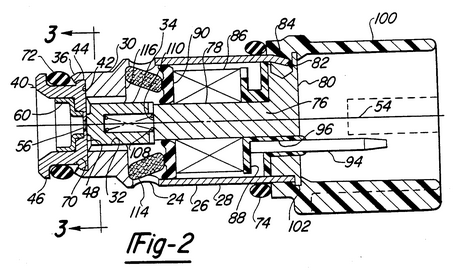
The Examiner maintained the rejection in a Final Office Action, relying on reference number 96 in FIG. 2 of the primary reference, Casey.

The Examiner then explained that while the text of Casey referred to 96 as  "mating aperture" rather than as a projection, "the numeral and line call-out are pointing out the projecting part of bobbin 88."

The Applicant argued in an After Final Response that the reference did not disclose that the projecting part of bobbin 88 was "selectively deformable."

The Examiner provided additional information in an Advisory Action, noting the cross-hatching pattern shown in Casey's FIG. 2 and indicating that this pattern is for "a synthetic resin or plastic." The Advisory Action same cross-hatching was used for number 100, described in Casey as an "electrical connector housing" made of "a structural plastic such as glass filled nylon."  The Action thus concluded that "such plastic is known to be selectively deformable."

The Applicant appealed, and maintained that Casey did not teach a "selectively deformable projection." The Applicant characterized Examiner's statement about inherent properties of structural plastic as "speculation and conjecture" since "there is no evidence in the present record that a structural plastic such as glass filled nylon is or may be selectively deformable." Turning to the cross-hatching in Casey's FIG. 2, the Applicant noted that the MPEP did not actually require particular cross-hatching patterns, but only indicated that Applicants should use these patterns, and also indicated that "use and clarity [of patterns] must be decided on a case-by-case basis." Thus, Casey's cross-hatching was not sufficient evidence that the projection was necessarily made of a structural plastic.

The Examiner's Answer elaborated once again on the cross-hatching issue, noting that the illustration of projection 27 in Applicant's FIG. 3 used the very same cross-hatching pattern as used in Casey, which in turn was the pattern for synthetic resin or plastic shown in MPEP 608.02. The Examiner also asserted that "synthetic resin and/or plastic are know for their inherently present deformation properties." Finally, the Answer included a statement that seemed to involve claim construction: "The Examiner would like to point out that any physical object is inherently selectively deformable to a degree."

The Applicant filed a Reply Brief and argued the above statements from the Answer were merely "conclusory allegations of inherency," where the law of inherency required "a basis in technical fact and/or technical reasoning."

The Board affirmed the rejection. The Board first interpreted the term at issue. Using dictionary definitions of the two adjectives, the Board found that “ 'a selectively deformable projection' is a projection that can have its form spoiled due to a highly specific activity or effect." (Emphasis in original.) Applying this interpretation to Casey's teachings, the Board found as follows:
The portion of bobbin 88 which forms aperture 96 juts out from the main body of bobbin 88 as shown in Figure 2, thus constituting a projection as required by claim 18. This projection can have its form spoiled due to a highly specific activity or effect such as when the jutting portion of bobbin 88 passes with electrical terminals 94 through apertures 96 provided in the radial flange 80 or when the terminals 94 are mated with a power source for the solenoid coil 86. See Casey, col. 4. Ll. 51-55. Accordingly, Casey describes “a selectively deformable projection” as broadly claimed.
The Board also commented on the cross-hatching issue as follows:
Appellant contends that the cross hatching symbol used for aperture 96 is not necessarily synthetic resin or plastic because such symbols are not required by MPEP § 608.02. This argument concedes that Casey’s aperture 96 is indicated to be synthetic resin or plastic, and the fact that such marking is not mandated does not demonstrate that this marking is in error. Further, consistent with the indication that it is synthetic rubber or plastic, aperture 96 is formed by pair of bosses 98 that circumscribe and electrically isolate electrical terminals 94. Casey, col. 4, ll. 55-58; fig. 7.
My two cents: The Examiner relied solely on cross-hatching and inherent properties of plastic. The Board, however, relied on teachings in Casey about the projection passing through the aperture. So I say the Board made a new ground of rejection without designating it as such.

Did the Board read too much into Casey? Maybe the protrusion deformed as it passed through the aperture. But maybe the aperture was sized just slightly larger than the protrusion, so that deformation of the protrusion wasn't needed. Absent a teaching that

The original rejection relied on aperture 96 as the "projection." The Examiner later clarified by essentially saying "Casey may say 96 is an aperture, but it clearly points to a projection." And though I didn't mention this in my discussion of the prosecution history, the Applicant and the Examiner actually went back and forth on this point several more times. This is silly because Casey actually names the relied-upon structure "boss 98."
 The electrical terminals 94 are electrically insulated from the stator's radial flange by a pair of bosses 98 circumscribing the electrical terminals. These bosses 98 are formed integral with the spool 92 and extend through the apertures 96 of the radial flange. Alternatively, the solenoid coil 86 may be wound on a separate spool as is commonly done in the art. 
Why didn't the Examiner modify his rejection to rely on this more specific teaching instead of confusingly referring to aperture 96? And when he didn't, why did the Applicant keep harping on an irrelevant point? I think sometimes Applicants just like pointing out Examiner errors, even ones that don't directly advance their case.

One final nitpick. The Board said the Applicant conceded that Casey indicated the aperture/projection was plastic. I disagree: all the Applicant conceded was that Casey used cross-hatching. The Applicant in fact argued (several times) that a POSITA wouldn't necessarily understand cross-hatching to mean plastic.

Tuesday, November 19, 2013

Board holds inherency does not require that all embodiments necessarily have claimed feature

Takeaway:  The Applicant appealed claims to an absorbent belted article (e.g., a diaper). The claims recited a belt attached to an absorbent structure by a joint, and also included functional limitations describing the release strength of the joint. The Examiner's anticipation rejection relied on the claimed release strength being inherent in the joint disclosed in the reference. The Applicant argued that inherency was improper here, because the reference taught that the joint could be formed by "any means known in the art", and not every known joint structure would necessarily meet the release strength limitation. The Board found that several types of joints specifically disclosed in the reference were identical to the types of joints in the Applicant's spec, so the Examiner's presumption of inherency was proper. Since the Applicant didn't rebut this presumption, the Board affirmed the inherency rejection. (Ex parte Almberg, PTAB 2012.)

Details:

Ex parte Almberg
Appeal 2010005008; Appl. No. 10/684,585; Tech. Center 3700
Decided:  March 23, 2012

The application on appeal was directed to a belted absorbent article. A representative claim read:
     A belted absorbent article comprising:
     an absorbent structure ... and
     a pair of opposed belt halves comprising nonwoven material attached to said absorbent structure at said rear end region of said rear panel,
     each of said belt halves being attached by a respective joint ...
     wherein each of said joints between each said belt half and said absorbent structure is such that when each said belt half is subjected to a tension force of 35 N acting along said longitudinal axis of the belt, and said longitudinal axis of the belt creates an angle (a) to said transverse axis of said absorbent structure, the following minimum average release times (t) of each said belt half from said absorbent structure are attained:
     when a = 10°, t >= 720 seconds; when a = 20°, t >= 330 seconds; when a = 25°, t >= 240 seconds; when a = 30°, t >= 180 seconds; and when a = 40°, t >= 75 seconds.
The Examiner rejected the claim as being anticipated by Ames. The Examiner found that Ames explicitly disclosed all the elements but the claimed release times. However, the Examiner found that Ames inherently disclosed the release properties, because the structure of the belt joint in Ames was the same as the belt joint structure disclosed in Applicant's specification.

In the Appeal Brief, the Applicant argued that Ames' broad teaching about the belt joint was not enough for inherency:
Ames does not disclose any specific structure for joining the belt flaps to the rear of the absorbent article.  The entire disclosure related thereto, as set forth at col. 17, lines 51-53, is that if the belt flaps 62 and 64 are separate elements joined to the diaper 20, they can be joined "by any means as known in the art." In order to rely on the theory of inherency, it must be shown that the recited conditions must be met in each and every instance.  MPEP, section 2112, IV.  Clearly, it must be recognized that all "means as known in the art" will not necessarily satisfy the requirements of the means for joining recited in claim 1. Accordingly, the claimed joint cannot be inherent based on Ames.
(Emphasis in original.)
In the Answer, the Examiner referred to Applicant's disclosure of "materials and structure suitable for forming the belt halves and attaching the belt" and then referred to portions of Ames that "teach similar materials and structures for the belt halves."  More specifically, the Examiner found that:
The belt halves of Ames have the same properties (elasticity, attached along the longitudinal axis, extending outwardly from a longitudinal edge) and is used in the same environment as appellant's outer cover (a belt in an absorbent product).
Because of this similarity in structure, the Examiner concluded that "Ames obviously includes belt halves capable of providing the claimed release times" because inherency case law holds that "when the structure recited in the reference is substantially identical to that of the claims of the instant invention, claimed properties or functions are presumed to be inherent."

In the Response to Arguments section, the Examiner elaborated on his inherency position as follows:
[T]he Examiner has provided technical reasoning which supports the position of inherency. The present application is primarily directed to the joints between the belt halves and the absorbent structure. The application claims when subjected to a certain force, the longitudinal axis of the belt creates an angle, and a certain release time is attained. Ames does in fact cite structure and materials similar to the claimed invention. ...
(Emphasis added, internal citation omitted.)
The Applicant filed a Reply Brief asserting that the Examiner's "technical reasoning" for inherency was insufficient:
The Examiner's allegation [that Ames discloses structures similar to the claimed invention], even if true, does not provide any factual or technical basis for holding that the materials and methods of Ames must necessarily result in the functional properties of the structure that are recited in the present claims.  The Examiner has provided no basis to refute the plain truth that similar materials may be assembled so as to provide a wide range of attributes.
(Emphasis added.)
The Applicant elaborated on this last point, explaining that Ames' failure to provide details about the belt joints undermined an inherency finding:
Ames did not disclose any teaching of a particular manner in which the belts are to be joined to the diaper.  Ames did not disclose any functional properties of the joint.  Consequently, there is no basis to conclude that the functional structural requirements of the present claims are inherent in the disclosure of Ames unless every means of attachment known in the art necessarily produces the required structural properties.  However, such cannot be the case. The conventional materials and methods encompassed by the Ames disclosure could produce very different results depending on the particulars of how the materials were joined.(Emphasis added.)
The Board was not persuaded by the Applicant's arguments, and instead found that the Examiner's reasoning as to inherency had shifted the burden the to Applicant to show that the belt joint in Ames would not necessarily last for the claimed release times.

The Board found that the Applicant's specification described the joint between the belt half and the absorbent structure as using "adhesive bond lines, though any attachment methods, such as thermal or ultrasonic bonding, may be employed."

The Board also found that the portion of Ames relied on by the Examiner disclosed that:
[belt flaps 62 and 64] can be joined [to the diaper 20] by any means as known in the art. Examples of suitable attachment means include adhesive bonding, heat bonding, pressure bonding, ultrasonic bonding, dynamic mechanical bonding or a combination of any of these means or any other means as are known in the art.
The Board noted that "there is no dispute that these two joining methods are the same as Ames' heat bonding and ultrasonic bonding", and framed the issue as follows:
Thus, the question is whether the evidence is sufficient to find that Ames' heat bonded joints or ultrasonic bonded joints would necessarily last, on average, for at least 12 minutes if a 7.8 pound force was applied to the joint at an angle of 10°, etc.
The Board decided that the Examiner had the better argument.
The opposite finding would mean that, on average, prior art diaper joints made by the same heat bonding or ultrasonic bonding method failed in less than 12 minutes, etc. The bald argument that prior art diaper joints generally failed in less than 12 minutes is not credible. Under these circumstances, the rejection's evidence is sufficient to shift the burden to Appellants to prove the contrary. See e.g. Best, 562 F.2d at 1255.
My two cents:  The issue here was a functional limitation (having to do with force needed to release a joint), and whether the joint structure disclosed in the reference inherently met that functional limitation. According to the Applicant, inherency is present only when "each and every instance" of the disclosed structure meets the functional limitation. The Applicant argued that this wasn't the case, since the reference stated that the joint could be formed by "any means known in the art," and not every known joint structure would necessarily meet the release strength limitation.

I was intrigued by the Applicant's line of reasoning, because I have never run across this "each and every instance" requirement for inherency. As far as I can tell, the Applicant was mistaken.

The Applicant did not cite to specific cases. The Applicant cited to an MPEP section on inherency (2112.IV), but I didn't see anything there about "each and every instance." And the Board didn't comment on this specific point, but applied plain vanilla inherency law. The joint structures mentioned in the reference – ones formed by adhesive bond lines, thermal bonding, or ultrasonic bonding – were the same ones that Applicant's spec described as providing the claimed release strength limitation. Because the structures were substantially identical, the release strength limitation was presumed to be inherent in the structures. The Applicant did not rebut this presumption, so the Board found the Examiner's anticipation-by-inherency argument to be persuasive. 

Wednesday, April 10, 2013

Board reverses anticipation rejection which relied on secondary reference incorporated into Background of primary reference

Takeaway: The Applicant appealed an anticipation rejection. The Examiner relied not only on the anticipatory reference, but also on an issued patent incorporated into the anticipatory reference. The incorporated reference was discussed in the Background section of the anticipatory reference, rather than in the Detailed Description. The Board reversed on the grounds that the Examiner's reliance on the incorporated reference was improper under these facts. "The Examiner has not provided a link between Martin’s embodiments and Table I in Beaverstock.Nor do we see such a link in Martin. Rather, the Examiner has simply selected various disparate features from the references in arriving at the claimed invention which is improper under § 102." (Ex parte Laub, PTAB 2009.) 

Details:
Ex parte Laub
Appeal 2009004880; Appl. No. 10/869,070; Tech. Center 2100
Decided  December 18, 2009

The application was directed to an online transactional processing (OLTP) system for a production line that makes a product. A representative claim on appeal read:
     13.  A method of calculating a value of work in progress on the basis of reporting data received from a set of reporting points of work centers of a production line for producing a product, the production line being logically divided into shop areas,  one reporting point of each shop area being an exit point corresponding to an intermediate production step, the method comprising the steps of:
...     generating a first table comprising aggregated quantities of intermediate products and aggregated scrap quantities reported from the exit points on the basis of the reporting data stored in the database;
     ... and
     calculating a total value of work in progress by means of the first and second tables by the server computer.
In a first Office Action, the Examiner rejected independent claim 13 as anticipated by Martin, which described real-time accounting of plant performance at a sub-plant level. In particular, the Examiner relied on the following two sentences in Martin for the "generating a first table" step.
The plant can also purchase electricity from a local utility and can sell excess electricity to the utility ... For the purposes of this example, it is assumed that the power plan consists of two boilers and a generator. Steam from the two boilers is used both to drive the generator, which in turn, provides electricity to the plant, and to provide steam directly to a number of process units in the plant."
The Applicant argued the "generating" limitation was not taught by Martin as alleged. More specifically, the Applicant argued that the Martin's statements that a power plant uses boilers and a generator did not teach generating a table, and did not teach aggregated quantities as reported from exit points, as recited in claim 1.

In the next (final) Office Action, the Examiner changed the rejection of claim 13 to anticipation by Martin "with incorporated reference Beaverstock." The rejection mapped the "generating" step to Beaverstock's Table 1, a block of code showing calculations from variables.

The Applicant filed an After Final Response. Applicant noted that Beaverstock taught an incurred resource cost that was calculated from the variables catalyst usage, energy cost, and materials cost, and that the calculation was implemented by six functions implemented by code in Table 1. The Applicant argued that these did not correspond to aggregated quantities as reported from exit points, as recited in claim 1. An Advisory Action did not comment on the Applicant's arguments on claim 13.

On appeal, the Applicant repeated the same arguments in the Appeal Brief. In the Answer, the Examiner further explained which variable in the code block corresponded to the claimed aggregate scrap quantity.

The Board reversed on the grounds that the Examiner had combined the unrelated teachings of Martin and Beaverstock in a manner not permitted in an anticipation rejection. Beaverstock was discussed in Martin's Background, and was therefore a distinct disclosure not directly related to the portions of Martin relied on for the other claimed elements.
The Examiner has not provided a link between Martin’s embodiments and Table I in Beaverstock. Nor do we see such a link in Martin. Rather, the Examiner has simply selected various disparate features from the references in arriving at the claimed invention which is improper under § 102. See Net MoneyIn, 545 F.3d at 1369; see also Arkley, 455 F.2d at 587.

My two cents: There are a few scenarios in which it's proper for the Examiner to use multiple references in an anticipation rejection -- see MPEP 2131.01 for a list. But these scenarios are pretty limited, so be ready to challenge if the Examiner steps outside of these bounds.

The Applicant got a lucky break here, since the Applicant did not argue the particular issue which the Board used to reverse the rejection.

Thursday, January 3, 2013

Board reverses anticipation based on inherency when Applicant provides counterexamples

Takeaway: An Applicant appealed claims to a user interface and argued the limitation "determining a distance between the focus of attention and the display event." The Examiner relied on a drawing in an Excel user manual showing "tracer arrows," in conjunction with an inherency argument. Though the Examiner went to some effort to explain how one could draw inferences about what Excel was doing from the screen shot, the Applicant used counterexamples to demonstrate that Excel wasn't necessarily determining distance. (Ex parte Mackinlay, PTAB 2012.)
Details:
Ex parte Mackinlay
Serial No.  10/687,486; Tech Center 2100
Decided:  June 18, 2012

The claims were directed to aspects of a user interface. A representative claim on appeal read:
     1. A method of shifting attention comprising the steps of:
     determining the location for a focus of attention;
     determining a display event;
     determining the location of the display event;
     determining an attention shifting display element based on the display event, the determined location of the display event and the focus of attention; and
     determining a distance between the focus of attention and the display event;
     wherein the attention shifting display element is determined based on the determined distance, such that different types of attention shifting display elements are determined for different distances. 
(Emphasis added.)

The Examiner rejected the independent claim as anticipated by the printed publication "User's Guide Microsoft Excel, Version 5.0 1993" (Excel). The Examiner read the "determining an attention shifting element" on Excel's "tracer arrows to show the flow of data into a formula, based on the starting active cell within a worksheet, and the users choice of tracing precedents or dependents." The Examiner asserted that FIG. 4 of Excel taught "determining the distance 'length of the tracer arrow', from beginning active cell to the point of the arrow."


The Examiner elaborated on his reasoning in an Advisory Action:
Excel teaches a tracer arrow starting in one cell and ending in another cell, which is acknowledge by the Applicant. One of skilled art has to infer that some sort of calculations of the "length of the tracer arrow" has to be taken into consideration by the system in order to draw the arrow accordingly. Knowing the relative number of pixels between the two cells, as the Applicant states, provides measurements to the system for calculating how long to create the tracer arrow to achieve the goal of the arrow starting in one cell and ending in another.

On appeal, the Applicant argued the "determining a distance" limitation. The Applicant first explained that the reference did not explicitly teach the limitation:
The applied reference makes no indication or reference to the length of the tracer arrow, but instead discloses tracers that "track data flow by drawing arrows connecting the active cell with related cells on your worksheet. Tracer arrows point in the direction of data flow." See page 668, section "About Tracer Arrows" from Excel. Thus, Excel merely discloses that a trace arrow will originate in one cell and terminate in another cell.

The Applicant then attacked the Examiner's inherency argument by explaining how Excel could draw the tracer arrows without using distance:
[T]he graphic generating software used by Excel need only know the relative pixel coordinates between the two cells, not the distance. The arrow can then be drawn by many methods not requiring a calculation or determination of distance, for example determining the slope of the trace arrow and subsequently generating the trace arrow graphic starting at one cell and using the slope and horizontal range. In this example[,] no distance is calculated.

In the Answer, The Examiner elaborated on his inherency argument
     In order for Excel to automatically draw the "tracer" lines and arrows, the software application makes at least three determinations: 1) the location of the "active" cell; 2) the location of each "related" cell; and 3) the direction of the flow of data between the "active" cell and the "related" cells.
     Because Excel automatically makes these determinations and then automatically draws the "tracer" lines and arrows between the "active" cell and the "related" cells, Excel discloses determining a distance between the ''focus of attention" (i.e., the active cell) and the "display event" (i.e., the drawing of the "tracer" lines and arrows between the "active" cell and the "related" cells).

The Board agreed with the Applicant, finding that the reference did not disclose the feature at issue. With regard to inherency, the Board explained:
As pointed out by Appellants, there are at least two alternative ways to connect cells in a spreadsheet with tracer arrows, such as by connecting the respective cell coordinates, or by using a slope and horizontal range. In both alternatives proffered by Appellants (App. Br. 12-13), we agree that no distance determination is necessary.

The Board then reversed the anticipation rejection.

My two cents: A good example of the best way to beat an inherency argument: prove that the feature at issue is not actually required by demonstrating an alternative. The next time you make an inherency argument, spend a few minutes and see if you can come up with a counterexample. Your argument will be much more persuasive.

I do have one nitpick with the decision, in that I don't read the Applicant's inherency argument as offering two alternatives. Yes, the slope/range discussion is clearly one counter-example. But I'm not sure what the Board is referring to by "connecting respective cell coordinates". That sounds to me like the Applicant's characterization of the reference's explicit teachings. But hey, you only need one counterexample to win on inherency.


Wednesday, September 19, 2012

BPAI affirms anticipation based on reasoning that performing action on whole implies peforming action on all parts

Takeaway: In a reexamination appeal, the BPAI considered the Patentee's arguments that a reference did not disclose "monitoring the operating system for an event". The Board first found that the reference taught monitoring a computer system for an event and also taught that the computer system included an operating system. The Board then affirmed the rejection since "Appellant does not sufficiently demonstrate any differences between ... continuously monitoring the computer system (including the operating system contained therein) for an event ... and the claimed feature of monitoring the operating system for an event. Nor do we identify any differences since in both cases, a computer system and operating system of the computer system are being monitored for an event." The Board's reasoning thus appeared to be that since the whole (computer system) was monitored, any included component (operating system) was also monitored.

Details:

Ex parte Finjan, Inc.
Appeal 2011003035; Reexam 90/008,684; Tech. Center 3900
Decided  June 6, 2011

The patent under ex parte reexamination involved virus protection software. A representative independent claim read:
1. A computer-based method, comprising:
     monitoring the operating system during runtime for an event caused from a request made by a Downloadable;
     interrupting processing of the request;
     comparing information pertaining to the Downloadable against a predetermined security policy; and
     performing a predetermined responsive action based on the comparison, the predetermined responsive action including storing results of the comparison in an event log.
(Emphasis added.)

During the reexam, the Examiner rejected claim 1 as anticipated by a non-patent reference (Rx PC - The Anti-Virus Handbook) which described a software package ("Virex PC") containing two anti-virus programs, VPCScan and VirexPro. The Patentee responded by arguing that several of the claim elements were not taught by the reference – and submitted declaration evidence to supplement these arguments.

One of the elements argued on appeal by the Patentee was the "monitoring" element. The Patentee argued in the Appeal Brief that Virex monitored a user-selected target file rather than the operating system. More specifically, the Patentee argued that Virex "sat in front of" a user-selected target file to intercept all requests associated with this file – regardless of which executable made the request. The Patentee contrasted this with claim 1, which described "monitoring all requests from Downloadable [files] to the operating system, not just requests to particular files." (Emphasis in original.) The Patentee then referred to the expert declaration to provide more technical detail about the workings of Virex:
In order to monitor the operating system for events caused by requests from Downloadables as required by the claims, requests to both selected and non-selected files and file types must be monitored. Per the expert affidavit of Dr. Giovanni Vigna (Paragraph 4), file-based Virex and VirexPRO did not and could not monitor an entire operating system for a requested action or resulting event from a requesting file or program (hereafter "virus file"), the Virex programs could only monitor actions to be taken on pre-determined target files. More particularly, the Virex programs hijack the response routine of specific software interrupts. By doing this, they are able to monitor only a subset of the operations that can be performed by a program (that is, those that are associated with the software interrupt), and, as a result, they are not capable of monitoring the operating system in a comprehensive fashion.

In the Answer, the Examiner responded to the Patentee's arguments. In response to the Patentee's assertion that Virex did not monitor the operating system, the Examiner cited to teachings in the Handbook that Virex monitored requests for disk formatting and requests for disk reads and write. According to the Examiner, "detecting these activities requires that Virex monitor subsystems of the operating system such as the file system, memory system, network system, and run-time execution system." In response to the Patentee's assertion that Virex monitored only user-selected files, the Examiner clarified that the rejection relied on teachings about installation. The Examiner explained that Virex's installation options allowed the user to select all files (via a wildcard ). With this option chosen, Virex would then monitor all files, i.e. "an entire operating system", at runtime.

The Patentee filed a Reply Brief to rebut points in the Examiner's Answer. According to the Patentee, "protecting every file on the computer is not the same as monitoring the operating system." Having the user "manually select every file or extension" is "incredibly inefficient and substantively different from monitoring the operating system" since "if any new files or extensions are added to the computer then the user would need to manually select those files."The Patentee then characterized user selection of every file on the computer as "a construction of the Examiner" that is "not mentioned in [the Handbook]." As for the Examiner's reliance on the teachings about disk formatting and disk reads/writes, "the 'features' are never described in any detail and [the Handbook] does not disclose anything about how these features are performed."

The Board affirmed the anticipation rejection. With regard to the Patentee's "monitoring" argument, the Board referred to the Handbook in making these findings of fact: Virex continuously monitored a computer system which included an operating system; and Virex created an alert when an attempt was made to perform tasks such as executing a program. The Board then drew the following conclusion:
Since [Virex] continuously monitors a computer system that includes an operating system for an “event” (e.g., an attempt to run a program or an attempt to terminate and stay resident – the attempt being a “request” for an event), we agree with the Examiner that Endrijonas discloses monitoring the operating system of the computer system for the event as recited in claim 1.

The Board explained why the Patentee's arguments were unpersuasive:
Appellant does not sufficiently demonstrate any differences between the [Virex program] continuously monitoring the computer system (including the operating system contained therein) for an event (e.g., an attempt to run a program or an attempt to terminate and stay resident) and the claimed feature of monitoring the operating system for an event. Nor do we identify any differences since in both cases, a computer system and operating system of the computer system are being monitored for an event.

Postscript: The Patentee appealed to the Federal Circuit. But the appeal involved another issue (whether or not the Virus Handbook was an enabling reference) so that Fed. Cir. stayed the appeal pending decision on another case on the presumption of enablement for non-patent references, In re Antor Media. Antor was decided in Aug. 2012, but no decision has been issued yet in In re Finjan.

My two cents: Right result. Bad reasoning.

The Board's simplistic reasoning was based on the unsupportable premise that performing an action on a whole implies performing the action on the components of the whole. Probably true in some contexts, but it's hardly a general truth. Does "painting a house" mean painting: 1) the exterior; 2) the exterior and the interior; 3) exterior, interior, and contents of the house; 4) exterior including the window panes and shingles on the roof? Generally, we mean #1. Maybe #2. #3 and #4 are unlikely choices.

In this case, "monitoring a computer system" might mean monitoring only the hardware components, or might mean monitoring only the software application components, or might mean monitoring only the operating system. I'm inclined to say that the Virus Handbook was talking about monitoring the operating system, since the entity that provides services for detecting actions like file access and program execution is usually referred to as an "operating system." But my point is that I reached that conclusion from the specific teachings of the reference, as understood by a POSITA –not from a premise that actions on a system applying to all components of the system.

Thursday, July 12, 2012

BPAI reverses anticipation rejection using trademark registration to support inherency theory

Takeaway: During a reexamination appeal, the BPAI reversed an anticipation rejection involving a trademark registration. The rejection was based on a print advertisement for a product in conjunction with the trademark registration for that product. The trademark registration listed four goods, only one of which corresponded to the claim limitation at issue ("wire glass"). The Board found that since the registration listed goods other than the claimed variety of glass, the trademark in the ad was not evidence that the publication necessarily described the claim limitation at issue. Therefore, the Board reversed the anticipation rejection. (Anemostat Products v. O'Keefe's, Inc., BPAI 2011.)

Details:

Anemostat v. O'Keefe's, Inc.
Appeal 2011005771
Reexamination Control Nos. 95/001,010, 95/001,020 & 90/010,016
Patent US 7,090,906 B2
Technology Center 3900
Decided  September 29, 2011

A patentee with an independent claim to a "fire resistant safety glass" appealed a § 102(b) rejection in a reexamination. The limitation at issue was "a piece of wire glass."

The publication used in the rejection was a print advertisement in a magazine. The ad identified the product as FireLite NT, and described the product as "an impact safety/fire-rated window glazing material. Product is made with abrasion-resistant 3M® Scotchshield® Ultra Film." Since the ad did not include the "wire glass" limitation, the Examiner relied on an inherency theory, based on a US trademark registration for FireLite NT. Specifically, the Examiner relied on the description of goods in the trademark registration, listed as "fire-rated and impact safety-rated glazing material for building windows, doors and partitions; namely sheet glass, wire glass, laminated glass, and multiple glass."

The Board reversed the Firelite NT rejection, finding that the trademark's description of goods was not enough to show that the advertised product necessarily included "a piece of wire glass" as claimed.  While the trademark showed that the product was used for one of four different glass products (sheet glass, wire glass, laminated glass, and multiple glass), it did not show that the product mentioned in the ad was wire glass rather than one of other three varieties of glass. The Board then cited In re Robertson for the proposition that "[i]nherency is not established by probabilities or possibilities. (In re Robertson, 169 F.3d 743, 745, (Fed. Cir. 1999)).

My two cents: I thought this was worth blogging about because it's unusual to find a trademark registration used in a rejection. (Although all kinds of unusual prior art shows up in reexamination).

Nothing wrong, in theory, with a rejection based on a trademark registration. In fact, this would have been a slam dunk rejection had the only good listed been the claimed "wire glass."

More interesting question: could the Examiner/requester have turned this into an obviousness rejection? With the ad being a primary reference used to teach a generic limitation "fire-rated and impact safety-rated glazing material" and the registration used to one show that the specific limitation "wire glass" was one of merely four options for the type of glass?

Wednesday, April 18, 2012

BPAI reverses anticipation when Examiner relies on multiple embodiments

Takeaway: The Applicant appealed an anticipation rejection, arguing that the figures relied on by the Examiner described two separate embodiments. The Examiner took the position that since the reference did not explicitly state that the two embodiments were separate and "non-combinable", "they are treated as a single embodiment." The Board agreed with the Applicant summarily reversed, noting that "Joy’s silence as to how the processor operates with the multithreaded cache can only show what Joy fails to describe or teach, as opposed to an inference of what it does." (Ex parte Lee, BPAI 2012.)

Details:
Ex parte Lee
Appeal 2011008999; Appl. No. 10/453,226; Tech. Center. 2100
Decided  March 21, 2012

The application was directed to microprocessor architecture. A representative claim on appeal read:
1. A cache system for a multithreaded processor having a single processing core and a plurality of active threads, the cache system comprising:
   a first thread micro-cache directly coupled to the single processing core; and
   a second thread micro-cache directly coupled to the single processing core,
   wherein the first thread micro-cache is assigned a first active thread and the second thread micro-cache is assigned a second active thread.

The Examiner rejected the independent claims as anticipated by Joy. The Examiner relied on a processor in FIG. 3 of Joy as teaching the multithreaded processor having a single processing core. The Examiner relied on FIG. 7A of Joy as teaching the claimed micro-caches and the claimed thread assignments.

In an After Final Response, the Applicant that the Examiner had improperly used two different embodiments from Joy in making an anticipation rejection. In an Advisory Action, the Examiner took the position that "[Slince there is no clear mentioning in the Joy reference that Fig. 3 and Fig. 7 are separate non-combinable
embodiments, they are treated as the same embodiment."

The Applicant appealed, arguing once again that the anticipation rejection improperly relied on multiple embodiments:
It is improper to assume that Joy or any other reference teaches something merely because the reference does not state that such a feature is not included. In order for a reference to anticipate or render obvious the limitations of a claim the reference must explicitly or implicitly teach or suggest the feature. ...  The processor configuration of Figure 3 and the cache 700 of Figure 7A are not directed to a single embodiment, as the Examiner states on page 16 of the final Office Action and in the Advisory Action.

The Applicant then referred to several sections of the Joy reference and explained how these sections related to different embodiments.

In the Answer, the Examiner repeated his earlier statement that "since there is no clear mentioning in the Joy  reference that Fig. 3 and Fig. 7 are separate non-combinable embodiments, they are treated as the same
embodiment."

The Board reversed the anticipation rejection with little discussion, merely noting that "we find Joy’s silence as to how the processor operates with the multithreaded cache can only show what Joy fails to describe or teach, as opposed to an inference of what it does."

My two cents: A good reminder to take a close look at anticipation rejections to see if multiple embodiments are involved. Unlike a lot of cases that take several rounds for the real issue to develop, the flaw in the rejection was apparent early in prosecution. I suspect the Examiner's Answer conference let this one go to appeal only because this was not the only prior art rejection of the independent claims. Still, the Examiner looks bad by taking such an untenable position and refusing to let go.

I have another post here that summarizes a few cases about multiple embodiments in the context of anticipation. You can also view today's case Ex parte Lee as a "silence in a reference" case. I've blogged about this general topic several times-- you can find those posts by picking "silence in a reference" from the Labels list on the right side of the blog.

Wednesday, August 24, 2011

BPAI reverses § 102(b) rejection because reference did not show sale or use in United States

Takeaway: The BPAI reversed an anticipation rejection under the "use or sale" prong of § 102(b) because neither the press release nor the related online article established use or sale of the game controller in the US.  The fact that the press release stated that the game controller could be used with game titles that were available in the US did not establish that the controller was actually used in the US. (Ex parte Kislevitz, BPAI 2011.)

Details:
Ex parte Kislevitz
Appeal 2009009637; Appl. No. 10/770,344; Tech. Center 3700
Decided  January 18, 2011

The sole independent claim on appeal read:
1. A hand-held controller configured to control an operation of an amusement device,
   the controller comprising a multi-part housing including at least a left-hand grip portion and a righthand grip portion,
   wherein the left-hand grip portion and the right-hand grip portion are substantially the same size and are pivotable with respect to each other to control the operation of the amusement device.

On appeal, the independent claim stood rejected as anticipated under § 102(b) by a press release describing a game controller called the NeGcon. The press release read, in its entirety:
NeGcon Goes Black:
The NeGcon, Namco's analog controller, will be rereleased in a brand-new color.
By Yutaka Ohbuchi, GameSpot / Posted Mar 6, 1998 4: 19 pm PT
      On April 29, Namco will rerelease its NeGcon analog controller,which is used for racing titles like Rage Racer, Wipeout XL, and Ace Combat. It has the same features as the previous version, but it is smaller in size than the original and has a lower price (2,980 yen compared with the older 4,980-yen price tag). It's currently not know whether this new NeGcon color will be released in the US.

The same anticipation rejection also relied on an online publication, the Twist article, as "evidence" of various features included in the NeGcon.

In the Appeal Brief, the Applicant first argued that the press release was not prior art under the § 102(b) public use or sale prong, since the press release referred to Japan rather than the US. The Applicant then argued that even if the press release was treated as prior art under the printed publication prong, the press release did not disclose any of the claimed elements, since the only feature mentioned was the color. The Applicant further argued that the Twist article did not establish use or sale in the US because the article did not identify the location of the toy store where the author found a NeGcon controller in 1996.

In the Answer, the Examiner clarified that "the first [press release] reference was used to establish the simple fact the reference was released prior to the filing" and that "the second reference was provided to establish the structure and features of the controller." The Examiner then replied to points raised in the Appeal Brief:
However the applicant refuses to agree the article is evidence of the original NeGcon was in public use or sale in the United States. The Examiner is amazed by this argument when the article clearly states the controller is used for racing titles such as Rage Racer, Wipeout XL & Ace Combat which are video games that were on sale & in the public at the time.
...
The picture below was disclosed by the second reference [(Twist article)] and clearly demonstrates the twisting or pivotable motion with respect to the left and right portion that the NeGcon is capable of performing. However the applicant refuses to believe the reference since the blogger posted the article after the applicant's filling date. Furthermore, the applicant refuses to believe the picture below is the original NeGcon the first reference mentions, even though the controllers labels: Namco, NeGcon and PlayStation are clearly visible in the picture.

The Applicant filed a Reply Brief to respond to various points in the Examiner's Answer:
   The Examiner relies on the identification of certain video games (Rage Racer, WipeOutXL, and Ace Combat) in the GameSpot article as proof the NeGcon controller was also on sale in the U.S. But the Examiner conveniently ignores the fact that NONE of these games REQUIRED the use of a Namco NeGcon controller (or that he has failed to even prove the games themselves to have been on sale or in public use in the U.S. before the critical date). ...
   Applicants have not argued that the controllers shown in the various pictures [in the Twist article] are in some way mislabeled. What applicants argue is regardless of what is shown, the article does not prove that a Namco NeGcon controller was on sale or in public use in the United States prior to the February 2, 2003, 102(b) bar date. The article is dated 2007. The identity and location of author and those of the "local toy store" referred to in the Twist article are not identified and are simply unknown.

The Applicant then concluded the Reply Brief argument as follows:
The mere fact that people today in the United States are familiar with certain items is not proof that any of those items were on sale or in use in the United States before a specific date. The mere fact that some items might have been available or in use in the United States before the specific date is not proof that another article that might be optionally used with such item(s) was also on sale or in public use in the United States before that specific date. Finally, the mere fact that something is described in English on the internet is not proof that whatever is being described is occurring or has occurred or exists or has existed in the United States.

The Board reversed the anticipation rejection, finding that neither the press release nor the Twist article showed public use or sale in the US. With regard to the press release reference, the Board noted that the press release did not explicitly refer to sale in the US, and that a price expressed in yen suggests that the controller was expected to go on sale in Japan. Furthermore, mentioning that "the controller may be used for certain enumerated racing titles does not establish such use was within the United States." The Board further found that "while the [Twist reference] states that the author (unnamed) found a controller 'at a local toy store' in 1996, nothing in the reference establishes the location of that toy store as being within the United States."

My two cents: Looks to me like the Examiner got a little too fancy here with his rejection, without properly understanding the use/sale prong. Perhaps the Examiner was simply unfamiliar with the fine points of the use/sale rejection because they're relatively rare in prosecution. I don't see many of them on appeal. And those that I do see tend to be in reexamination, which is handled by a special reexam art unit.

I thought the Applicant did a great job in arguing, and in responding to each of the Examiner's points. Maybe the Board would have reversed even without such compelling arguments, because the Examiner's arguments were weak. But why rely on the Board to find these weaknesses – point them out yourself.

I notice that the Board didn't comment on the propriety of the Examiner combining multiple references into a single § 102, with the "Twist" article being used as "evidence" of NeGcon features. I suppose the Board didn't need to reach this question, since even when considered together the two references didn't show use or sale in the US.


Sunday, July 31, 2011

BPAI reverses anticipation rejection for method of manufacturing a syringe "free of flash lines" based on drawing of finished syringe with no flash lines

Takeaway: In Ex parte Boucherie, the Applicant claimed a method of manufacturing a plunger for a medical syringe. A claim on appeal included the limitation "said piston body ... being formed such that the front side and side wall thereof are free of any flash lines and/or gate points for the plastic." The Examiner used an anticipatory reference that disclosed a syringe manufacturing process. The Examiner also found that the "formed free of flash lines" limitation was disclosed by a drawing of the final product, which did not show flash lines. The Board reversed the anticipation rejection, finding that "there are a number of reasons why the flash lines and gate point formed in the gasket during the Fig. 2(a)-(c) molding process might not be illustrated in the syringe shown in Fig. 1, though actually present in the final molded product."

Details:

Ex parte Boucherie
Appeal 2010002109; Appl. 10/530,351; Tech. Center 1700
Decided  May 2, 2011

The application on appeal related to a method for manufacturing plungers for medical syringes.
1. Method for manufacturing plungers for medical syringes,
     said plunger comprising at least two parts including a longitudinal plunger body made of plastic and a piston body provided at a front end of the plunger body,
    which piston body comprises a plastic which is softer than the plastic of the plunger body,
    wherein said plunger, or at least a part of the plunger, is formed by first manufacturing the piston body and then the plunger body, or at least a part of the plunger body, by means of injection moulding, and
    wherein the plunger body, or said part of the plunger body, is injected against the piston body,
    said piston body having a front side and a side wall and being formed such that the front side and side wall thereof are free of any flash lines and/or gate points for the plastic.
(Emphasis added.)

The term "flash lines," also known as flashing, refers to the excess bits of plastic produced by the molding process. As explained in the specification, this excess plastic is especially undesirable for a medical syringe, since the material "may come off and thus end up in the reservoir of the syringe, and thus also in the medical liquid to be injected."

The Examiner rejected the independent claims as being anticipated by various references. One of the references was a Japanese patent publication, Chiba, which disclosed a method of manufacturing a syringe. The Examiner asserted that manufactured syringe was shown in Fig. 1 of Chiba as having no flash lines or gate points and thus met the claim limitation highlighted above.

On the final rejection, the Applicant appealed and argued (inter alia) the claim limitation highlighted above. In the Appeal Brief, the Applicant distinguished Chiba as follows:
As can be seen in Figs. 2(a)-(c) of the Chiba publication, the front side and the sidewalls of the gasket 6 include a gate point for the thermoplastic elastomer and flash lines, respectively. For clarification, the flash lines are formed on the side wall of the gasket 6 along the split between the molds 21a, 21b. This is due to the fact that some of the thermoplastic elastomer material injected to form the gasket 6 will fill in the gaps defined by the split between the two mold parts 21a, 21b, no matter how small the gaps are.
In the annotated Fig. 2(c) below, the flash lines are drawn in red.

In the Answer, the Examiner explained that the manufactured product in Fig. 1 was relied on for teaching the contested limitation:
Figure 1 of Chiba clearly shows a gasket 6 (i.e. piston body) that is free from any flash lines and/or gate points for the plastic. Although Figures 2(a)-2(c) show a gasket 6 (i.e. piston body) having a gate point, this gate point is removed to the extent that the resulting gasket, shown in Figure 1, is free from any flash lines or gate points. Note that the claim does not require the piston to be free of  any flash lines and/or gate points as it exits the die, for example, but the claim only requires the piston being free from flash lines and/or gate points. It is therefore interpreted that as long as the final form of the molded gasket 6 (i.e. piston body) is free from flash lines and/or gate points, Chiba's gasket 6, as shown in Figure 1, meets the claimed limitation. The claim does not preclude a finishing step that would remove any flash lines or gate points resulting from the molding process.
(Emphasis added.)
The Applicant filed a Reply Brief to contest these findings. First, the Applicant repeated the explanation of how the manufacturing process discussed in the text of Chiba and illustrated in Figs. 2(a) - (c) of Chiba would produce flash lines and gate points. The Applicant then explained why it was inappropriate to rely on the final product shown in Chiba's Fig. 1 for the claimed process limitation:
While the flash lines and the gate point for the plastic may not actually appear to be shown in Fig. 1, this may be for a number of reasons that do not involve the steps according to the method as recited in claim 1. In particular, since the drawing of Fig. 1 is shown as a cross-sectional view, if the view is taken along any plane other than the plane that contains the flash lines, the flash lines would not appear in the drawing of Fig. 1. Alternatively, even if the cross-sectional view is taken along the plane that contains the flash lines, since there is a necessary compression of the gasket 6 at the interface between the gasket 6 and the walls 4a of the outer case 4 to ensure sealing therebetween, such flash lines would also be compressed, and not necessarily visible in the drawing of Fig. 1.

The Reply Brief also explained that while finishing steps in general were not excluded by the claim, those that eliminated flash lines and gate points were excluded, by the "formed free of" limitation:
While the examiner's answer is correct in that pending claim 1 does not preclude any finishing steps, such a finishing step to remove any flash lines and/or gate points for the plastic is unnecessary in the method of pending claim 1, which requires that the front wall and side wall of the piston body are formed free of any flash lines and/or gate points for the plastic at the injection molding step.
(Emphasis added.)

The Board agreed with the Applicant and reversed the Chiba anticipation rejection:
We are in agreement with Appellant that the Examiner’s findings are insufficient to establish that Chiba inherently performs a step to remove the flash lines and gate point created in the disclosed molding process. As explained by Appellant, there are a number of reasons why the flash lines and gate point formed in the gasket during the Fig. 2(a)-(c) molding process might not be illustrated in the syringe shown in Fig. 1, though actually present in the final molded product. (Rep. Br.10 5-7.)

My two cents: Right result, and an example of good advocacy. The Applicant didn't just say that the Examiner was wrong, but explained why. And every time the Examiner provided more information about what he was thinking, the Applicant explained in even more detail why this was wrong. Perhaps the Board would have looked at the facts and decided for the Applicant anyway – but the Applicants arguments made it easy for the Board to reach that result.

The Examiner's mistake in thinking that the reference anticipated because the claim didn't exclude a finishing step is a common one. Yes, it's true that the transition term "comprising" allows additional steps. But not one that is excluded by other claim limitations, which is the case here: "said piston body ... being formed such that the front side and side wall thereof are free of any flash lines and/or gate points for the plastic." As the Federal Circuit so aptly put it, " '[c]omprising' is not a weasel word with which to abrogate claim limitations." (Dippin' Dots, Inc. v. Mosey, 476 F.3d 1337, 1343 (Fed.Cir.2007).)

Friday, March 18, 2011

BPAI finds needle "configured to drive a suture against tissue without severing the suture" does not require the tip to sever the suture in all scenarios

Takeaway: The Applicant claimed a needle tip "configured to drive a suture against tissue without severing the suture." On appeal, the BPAI affirmed an anticipation rejection after finding that the limitation "excludes only those structures that would sever a suture in every instance upon being driven against tissue" and "does not mean that in all circumstances the tip severs the suture material."

Details:

Ex parte Strkyer Endoscopy
Appeal 2009-010003; Appl. No. 10/680,079; Tech. Center 3700
Decided   December 22, 2010

This application involved a surgical apparatus for delivering and retrieving a suture. Claim 36 included a cannula (hollow tube for insertion into a body cavity), and the disputed limitation was "wherein a portion of a distal end of the cannula is configured to drive a suture against tissue without severing the suture."

The Examiner rejected claim 36 as being anticipated by Violante, which disclosed a surgical instrument including a hollow needle for delivering suture thread to a body location. According to the Examiner, the needle tip 42 in FIG. 2 corresponds to the "distal end of the cannula is configured to drive a suture against tissue without severing the suture."

Neither FIG. 2 nor any other figure in Violante showed the needle tip in detail. But in the Appeal Brief, the Applicant pointed to the portions of the specification which described the needle tip. These portions described the needle tip as "beveled and sharpened" and "present[ing] a sharpened edge that may be employed in cutting of suture material." The Applicant argued that "the bevel causes the interior surface of the trailing end of the bevel to be sharply acute," which presents "a distinct danger that a suture ... will be severed during insertion." Thus, Violante's needle tip was not "configured to drive a suture ... without severing."

In the Answer, the Examiner responded that Violante met the claim limitation in two ways. First, while the point of the needle tip is sharp, the face of the bevel is blunt. Thus, the face of the bevel is "a portion of the distal end of the cannula" which can be applied to drive the suture "without severing." Furthermore, even the sharp portion of the beveled tip "forms a narrow point that would not likely engage and sever a suture." (Emphasis added.) Since Violante describes the needle as being used for tissue penetration "there is little or no danger that a suture inserted through the use of the device of Violante would be severed during insertion."

The Applicant responded to this last point in the Reply Brief.  While acknowledging that a beveled and sharpened tip can penetrate tissue, the Applicant argued that the reference did not disclose "how the suture can be inserted through tissue without being severed by the sharpened edge." According to the Applicant, the reference did not explain how the needle tip actually interacts with the suture during tissue puncturing. 

The Board affirmed the anticipation rejection, but seemed to apply a slightly different rationale. The Board agreed with the Examiner that some portions of the needle tip would be incapable of severing the suture. But while the Examiner relied on the face of the bevel as that portion, the Board instead looked to the "side of Violante's tip that is not beveled". That side "remains unmodified and thus retains the curved shape of the cylindrical tube's outer surface." The Board found that this curved portion of Violante's needle tip "would not operate to sever suture when driven against tissue."


The Board then went further to note that Violante's structure actually taught more than was necessary. According to the Board, all that was necessary to satisfy the "broadly written" claim was "a structure that in some circumstances will not sever a suture when pressed or driven against body tissue. "

[C]laim 36, as broadly written, excludes only those structures that would sever a suture in every instance upon being driven against tissue. That a "beveled and sharpened tip" includes a sharpened edge which may be useful in cutting a suture material does not mean that in all circumstances the tip severs the suture material. Indeed, the tip's ability to cut the material is not dependent solely on the tip's configuration but is also a function of other factors such as the driving force applied to the suture, the strength of the material that makes up the suture, and the tension on the suture. Violante's tip, even if
sharpened, may be driven against tissue with a force of inadequate magnitude to severe a particular suture. It is neither unreasonable nor inconsistent with Stryker's specification that the beveled and sharpened tip in Violante constitutes a structure that in some circumstances will not sever a suture when pressed or driven against body tissue. That is sufficient to satisfy claim 36.

My two cents: Was it the presence of "configured to" that led the Board to take such an expansive reading of the claim language? Under the Board's reading, a sharp needle tip meets the limitation as long as the surgeon uses minimal force and/or the suture is made of incredibly strong fiber. Does using purely functional language always result in this sort of interpretation?

To combat this you may need to recite structure that performs this function. In this case, the structure that produced the behavior of "driv[ing] a suture against tissue without severing the suture" was a "blunt heel" (274 in FIG. 42 below).


In fact, the Applicant argued this distinction in the Appeal Brief:
This feature is very clearly shown in Figures 42 and 43, and is described in the accompanying text of paragraph 222, which reads "[tlhe cannula is preferably blunted or rounded off at 274 (see FIGS. 42 and 43) so as to minimize the possibility of damaging a suture during a tissue piercing operation, as will hereinafter be discussed in further detail." ...
Clearly, the blunt heel 274 is a feature entirely different from and independent of the beveled shape of the cannula tip.

The BPAI ignored this argument, of course
In this case, if Stryker intended that its cannula end includes the  specific structural characteristic of a "blunt heel," it could easily have amended the claims accordingly. It did not. Claim 36 requires simply that "a portion of the distal end of said cannula is configured to drive a suture against tissue without severing the suture." That feature is met in the prior art by a cannula or tube having a distal end with any portion of the distal end configured such that it does not sever suture when driven against tissue.

This feature was captured in an originally filed dependent claim. But that claim was canceled before appeal.

The first explanation of how the needle tip in the reference met the limitation didn't appear until the Examiner's Answer.

Thursday, February 10, 2011

BPAI finds disclosure of two options for building a system is not selective disablement of options during system operation

Takeaway: In Ex parte Khayrallah, one of the claims at issue included "wherein selectively varying the gain of the secondary receiver comprises disabling one or more components of an analog-to-digital converter." The BPAI reversed an obviousness rejection because the reference relied on by the Examiner did not teach this feature. Instead, the reference taught two different receivers, one with a single A/D converter and another with two converters. Thus, disclosure of two options for building a system is not the same as selective disablement of those two options during operation of the system.

Details:

Ex parte Khayrallah
Appeal 2009007971; Appl. No. 10/427,872; Tech. Center 2600
Decided  October 15, 2010

15. A method for improving the performance of a portable wireless device in a wireless network, the portable wireless device comprising a front-end and a front-end controller, wherein the front-end comprises a primary antenna connected to a primary receiver and a secondary antenna connected to a secondary receiver, the method comprising:
    activating the primary antenna; and
    selectively varying the gain of the secondary receiver to maintain a desired performance and to reduce power consumption.

21. The method of claim 15 wherein selectively varying the gain of the secondary receiver comprises disabling one or more components of an analog-to-digital converter.

In the Appeal Brief, the Applicant didn't even make arguments to distinguish over the prior art for dependent claim 21. Instead, the Applicant argued that the rejection was legally deficient because the rejection didn't even address the specific limitations of the dependent claim. Instead, the Examiner discussed features in the prior art related to adjusting sampling rate. Those limitations were present in a different dependent claim. 

In the Examiner's Answer, the Examiner alleged for the first time that:
Schumutz teaches of using one of the A-D converter when there is no diversity capability is required (see column 6 and lines 60-64) in which means one of the A-D converter is disable when there is not need for it in which does make sense of power reduction.

The Applicant filed a Reply Brief, but did not address the Examiner's new argument. Instead, the Applicant referred to the deficient rejection in the last Office Action, and mistakenly stated that "the Examiner's Answer does not address this point."

The relied-upon section of reference disclosed:
This multichannel baseband signal is preferably coupled to high-speed A-D converters 52-1 and 52-2 operating in parallel for diversity receive capability. Where no diversity capability is required, a single A-D 52-1 could be utilized. 

The BPAI found that this section taught "design choices for different systems", but "does not teach disabling one or more components of an analog-to-digital converter for varying the gain of a secondary receiver."

Takeaway: The BPAI reached the right outcome, but only because the Board read the reference. This case could have easily gone the other way, because the Applicant did not actually address the grounds of rejection which appeared for the first time the Examiner's Answer.

A safer bet would be for the Applicant to use the Reply Brief to make the same point the Board did: that the reference merely disclosed two options for building a receiver(use two converters when diversity is desired and one when diversity is not required), which is not the same as selective enabling one or more components during operation of the receiver.

Perhaps you are thinking that selectively enabling converters during operation of a receiver is still obvious. What about this for a prima facie case ... Adding selective enablement of an A/D converter to a receiver produces a predictable result. Any required design modifications are within the skill of a POSITA. The motivation is to reduce power consumption, a benefit that would a POSITA would readily appreciate.  

Finally, one minor quibble. If you read the claim closely, it says disabling one or more components of an A/D converter. The reference described, and the Board discussed, options for building a receiver using one or two A/D converters. There's a difference, right?

Now, the reference certainly didn't teach disabling components of an A/D converter, so the Board properly reversed. But was that an accident? Did the Board go down the wrong track because they didn't read the claim carefully? Makes me wonder.

Related Posts:  This case says disclosing two alternatives for components when building a system is not the same as disclosing selective disablement of the components during operation. I blogged about another case, Ex parte Keller, and made a related point: a reference that discloses the presence of a particular feature in one embodiment along with the absence of the same feature in another embodiment does not teach selectively enabling the feature.