Takeaway: The Applicant appealed a claim to a tourniquet including "the block body and cuff cooperate to provide safe occlusive pressures to both sides of the target digit." The Examiner rejected as anticipated by a cable tie used with telecom cable: the range of pressures exerted by the cable tie included "safe" pressure, and this capability was enough for anticipation. The Applicant argued that the reference cable tie was made of high-tensile thermoplastic and had a loop tensile strength over 250 pounds. The Applicant entered expert affidavits by two surgeons attesting that this cable tie "was not suitable for use as a digit tourniquet." The Board adopted the Examiner's reasoning and affirmed the rejection.
Details:
Ex parte Warburton
Appeal 2011-011302; Appl. No. 11/222,956; Tech. Center 3700
Decided January 18, 2013
The application on appeal was directed to a tourniquet for a finger or toe. The application included several independent apparatus claims of differing scope, as well as a method-of-use claim.
Showing posts with label capability. Show all posts
Showing posts with label capability. Show all posts
Monday, September 29, 2014


Friday, July 25, 2014
PTAB assumes any verb phrase using "to" signals intended use
Takeaway:
Sometimes Examiners ignore claim language – give it no patentable weight – by characterizing a phrase as "intended use." However, not every verb phrase using "to" signals intended use. In many types of claims – computer-implemented ones in particular – the word "to" denotes the result of an action.
Consider this simple example: searching a document to find a match on a search term. The match is the result of the search. The result is not inherent – not every search produces a match – but neither is the result an intended use of the search.
In today's post, I'll review some cases in which the PTAB ignored verb phrases introduced by the word "to" because the Board concluded that the phrase was intended use.
Analysis:
The Board considered the phrase "to analyze costs" in Ex parte Liebich (PTAB 2013). The claim language at issue was "performing, using a processor, a value chain analysis by evaluating the attributes ... to analyze costs associated with the costed entities." Because no analyzing step was positively recited, the Board found intended use and gave the phrase no patentable weight.
The application in Ex parte Teichman (PTAB 2013) involved power control. The method claim recited the step “controlling a grid-side converter . . . to regulate the voltage and frequency of the grid via scheduling power flow to a compensating circuit.”
The application in Ex parte Kim (PTAB 2013) dealt with a power control system. The portion of the claim at issue read:
The application in Ex parte Khayrallah was directed to a multiple antenna receiver. The Board considered a method claim having the limitation "selectively assigning an first one of the receive antennas to receive one or more signals of interest on a first sub-signal of the wideband signal." The Once again citing Boehringer, the Board found that the "to receive" phrase was intended use. As such, it did not limit the claim "because it merely defines a context in which the invention operates."
To bolster its conclusion, the Board noted the presence of a separate receiving step in the claim:
Additionally, we note further that the claim positively recites a “receiving” step where two or more receive antennas receive the entire wideband signal including all of the multiple sub-signals prior to a first one of the receive antennas being selectively assigned to receive a sub-signal. Thus, we give “selectively assigning a first one of said receive antennas to receive one or more signals of interest on a first sub-signal of the wideband signal” its broadest reasonable interpretation as merely assigning a first antenna that is capable of receiving a signal at a first discrete frequency component of the wideband signal.
In Ex parte Lippincott a video decoding system that included "a plurality of processors, each ... arranged to execute the certain instructions stored in the instruction memory to decode a frame of the video information"and "a control processor to determine a subset of instructions needed to process a
particular frame of the video information from the type information."
My two cents: Among the cases reviewed today, there's no question in my mind that the following phrases deserve patentable weight, since they express results not intention
Sometimes Examiners ignore claim language – give it no patentable weight – by characterizing a phrase as "intended use." However, not every verb phrase using "to" signals intended use. In many types of claims – computer-implemented ones in particular – the word "to" denotes the result of an action.
Consider this simple example: searching a document to find a match on a search term. The match is the result of the search. The result is not inherent – not every search produces a match – but neither is the result an intended use of the search.
In today's post, I'll review some cases in which the PTAB ignored verb phrases introduced by the word "to" because the Board concluded that the phrase was intended use.
Analysis:
The Board considered the phrase "to analyze costs" in Ex parte Liebich (PTAB 2013). The claim language at issue was "performing, using a processor, a value chain analysis by evaluating the attributes ... to analyze costs associated with the costed entities." Because no analyzing step was positively recited, the Board found intended use and gave the phrase no patentable weight.
Furthermore, we note that claim 1 merely requires that the “chain analysis” is performed “to analyze cost” by a processor. That is, claim 1 does not positively recite any step of analyzing cost. Instead, we find such “to analyze cost” language merely represents a statement of intended use or purpose (intended result) of the evaluated data which does not limit the claim. Particularly, an intended use will not limit the scope of the claim because it merely defines a context in which the invention operates. Boehringer Ingelheim Vetmedica, Inc. v. Schering-Plough Corp., 320 F.3d 1339, 1345 (Fed. Cir. 2003). Accordingly, we conclude that claim 1 merely requires ... performing, using a processor, an analysis by evaluating the data.This issue was dispositive, since the Applicant had admitted that the reference taught data analysis by a processor, which was all that was required by this portion of the claim.
The application in Ex parte Teichman (PTAB 2013) involved power control. The method claim recited the step “controlling a grid-side converter . . . to regulate the voltage and frequency of the grid via scheduling power flow to a compensating circuit.”
We note that the portion of the limitation – “to regulate the voltage and frequency of the grid” – argued by Appellant fails to distinguish the claimed invention from the prior art either structurally or functionally. Specifically, the recited feature essentially consists of a statement of intended use or purpose for the controlling functionality. Such statements of intended purpose “usually will not limit the scope of the claim because such statements usually do no more than define a context in which the invention operates.” Boehringer Ingelheim Vetmedica, Inc. v. Schering-Plough Corp., 320 F.3d 1339, 1345 (Fed. Cir. 2003).The phrase at issue in Ex parte Kreichbaum (PTAB 2013) was "transmitting the inputs to a second body part of the user providing tactile feedback to enable the user to identify the different alphanumeric characters." Once again relying on Boehringer, the Board construed the phrase that began with "to enable" as "represent[ing] the intended use of the inputs which provide tactile feedback." (Emphasis added.) As a result, the Board concluded that "claim 1 merely requires transmitting data to a second body part of the user that is capable of enabling the user to identify the different alphanumeric characters or symbols input onto the pressure-sensitive area of the entry device."
The application in Ex parte Kim (PTAB 2013) dealt with a power control system. The portion of the claim at issue read:
a control system . . .The Board treated the limitations "to calculate ..." and "to control ..." as intended use, giving them no patentable weight because they were not "positively recited as actually occurring."
to calculate a decreased residual amount of the battery based on a difference between the determined residual amount and a previous residual amount, and
to control the power supply to the system part based on comparing the calculated decreased residual amount and the residual amount to a predetermined value,
The application in Ex parte Khayrallah was directed to a multiple antenna receiver. The Board considered a method claim having the limitation "selectively assigning an first one of the receive antennas to receive one or more signals of interest on a first sub-signal of the wideband signal." The Once again citing Boehringer, the Board found that the "to receive" phrase was intended use. As such, it did not limit the claim "because it merely defines a context in which the invention operates."
To bolster its conclusion, the Board noted the presence of a separate receiving step in the claim:
Additionally, we note further that the claim positively recites a “receiving” step where two or more receive antennas receive the entire wideband signal including all of the multiple sub-signals prior to a first one of the receive antennas being selectively assigned to receive a sub-signal. Thus, we give “selectively assigning a first one of said receive antennas to receive one or more signals of interest on a first sub-signal of the wideband signal” its broadest reasonable interpretation as merely assigning a first antenna that is capable of receiving a signal at a first discrete frequency component of the wideband signal.
In Ex parte Lippincott a video decoding system that included "a plurality of processors, each ... arranged to execute the certain instructions stored in the instruction memory to decode a frame of the video information"and "a control processor to determine a subset of instructions needed to process a
particular frame of the video information from the type information."
We find Appellant’s argument that the Gove reference fails to teach “any kind of decoding” and “determining a subset of instructions” to be unpersuasive. App. Br. 11. Claim 24 merely requires memory for storing instructions for decoding and a processor for executing instructions. It is well settled that the recitation of a new intended use for an old product does not make a claim to that old product patentable. See In re Spada, 911 F.2d 705, 708 (Fed. Cir. 1990) (“The discovery of a new property or use of a previously known composition, even when that property and use are unobvious from prior art, can not impart patentability to claims to the known composition.”); In re Schreiber, 128 F.3d 1473, 1477 (Fed. Cir. 1997).
My two cents: Among the cases reviewed today, there's no question in my mind that the following phrases deserve patentable weight, since they express results not intention
- controlling a grid-side converter . . . to regulate the voltage
- evaluating the attributes ... to analyze costs associated with the costed entities
- selectively assigning one of the receive antennas to receive ...
- transmitting the inputs to a second part of the user providing tactile feedback to enable the user to identify the different alphanumeric characters
- a control system . . . to calculate [an amount] ... and to control the power supply
- a control processor to determine a subset of the instructions needed to process a particular frame.
Thursday, December 19, 2013
Board explains that when functional language is coupled with program structure, prior art structure be capable of performing the function without further programming
Sometimes when an Examiner sees a "controller" claimed in combination with functional language, he asserts that a controller in the reference reads on the claim language even though it doesn't perform the function. The Examiner's reasoning is that any controller is "capable of" performing the claimed function, and apparatus claims must distinguish on structure not function.
Last year I blogged here about a number of Board decisions that reversed an Examiner for using this reasoning. And I recently ran across another one of these reversals, in Ex parte Stein. Stein involved claims to an "immunoassay analyzer" which recited "a computer controller which [functional limitations]". I think this language in the Board's decision discussing the relevant case law makes a good template for arguing against such rejections.
Last year I blogged here about a number of Board decisions that reversed an Examiner for using this reasoning. And I recently ran across another one of these reversals, in Ex parte Stein. Stein involved claims to an "immunoassay analyzer" which recited "a computer controller which [functional limitations]". I think this language in the Board's decision discussing the relevant case law makes a good template for arguing against such rejections.
Although it is well established that claims directed to an apparatus must be distinguished from the prior art in terms of structure rather than function, see, e.g., In re Schreiber, 128 F.3d 1473, 1477-78 (Fed. Cir. 1997), in order to satisfy the functional limitations in an apparatus claim, however, the prior art apparatus as disclosed must be capable of performing the claimed function. Id. at 1478. As such, to be capable of performing the functional limitations in claim 1, the controller must possess the necessary structure, hardware or software, for example, the programming, to function as claimed.Note that the Board distinguishes In re Schreiber, which was purely mechanical, and which seems to be a favorite among Examiners. The Board relies instead upon more recent cases that involve electronics.
The Examiner’s analysis appears to be based upon a finding that Hanawa’s controller would have been capable of performing the claimed functions upon further modification, such as the installation of software (Ans. 17, 18). While it might be possible to install software and/or hardware that would allow Hanawa’s controller to perform the functions of controlling movement, tracking location and determining the path for each of a plurality of test vessels as required in claim 1 and 13, the “capable of” test requires that the prior art structure be capable of performing the function without further programming. Typhoon Touch Techs., Inc. v. Dell, Inc., 659 F.3 1376, 1380 (Fed. Cir. 2011) (discussing Microprocessor Enhancement Corp. v. Texas Instruments, Inc. , 520 F.3d 1367 (Fed. Cir. 2008)). When the functional language is associated with programming or some other structure required to perform the function, that programming or structure must be present in order to meet the claim limitation. Id. While in some circumstances generic structural disclosures may be sufficient to meet the requirements of a “controller,” see Ergo Licensing, LLC v. CareFusion 303, Inc., 673 F.3d 1361, 1364 (Fed. Cir. 2012) (citing Telcordia Techs., Inc. v. Cisco Sys., Inc., 612 F.3d 1365, 1376–77 (Fed. Cir. 2010)), that is not the case here.
Monday, November 26, 2012
Board explains proper determination of whether prior art controller is "capable of" performing claimed function
Takeaway: In several appeals from Technology Center 1700, the Patent Trial and Appeal Board has reversed rejections when the Examiner asserted that a controller would have been "capable of" performing functional language. In doing so, the Board cites to precedent dealing with mechanical apparatuses, such as In re Schreiber, but also to more recent cases dealing with electronics, such as Typhoon Touch Techs., Inc. v. Dell.
One of the claims in Ex parte Fischer was directed to a plasma deposition apparatus, and included "a controller ... adapted for changing a sense of direction of said flexible substrate in said chamber ..." The Examiner asserted that the "adapted for" language was intended use, and found that the controller in the reference would have been capable of performing the function. On appeal, the Applicant argued that "adapted for" was not intended use, and that the reference must teach a controller that is programmed to support the claimed function. The Board agreed. The Board looked to the Applicant's specification and found it described a controller that was programmed to control the valves in relation to the substrate direction. The claimed controller thus becomes "a special purpose computer structured via programming to perform the control ... recited in the claims" (citing In re Alappat). Comparing that controller to the prior art controller, the Board explained that the "capable of" test was a much higher bar than that used by the Examiner:
Ex parte Stengelin included claims to a fuel cell system, including a cell voltage monitoring sub-system "configured to" perform various recited functions such as "determine if a wire connection has failed by measuring the voltage of each fuel cell in the fuel cell stack". The Examiner dismissed the functional language as not adding any structure to the monitoring sub-system, finding that neither the specification nor the claims themselves explain "what in the fuel system actually performs said function." The Board found error in the Examiner's application of the "capable of" rule.
The Board first noted that the Applicant's specification described an algorithm for determining whether various components in the fuel system have failed. The Board then explained the proper standard for determining whether a prior art apparatus is "capable of" performing a claimed function.
claimed."
The claims in Ex parte Wheat were also directed to a fuel cell system, including "a controller that controls said hydrogen supply and said air supply to power said heater to warm said fuel cell stack and said water supply when said vehicle is not running" (emphasis added). The reference taught using a programmable logic controller to maintain the temperature of the fuel cell at its optimum operating temperature while the vehicle is running. Examiner took the position that the controller in the reference nonetheless satisfied the limitation at issue, because the structure of the controller did not depend on whether the vehicle is running. The Board found error in the Examiner's position.
The Board discussed the line of case law that requires an apparatus to be distinguishable on structure, then explained how this case law is applied to controllers, where algorithms define structure:
Therefore, to be "capable of" performing the recited functions, the prior art controller must "contain some mechanism or software program for performing the required control". Since it did not, the Board reversed. Moreover, the Board explained that the “capable of” test requires that the prior art structure be capable of performing the function without further programming, so it is irrelevant to anticipation that "it might be possible to install software that would allow the prior art controller to warm the fuel cell stack and the water supply when the vehicle is not running."
The claims in Ex parte Kamihara were also directed to a fuel system, including "a control unit configured to control the electric power or electric current extracted from the fuel cell stack in accordance withas not adding any structure." The Examiner dismissed the "configured to" phrase as not adding any structure, asserting that “nothing in the disclosure . . . is drawn to being programmed or having programs” and that “only a general purpose computer is supported by the disclosure.” On appeal, the Applicant argued that the claimed control unit was a special program computer “programmed or otherwise configured to perform” the claimed functions. The Board reversed the rejection, citing In re Schreiber and using the same reasoning found in Ex parte Wheat:
The Examiner in Ex parte Dewey was similarly reversed. The claims were, once again, directed to a fuel cell system, and included "a controller for controlling the amount of heat provided by the heater ... " The Examiner asserted that the functional language did not distinguish over the prior art apparatus since the reference taught "a fuel cell stack, a heater circuit including a heater and a controller, which are the same structural features as those claimed by Applicant." The Board reversed, explaining as follows:
My two cents: Good stuff for Applicants. This sort of broad brush treatment of the "capability" of a reference isn't common in the art units where I do most of my work. But it appears to be all too common in Tech. Center 1700. I realize that none of these decisions are precedential. Even so, if faced with such a rejection, I would borrow the reasoning used by the Board in these cases. It's a good way to school the Examiner in how case law such as In re Scheiber is properly applied to computer or controller limitations.
Note that the Typhoon and Microprocessor Enhancement cases are infringement suits. However, the stuff about capabilities and functional language relates to claim construction, not infringement analysis. And while a different standard is used for claim construction standard during prosecution, I say the "capabilities" rule used by the Federal Circuit in these cases applies equally to prosecution.
One of the claims in Ex parte Fischer was directed to a plasma deposition apparatus, and included "a controller ... adapted for changing a sense of direction of said flexible substrate in said chamber ..." The Examiner asserted that the "adapted for" language was intended use, and found that the controller in the reference would have been capable of performing the function. On appeal, the Applicant argued that "adapted for" was not intended use, and that the reference must teach a controller that is programmed to support the claimed function. The Board agreed. The Board looked to the Applicant's specification and found it described a controller that was programmed to control the valves in relation to the substrate direction. The claimed controller thus becomes "a special purpose computer structured via programming to perform the control ... recited in the claims" (citing In re Alappat). Comparing that controller to the prior art controller, the Board explained that the "capable of" test was a much higher bar than that used by the Examiner:
While it might be possible to install software that would allow Lu's controller to control the valve opening based on the sense of direction of the substrate, the "capable of" test requires that the prior art structure be capable of performing the function without further programming. Typhoon Touch Techs., Inc. v. Dell, Inc., 659 F.3d 1376, 1380 (Fed. Cir. 2011) (discussing Microprocessor Enhancement Corp. v. Texas Instruments, Inc., 520 F.3d 1367 (Fed. Cir. 2008)). When the functional language is associated with programming or some other structure required to perform the function, that programming or structure must be present in order to meet the claim limitation. Id. While in some circumstances generic structural disclosures may be sufficient to meet the requirements of a "controller", see Ergo Licensing, LLC v. CareFusion 303, Inc., 673 F.3d 1361, 1364 (Fed. Cir. 2012) [*22] (citing Telcordia Techs., Inc. v. Cisco Sys., Inc., 612 F.3d 1365, 1376-77 (Fed. Cir. 2010)), that is not the case here.
(Emphasis added.)
Ex parte Stengelin included claims to a fuel cell system, including a cell voltage monitoring sub-system "configured to" perform various recited functions such as "determine if a wire connection has failed by measuring the voltage of each fuel cell in the fuel cell stack". The Examiner dismissed the functional language as not adding any structure to the monitoring sub-system, finding that neither the specification nor the claims themselves explain "what in the fuel system actually performs said function." The Board found error in the Examiner's application of the "capable of" rule.
The Board first noted that the Applicant's specification described an algorithm for determining whether various components in the fuel system have failed. The Board then explained the proper standard for determining whether a prior art apparatus is "capable of" performing a claimed function.
Although it is well established that claims directed to an apparatus must be distinguished from the prior art in terms of structure rather than function, see, e.g., In re Schreiber, 128 F.3d 1473, 1477-78 (Fed. Cir. 1997), in order to satisfy the functional limitations in an apparatus claim, however, the prior art apparatus must be capable of performing the claimed function. Id. at 1478. As such, to establish such capability recited in claim 1, the Examiner must demonstrate that the prior art cell voltage monitoring sub-system possesses the necessary structure, hardware or software, for example, the programming, to function as claimed. The prior art structure must be capable of performing the function without further programming. Typhoon Touch Techs., Inc. v. Dell, Inc., 659 F.3d 1376, 1380 (Fed. Cir. 2011) (discussing Microprocessor Enhancement Corp. v. Texas Instruments, Inc., 520 F.3d 1367 (Fed.Cir.2008)). When the functional language is associated with programming or some other structure required to perform the function, that programming or structure must be present in order to meet the claim limitation. Id.The Board then reversed, because the Examiner admitted that "neither reference is programmed or otherwise structured to function as claimed," nor did the Examiner "rely upon any reasoning why one of ordinary skill in the art would have configured the cell voltage monitoring subsystem to function as
claimed."
The claims in Ex parte Wheat were also directed to a fuel cell system, including "a controller that controls said hydrogen supply and said air supply to power said heater to warm said fuel cell stack and said water supply when said vehicle is not running" (emphasis added). The reference taught using a programmable logic controller to maintain the temperature of the fuel cell at its optimum operating temperature while the vehicle is running. Examiner took the position that the controller in the reference nonetheless satisfied the limitation at issue, because the structure of the controller did not depend on whether the vehicle is running. The Board found error in the Examiner's position.
The Board discussed the line of case law that requires an apparatus to be distinguishable on structure, then explained how this case law is applied to controllers, where algorithms define structure:
The concept behind the “capable of” test is that an apparatus that is inherently capable of performing the function recited in the claim is an apparatus no different in structure from the apparatus of the claim. For instance, a parachute defined as opening in a certain functional way, does not have a different structure than one not disclosed as so opening if the prior art parachute is inherently capable of opening as claimed. See In re Ludtke, 441 F.2d 660, 664 (CCPA 1971). A funnel-like structure that functions to control the flow of oil is really no different in structure from a funnel-like structure defined as shaped to dispense popcorn kernels if the oil funnel is capable of dispensing popcorn in the same way. See In re Schreiber, 128 F.3d 1473, 1478 (Fed. Cir. 1997). Defining a structure in terms of its function does not necessarily distinguish it structurally from a prior art structure capable of performing the function.
However, the situation is more complicated when what is being defined by the claim limitation is a controller. The function of a controller serves to define structure by defining software and/or hardware for performing the function.
Therefore, to be "capable of" performing the recited functions, the prior art controller must "contain some mechanism or software program for performing the required control". Since it did not, the Board reversed. Moreover, the Board explained that the “capable of” test requires that the prior art structure be capable of performing the function without further programming, so it is irrelevant to anticipation that "it might be possible to install software that would allow the prior art controller to warm the fuel cell stack and the water supply when the vehicle is not running."
The claims in Ex parte Kamihara were also directed to a fuel system, including "a control unit configured to control the electric power or electric current extracted from the fuel cell stack in accordance withas not adding any structure." The Examiner dismissed the "configured to" phrase as not adding any structure, asserting that “nothing in the disclosure . . . is drawn to being programmed or having programs” and that “only a general purpose computer is supported by the disclosure.” On appeal, the Applicant argued that the claimed control unit was a special program computer “programmed or otherwise configured to perform” the claimed functions. The Board reversed the rejection, citing In re Schreiber and using the same reasoning found in Ex parte Wheat:
Although it is well established that claims directed to an apparatus must be distinguished from the prior art in terms of structure rather than function, see, e.g., In re Schreiber, 128 F.3d 1473, 1477-78 (Fed. Cir. 1997), in order to satisfy the functional limitations in an apparatus claim, however, the prior art apparatus must be capable of performing the claimed function. Id. at 1478. As such, to be capable of performing the functional limitations in claim 1, the control unit must possess the necessary structure, hardware or software, for example, the programming, to function as claimed. The Examiner indeed de facto admits that neither reference nor their combination is programmed or otherwise structured to function as claimed, nor does the Examiner rely upon any reasoning why one of ordinary skill in the art would have configured the control unit to function as claimed.
The Examiner in Ex parte Dewey was similarly reversed. The claims were, once again, directed to a fuel cell system, and included "a controller for controlling the amount of heat provided by the heater ... " The Examiner asserted that the functional language did not distinguish over the prior art apparatus since the reference taught "a fuel cell stack, a heater circuit including a heater and a controller, which are the same structural features as those claimed by Applicant." The Board reversed, explaining as follows:
However, contrary to the Examiner's apparent belief, the mere fact that Breault's fuel cell system includes a controller is not an acceptable reason to believe that the controller inherently possesses the capability of performing the function required by Appellant's claim 1 controller. For the reasons detailed in the Appeal Brief and Reply Brief, the claim 1 controller is patentably distinct from a controller which is not programmed or otherwise designed to perform the claim 1 function. (Internal citations omitted.)
Similarly, as correctly argued by Appellant, the record provides no acceptable reason for the Examiner's above presumption "that [in Breault's system] the current and voltage flow through the heater are also being monitored by the controller."
My two cents: Good stuff for Applicants. This sort of broad brush treatment of the "capability" of a reference isn't common in the art units where I do most of my work. But it appears to be all too common in Tech. Center 1700. I realize that none of these decisions are precedential. Even so, if faced with such a rejection, I would borrow the reasoning used by the Board in these cases. It's a good way to school the Examiner in how case law such as In re Scheiber is properly applied to computer or controller limitations.
Note that the Typhoon and Microprocessor Enhancement cases are infringement suits. However, the stuff about capabilities and functional language relates to claim construction, not infringement analysis. And while a different standard is used for claim construction standard during prosecution, I say the "capabilities" rule used by the Federal Circuit in these cases applies equally to prosecution.
Friday, March 18, 2011
BPAI finds needle "configured to drive a suture against tissue without severing the suture" does not require the tip to sever the suture in all scenarios
Takeaway: The Applicant claimed a needle tip "configured to drive a suture against tissue without severing the suture." On appeal, the BPAI affirmed an anticipation rejection after finding that the limitation "excludes only those structures that would sever a suture in every instance upon being driven against tissue" and "does not mean that in all
circumstances the tip severs the suture material."
Details:
Ex parte Strkyer Endoscopy
Appeal 2009-010003; Appl. No. 10/680,079; Tech. Center 3700
Decided December 22, 2010
This application involved a surgical apparatus for delivering and retrieving a suture. Claim 36 included a cannula (hollow tube for insertion into a body cavity), and the disputed limitation was "wherein a portion of a distal end of the cannula is configured to drive a suture against tissue without severing the suture."
The Examiner rejected claim 36 as being anticipated by Violante, which disclosed a surgical instrument including a hollow needle for delivering suture thread to a body location. According to the Examiner, the needle tip 42 in FIG. 2 corresponds to the "distal end of the cannula is configured to drive a suture against tissue without severing the suture."

Neither FIG. 2 nor any other figure in Violante showed the needle tip in detail. But in the Appeal Brief, the Applicant pointed to the portions of the specification which described the needle tip. These portions described the needle tip as "beveled and sharpened" and "present[ing] a sharpened edge that may be employed in cutting of suture material." The Applicant argued that "the bevel causes the interior surface of the trailing end of the bevel to be sharply acute," which presents "a distinct danger that a suture ... will be severed during insertion." Thus, Violante's needle tip was not "configured to drive a suture ... without severing."
In the Answer, the Examiner responded that Violante met the claim limitation in two ways. First, while the point of the needle tip is sharp, the face of the bevel is blunt. Thus, the face of the bevel is "a portion of the distal end of the cannula" which can be applied to drive the suture "without severing." Furthermore, even the sharp portion of the beveled tip "forms a narrow point that would not likely engage and sever a suture." (Emphasis added.) Since Violante describes the needle as being used for tissue penetration "there is little or no danger that a suture inserted through the use of the device of Violante would be severed during insertion."
The Applicant responded to this last point in the Reply Brief. While acknowledging that a beveled and sharpened tip can penetrate tissue, the Applicant argued that the reference did not disclose "how the suture can be inserted through tissue without being severed by the sharpened edge." According to the Applicant, the reference did not explain how the needle tip actually interacts with the suture during tissue puncturing.
The Board affirmed the anticipation rejection, but seemed to apply a slightly different rationale. The Board agreed with the Examiner that some portions of the needle tip would be incapable of severing the suture. But while the Examiner relied on the face of the bevel as that portion, the Board instead looked to the "side of Violante's tip that is not beveled". That side "remains unmodified and thus retains the curved shape of the cylindrical tube's outer surface." The Board found that this curved portion of Violante's needle tip "would not operate to sever suture when driven against tissue."
The Board then went further to note that Violante's structure actually taught more than was necessary. According to the Board, all that was necessary to satisfy the "broadly written" claim was "a structure that in some circumstances will not sever a suture when pressed or driven against body tissue. "
My two cents: Was it the presence of "configured to" that led the Board to take such an expansive reading of the claim language? Under the Board's reading, a sharp needle tip meets the limitation as long as the surgeon uses minimal force and/or the suture is made of incredibly strong fiber. Does using purely functional language always result in this sort of interpretation?
To combat this you may need to recite structure that performs this function. In this case, the structure that produced the behavior of "driv[ing] a suture against tissue without severing the suture" was a "blunt heel" (274 in FIG. 42 below).
 In fact, the Applicant argued this distinction in the Appeal Brief:
The BPAI ignored this argument, of course
This feature was captured in an originally filed dependent claim. But that claim was canceled before appeal.
The first explanation of how the needle tip in the reference met the limitation didn't appear until the Examiner's Answer.
Details:
Ex parte Strkyer Endoscopy
Appeal 2009-010003; Appl. No. 10/680,079; Tech. Center 3700
Decided December 22, 2010
This application involved a surgical apparatus for delivering and retrieving a suture. Claim 36 included a cannula (hollow tube for insertion into a body cavity), and the disputed limitation was "wherein a portion of a distal end of the cannula is configured to drive a suture against tissue without severing the suture."
The Examiner rejected claim 36 as being anticipated by Violante, which disclosed a surgical instrument including a hollow needle for delivering suture thread to a body location. According to the Examiner, the needle tip 42 in FIG. 2 corresponds to the "distal end of the cannula is configured to drive a suture against tissue without severing the suture."
Neither FIG. 2 nor any other figure in Violante showed the needle tip in detail. But in the Appeal Brief, the Applicant pointed to the portions of the specification which described the needle tip. These portions described the needle tip as "beveled and sharpened" and "present[ing] a sharpened edge that may be employed in cutting of suture material." The Applicant argued that "the bevel causes the interior surface of the trailing end of the bevel to be sharply acute," which presents "a distinct danger that a suture ... will be severed during insertion." Thus, Violante's needle tip was not "configured to drive a suture ... without severing."
In the Answer, the Examiner responded that Violante met the claim limitation in two ways. First, while the point of the needle tip is sharp, the face of the bevel is blunt. Thus, the face of the bevel is "a portion of the distal end of the cannula" which can be applied to drive the suture "without severing." Furthermore, even the sharp portion of the beveled tip "forms a narrow point that would not likely engage and sever a suture." (Emphasis added.) Since Violante describes the needle as being used for tissue penetration "there is little or no danger that a suture inserted through the use of the device of Violante would be severed during insertion."
The Applicant responded to this last point in the Reply Brief. While acknowledging that a beveled and sharpened tip can penetrate tissue, the Applicant argued that the reference did not disclose "how the suture can be inserted through tissue without being severed by the sharpened edge." According to the Applicant, the reference did not explain how the needle tip actually interacts with the suture during tissue puncturing.
The Board affirmed the anticipation rejection, but seemed to apply a slightly different rationale. The Board agreed with the Examiner that some portions of the needle tip would be incapable of severing the suture. But while the Examiner relied on the face of the bevel as that portion, the Board instead looked to the "side of Violante's tip that is not beveled". That side "remains unmodified and thus retains the curved shape of the cylindrical tube's outer surface." The Board found that this curved portion of Violante's needle tip "would not operate to sever suture when driven against tissue."
The Board then went further to note that Violante's structure actually taught more than was necessary. According to the Board, all that was necessary to satisfy the "broadly written" claim was "a structure that in some circumstances will not sever a suture when pressed or driven against body tissue. "
[C]laim 36, as broadly written, excludes only those structures that would sever a suture in every instance upon being driven against tissue. That a "beveled and sharpened tip" includes a sharpened edge which may be useful in cutting a suture material does not mean that in all circumstances the tip severs the suture material. Indeed, the tip's ability to cut the material is not dependent solely on the tip's configuration but is also a function of other factors such as the driving force applied to the suture, the strength of the material that makes up the suture, and the tension on the suture. Violante's tip, even if
sharpened, may be driven against tissue with a force of inadequate magnitude to severe a particular suture. It is neither unreasonable nor inconsistent with Stryker's specification that the beveled and sharpened tip in Violante constitutes a structure that in some circumstances will not sever a suture when pressed or driven against body tissue. That is sufficient to satisfy claim 36.
My two cents: Was it the presence of "configured to" that led the Board to take such an expansive reading of the claim language? Under the Board's reading, a sharp needle tip meets the limitation as long as the surgeon uses minimal force and/or the suture is made of incredibly strong fiber. Does using purely functional language always result in this sort of interpretation?
To combat this you may need to recite structure that performs this function. In this case, the structure that produced the behavior of "driv[ing] a suture against tissue without severing the suture" was a "blunt heel" (274 in FIG. 42 below).

This feature is very clearly shown in Figures 42 and 43, and is described in the accompanying text of paragraph 222, which reads "[tlhe cannula is preferably blunted or rounded off at 274 (see FIGS. 42 and 43) so as to minimize the possibility of damaging a suture during a tissue piercing operation, as will hereinafter be discussed in further detail." ...
Clearly, the blunt heel 274 is a feature entirely different from and independent of the beveled shape of the cannula tip.
The BPAI ignored this argument, of course
In this case, if Stryker intended that its cannula end includes the specific structural characteristic of a "blunt heel," it could easily have amended the claims accordingly. It did not. Claim 36 requires simply that "a portion of the distal end of said cannula is configured to drive a suture against tissue without severing the suture." That feature is met in the prior art by a cannula or tube having a distal end with any portion of the distal end configured such that it does not sever suture when driven against tissue.
This feature was captured in an originally filed dependent claim. But that claim was canceled before appeal.
The first explanation of how the needle tip in the reference met the limitation didn't appear until the Examiner's Answer.
Thursday, November 11, 2010
BPAI reverses rejection of "configured to move" because Examiner's statement that reference "could move" was speculation
Takeaway: In Ex parte Tipley, the claims described physical parts "configured to" move in a specified manner. The Examiner acknowledged that the reference did not teach parts configured to move as claimed. The Examiner insisted that the reference nonetheless anticipated by treating "configured to" as "capable of" and further insisted that the parts in the reference could move as claimed. The Board treated this as an inherency argument. The Board then found that the Examiner's understanding that the parts could move was simply speculation. Since speculation is not enough to support inherency, the Board reversed the anticipation rejection.
Details:
Ex parte Tipley
Appeal 2009000300, Appl. No. 11/108,338, Tech. Center 2800
Decided September 18, 2009
The claims were directed to an arrangement of circuit boards in a computer. Two of the appealed claims are shown below, with the limitations at issue being highlighted:
5. A computer system comprising:
a first circuit board comprising a first connector;
a second circuit board ... having a second connector couplable to the first connector, wherein the second circuit board is configured to move in a first direction along the first circuit board to generally align the first and second connectors;
18. A computer system comprising:
a first circuit board comprising a first connector;
...a second circuit board coupled to the housing, wherein the second circuit board comprises a second connector; and
a biasing mechanism coupled to the housing, wherein the biasing mechanism is configured to bias the second circuit board along a curved path to connect the first and second connectors in the second position of the module.
The Examiner rejected all independent claims as being anticipated by the same reference.
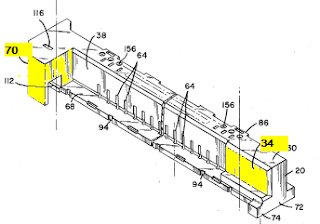
With regard to the "configured to move in a first direction" limitation, the Applicant argued in the Appeal Brief that the limitation was not present in the reference because "housing end 70 blocks the daughter board 8 from moving along the mother board at one end, and surface 34 of housing end 72 blocks the daughter board from moving along the mother board 14 at the other end." [See Fig. 2 below.]
In the Answer, the Examiner further explained the rejection as follows:
 The Board noted that the Examiner did not point to an express teaching of the limitation, and therefore analyzed under an inherency theory:
With regard to the "configured to bias the second circuit board along a curved path" limitation, the Applicant argued in the Appeal Brief that the limitation was not present in the reference because:

In the Answer, the Examiner further explained the rejection as follows:
 Once again, since an express teaching was missing, the Board analyzed under an inherency theory, and found the Examiner's rejection to be in error:
My two cents: I don't view this case as being about inherency, at least not in the classic sense. The Examiner's position seems to be that there is no difference between "capable of" and "configured to". The parts in the reference were not designed to move in the claimed manner – but could move a micrometer or two if enough force was applied.
I have two objections to the Examiner's argument. First, even if the claims used the phrase "capable of", this is a strained interpretation of that phrase "capable of". It's akin to saying that one piece glued to another is "capable of being released" simply because the pieces come apart with a pry bar. Second, the claims didn't even use "capable of", they used "configured to." The Examiner's interpretation of "configured to" is simply unreasonable in my opinion.
It's been a long time since I saw a "creative" rejection like this. I wish the Board had hit the Examiner's argument head on rather than shoehorning it into an inherency framework.
Details:
Ex parte Tipley
Appeal 2009000300, Appl. No. 11/108,338, Tech. Center 2800
Decided September 18, 2009
The claims were directed to an arrangement of circuit boards in a computer. Two of the appealed claims are shown below, with the limitations at issue being highlighted:
5. A computer system comprising:
a first circuit board comprising a first connector;
a second circuit board ... having a second connector couplable to the first connector, wherein the second circuit board is configured to move in a first direction along the first circuit board to generally align the first and second connectors;
18. A computer system comprising:
a first circuit board comprising a first connector;
...a second circuit board coupled to the housing, wherein the second circuit board comprises a second connector; and
a biasing mechanism coupled to the housing, wherein the biasing mechanism is configured to bias the second circuit board along a curved path to connect the first and second connectors in the second position of the module.
The Examiner rejected all independent claims as being anticipated by the same reference.
With regard to the "configured to move in a first direction" limitation, the Applicant argued in the Appeal Brief that the limitation was not present in the reference because "housing end 70 blocks the daughter board 8 from moving along the mother board at one end, and surface 34 of housing end 72 blocks the daughter board from moving along the mother board 14 at the other end." [See Fig. 2 below.]

In the Answer, the Examiner further explained the rejection as follows:
[P]lease note that the recitation that an element is "configure to" perform a function is not a positive limitation but only requires the ability to so perform. In this case, Grabbe discloses that the second circuit board (8) can move in a first direction along the first circuit board (14), as shown in the following figure. (Emphasis added. See Fig. 1 below.)

[W]e note that the Examiner’s finding, portrayed in the figure on page 8 of the Answer that allegedly shows the daughter board moving in a direction along the mother board via a directional line added by the Examiner, is based on the mere possibility of such movement and thus is speculative and insufficient to establish the inherency of such movement. The Examiner does not provide any reasoning to support such a determination.The Board therefore reversed the rejection of the claim (claim 9).
With regard to the "configured to bias the second circuit board along a curved path" limitation, the Applicant argued in the Appeal Brief that the limitation was not present in the reference because:
the daughter board 8 is in contact with a ledge 68, it is impossible for the daughter board 8 to move along a curved path. See Grabbe Fig. 5. As such, the daughter board 8 moves laterally in a straight direction along the surface of the ledge 68 until the engaging surface 38 couples with the connector. [See Fig. 5 below.]

In the Answer, the Examiner further explained the rejection as follows:
[I]t is again noted that the recitation that an element is "configure to" perform a function is not a positive limitation but only requires the ability to so perform. In this case, the second connector (4) of Grabbe can rotate around a pivot structure and along a curved path, as shown in the following figure. (Emphasis added. See Fig. 3 below.)

In this regard, we note that the Examiner’s finding portrayed in the figure on page 10 of the Answer that allegedly shows the daughter board 8 moving in a curved path via a curved line added by the Examiner is mere speculation. The Examiner does not provide any reasoning to support a finding that Grabbe’s circuit board inherently moves in a curved path. (Emphasis added.)
My two cents: I don't view this case as being about inherency, at least not in the classic sense. The Examiner's position seems to be that there is no difference between "capable of" and "configured to". The parts in the reference were not designed to move in the claimed manner – but could move a micrometer or two if enough force was applied.
I have two objections to the Examiner's argument. First, even if the claims used the phrase "capable of", this is a strained interpretation of that phrase "capable of". It's akin to saying that one piece glued to another is "capable of being released" simply because the pieces come apart with a pry bar. Second, the claims didn't even use "capable of", they used "configured to." The Examiner's interpretation of "configured to" is simply unreasonable in my opinion.
It's been a long time since I saw a "creative" rejection like this. I wish the Board had hit the Examiner's argument head on rather than shoehorning it into an inherency framework.
Subscribe to:
Posts (Atom)