Showing posts with label written description. Show all posts

Wednesday, January 21, 2015

PTAB decisions involving failure to specify a limit in a claim

Today's post will consider various non-prior art issues that might arise when a claim fails to include either an upper or lower limit. In some of these cases, I'm not sure the Applicant even realized a range or limit was implicated.

Ex parte Akers (BPAI 2010) involved an enablement rejection for "at least one" with no upper limit in the claim. (Essentially a recap of a post from 2012, see the full post here: http://allthingspros.blogspot.com/2012/08/bpai-enablement-full-scope-at-least-one.html).
The claim in Akers was directed to using radiation to test various materials, and the language at issue read "detecting at least one emitted prompt gamma ray." The Examiner gave an enablement rejection, asserting that "[i]t is a notorious scientific fact that statistically meaningful data requires collection of information from not one but from a plurality of events and nuclear interactions." The Applicant argued on appeal that the specification need not enable every embodiment, and the Examiner must show that all multiple ray embodiments were inoperative or not enabled.

The Board affirmed the rejection in Akers, in part because the Applicant admitted that detection did require more than one ray: "As such, Appellant has conceded that the disclosure of the present application does not provide an enabling description for the full scope of Appellant’s claims. Appellant, having chosen the broad claim language, must make sure that the broad claims are fully enabled."

The claim in Ex parte Yamazki (PTAB 2011) recited “a channel length of said semiconductor device is 0.3 m or less." The Examiner issued rejections for inoperability (a type of § 101 rejection) and indefiniteness, used the same rationale for both: the claim did not recite a lower limit for the channel length. The Board reversed both rejections, treating this as a mater of claim construction. The Examiner interpreted the claim to cover embodiments with a zero (or infinitesimally close to zero)  channel length, which would be inoperative according to the Examiner. The Board looked to the specification, which described the channel length as "typically from 0.1 to 0.3 μm." According to the Board, a POSITA informed by the specification "would not have viewed the claim as reading upon non-working embodiments." Similarly, a POSITA informed by the specification would not have found the claim indefinite.


Semiconductor devices were also the subject of the application in Ex parte Lin (PTAB 2011). A dependent claim recited "the photomask of claim 1 wherein the wavelength reducing material has a refractive index larger than 1." The Examiner rejected this claim under § 112 First Enablement, asserting that a POSITA would not know how to make a photomask having a refractive index with no upper limit. On appeal, the Applicant pointed to a section of the Specification which described materials having a refractive index ranging from about 1.3 to 3.5. The Board noted that the issue was not whether the specification described some materials with a refractive index larger than 1, but was instead enablement through the entire scope of the claim (citing In re Goodman, 11 F.3d 1046, 1050 (Fed. Cir. 1993)). The Board affirmed the rejection because the Applicant did not address this specific issue on appeal.

 The technology in Ex parte Drzal (PTAB 2011) was graphite composites. The claim language at issue was "expanded from a graphite ... by boiling the intercalcant with radio frequency or microwaves for up to five minutes." The Examiner rejected the claim under § 112 First Written Description, alleging that the specification failed to provide support for the entire range "for up to five minutes." On appeal, the Applicant pointed to these teachings in the specification:
     Heating for 3 to 5 minutes removes the expanding  chemical. ... The intercalant heats up past the boiling point and causes the graphite to expand to many times its original volume"
     In example 1, expanded graphite was prepared by exposing intercalated graphite flakes ... to microwave energy, typically at 2.45 GHz frequency, for a few seconds to a few minutes in an oven.
The Applicant then argued that since the claims did require "boiling," which must necessarily take some period of time, the claims did not encompass zero minutes.

The Board in Drzal interpreted "boiling for up to five minutes" as encompassing a fraction of second, though not zero. "Appellants have not identified, nor do we find, any basis in the Specification or claims which supports a narrower interpretation of the claimed range." Since the Specification did not disclose at what point during the exposure the intercalcant begins to boil (emphasis in original), the Board found the Applicant had not demonstrated possession of a compound as claimed.

Wednesday, December 10, 2014

Board finds no inconsistency with relying on Official Notice for a claimed feature while also asserting that this feature isn't supported by Applicant's sparse description

Takeaway: The Examiner denied the Applicant's priority claim to a provisional, for failure to adequately describe a claim limitation. According to the Examiner, some description was present, but not in the context claimed. The Examiner then used Official Notice for this same feature in an obviousness rejection. On appeal, the Applicant argued the "facial inconsistency" of these two positions: "asserting the feature was unquestionably and notoriously known in the prior art (which was silent about the feature), while contending that the applicant's provisional application, which provided textual support for the feature, nevertheless was not sufficient to establish a priority for the feature." The Board was not persuaded by the inconsistency argument, and cited to Vas-Cath Inc. v. Mahurkar to explain that "a claimed feature that is common knowledge in the art must nevertheless have adequate written description support in the specification to demonstrate to a person of ordinary skill in the art that the inventors had possession of the claimed invention at the time of the filing of the application." (Ex parte Timbadia, PTAB 2013.)

Details:
Ex parte Timbadia
Appeal 2010002877; Appl. No. 10/712,938; Tech. Center 3700
Decided: March 25, 2013

The application was directed to automated test-taking. During prosecution, the Applicant amended to add these limitations:
     delivering a changed state object at the same time that a triggering event occurs on the testing station;
     upon failure of the testing station, the [state objects] ... are used to recreate the examination on the testing station ... and
     wherein the user will not be penalized for the time that questions are not available.
(Emphasis added for limitations at issue.)
In response, the Examiner switched to a different secondary reference in the obviousness rejection (Ashley)of all independent claims. The Examiner relied on this secondary reference for the "at the same time" feature, and took Official Notice of the new "not penalized" feature. At the same time, the Examiner denied the priority claim because the newly added "at the same time" and "not penalized" features were allegedly not present in the provisional. However, Examiner did not reject any claims under written description or enablement.

In an After Final response, the Applicant argued that the Ashley reference was not prior art because the Applicant's provisional did provide an enabling disclosure for the newly claimed features. In support of this argument, the Applicant pointed to to specific passages in the provisional and explained their relevance. The Applicant also traversed the Official Notice as follows:
Applicants cannot fail to note that this portion of the claims so evidently and precisely enabled by the provisional application is also the same portion of the claims for which the Examiner has relied upon official notice. Per MPEP 2144.03, Applicants thus traverse such taking of official notice as improper as lacking sufficient documentary evidence. Citation of a post-dated alleged prior art reference by the Examiner is erroneous not only for the obviousness rejection presented, but also as grounds for taking official notice that the claimed feature is of such notorious character as capable of instant and unquestionable demonstration as to defy dispute. See In re Zurko, 258 F.3d at 1386.
The Applicant appealed. In the Brief, the Applicant specifically traversed the issue of the priority claim. The Applicant explained that the provisional application described using a test state to recover an exam after testing station failure, and this test state includes an elapsed test time that takes into consideration the amount of time that a test is unavailable to the user. Thus, Ashley was not prior art. In the obviousness section of the Brief, the Applicant also argued that Ashley did not teach the "at the same time" limitation. Notably, this section did not discuss the "not penalized" claim limitation or the Examiner's reliance of Official Notice for this feature.

In the Answer, the Examiner maintained the obviousness rejection of all independent claims. The Examiner discussed the denial of priority in the obviousness rejection. The Examiner acknowledged that the "not penalized" claim language was present in the provisional, but noted this was in the context of accounting for transmission latency rather than in the context of a recovery function (as claimed). In a Response to Arguments section, the Examiner noted there were "significant modifications" and "stark differences" between the provisional and the application on appeal. Also, the Applicant had failed to adequately traverse the Official Notice during prosecution, thus admitting that the "not penalized" feature was well-known.

The Applicant filed a Reply Brief which included a section titled "the Examiner's use of Official Notice was properly traversed, is improper and is Squarely Inconsistent with the Office's Contention that Subject Matter at Issue is Not Supported by Applicants'Own Provisional Application." The Applicant argued that the traversal was proper, as follows:
[T]he traversal highlighted the facial inconsistency in the examiner's logic of asserting that the feature was unquestionably and notoriously known in the prior art (which was silent about the feature), while contending that the applicant's provisional application, which provided textual support for the feature, nevertheless was not sufficient to establish a priority for the feature.
On appeal, the Board made findings with regard to "Claims 1 and 13 – Written Description Support" since this issue was contested and impacted the obviousness rejection. The Board found that all features recited in claims 1 and 13 were adequately described in the provisional, so that Ashley was not prior art. With regard to the "not penalized feature," the Board found that the Examiner’s interpretation of what the provisional application describes was "unreasonably narrow." The Examiner incorrectly focused on the provisional's teachings about accounting for transmission latency, but a person of ordinary skill reading the document as a whole "would conclude that recreating the test based on the state of the test at the time of a testing station failure would require not penalizing the user for time lost due to this failure."

Since Ashely was not prior art for claims 1 and 13, the Board reversed the obviousness rejection of these claims. However, claim 20 used slightly different language to describe the "initial state object" feature, which the Board found was not adequately described in the provisional. The Board therefore considered the obviousness rejection of claim 20 on the merits, and affirmed.

With regard to the "at the same time" feature, the Board found no error in the Examiner's finding that Kershaw taught this feature. With regard to the "not penalized" feature, the Board found that the Applicant had not properly traversed the taking of Official Notice because it did not "explain why the noticed fact is not considered to be common knowledge or well-known in the art" (citing In re Boon, 439 F.2d 724, 728 (CCPA 1971)).

The Board also commented on the Applicant's inconsistency argument – that the Notice'd feature was completely missing in the reference yet textually supported by Applicant's provisional:
Appellants have not provided persuasive argument as to why the Examiner’s findings are inconsistent. A claimed feature that is common knowledge in the art must nevertheless have adequate written description support in the specification to demonstrate to a person of ordinary skill in the art that the inventors had possession of the claimed invention at the time of the filing of the application. See Vas-Cath Inc. v. Mahurkar, 935 F.2d 1555, 1562-63 (Fed. Cir. 1991).
Finally, the Board noted that any alleged inconsistency was resolved by the Board's finding that the subject of the Official Notice ("not penalized" feature) was indeed properly supported in the provisional application.


My two cents: The Applicant's inconsistency argument has intuitive appeal, but is ultimately flawed. The argument goes like this: "Surely the Examiner's characterization of a feature as 'well-known' indicates that very little description is needed, in which case a sparse description of the same feature by the Applicant shouldn't result in a denial of the priority claim." However, this argument is flawed because it confuses enablement and written description.

A reference has only to enable. Since this can take into account the background knowledge of a POSITA, a sparse description may indeed be enough for enablement. On the other hand, the Applicant's spec has to comply with both the enablement and the written description requirement. And written description "must clearly allow persons of ordinary skill in the art to recognize that [the inventor] invented what is claimed." (Ariad Pharm., Inc. v. Eli Lilly & Co., 598 F.3d 1336, 1351 (Fed.Cir.2010) (en banc)).

Unfortunately, when you have a sparse description of a particular embodiment that falls within the claim scope, then try to argue that a POSITA can fill in the rest, the case law on written description goes against you:
The question is not whether a claimed invention is an obvious variant of that which is disclosed in the specification. Rather, a prior application itself must describe an invention, and do so in sufficient detail that one skilled in the art can clearly conclude that the inventor invented the claimed invention as of the filing date sought.
Lockwood v. American Airlines, Inc., 107 F. 3d 1565 (Fed. Cir. 1997).
Or, put another way:
A description of one method . . . does not entitle the inventor . . . to claim any and all means for achieving that objective."
LizardTech v. Earth Resource Mapping, Inc., 424 F.3d 1336, 1346 (Fed. Cir. 2005).

Monday, July 8, 2013

Board decisions involving Written Description rejections of computer readable medium claims

Once Examiners started issuing lots of § 101 rejections for computer applications, Applicants started to respond with amendments to turn non-CRM claim into CRM claims. If the spec didn't contain the magic words "computer-readable medium," the amendment often triggered a rejection under § 112 First, Written Description (the "possession" requirement).

In this post, I'll take a look at some PTAB decisions involving Written Description rejections. It's a mixed bag, with some affirmances and some reversals. 

The Board reversed a Written Description rejection in Ex parte Davis (PTAB 2011).  The originally filed claims recited "a computer readable medium or media having thereon a method." The Examiner gave a § 112 First, Written Description requirement to this claim, alleging that "there is no support in the originally filed specification for a computer readable medium or media." The same claim was also subject to an indefiniteness rejection, as it was allegedly "unclear how a computer readable medium could 'have thereon' a method."

To overcome the indefiniteness rejection, the Applicant amended the claim to recite "a computer readable medium encoded with computer executable instructions which, when executed by the computer cause the computer to perform the steps of." With respect to the enablement rejection, the Applicant made two arguments.

First, the Applicant noted that "this application is drawn to computer based lookups by collisionless direct tables and CAMS and inherently includes [support] for a computer readable medium." Second, the Applicant noted that the original specification "states that the control function 18 which controls the operation of the CAM 10 and hashing function 16 is implemented in hardware or software." The Applicant concluded that "a computer readable medium necessarily flows from such a software implementation."

The Examiner maintained the rejection, and indicated that "this evidence does [not show] sufficient support in the original disclosure for the specific implementation using a computer readable medium which is current claimed."

The Applicant appealed and repeated these same arguments for the enablement rejection. In the Answer, the Examiner elaborated on the rejection:
In other words, the Applicant is stating that although explicit support for the claim limitations ... are not included in the original disclosure, this specific software limitation is inherent. [However.] the mere suggestion of a software implementation ("A control function (either hardware or software) 18 is provided...") only suggests support that software programming can be used instead of hardware and it does not provide adequate support for a computer readable storage medium or computer performing specific steps based on instructions stored in such a medium as presented in the claims. ... [T]he suggestion of a software implementation would only suggest that one of ordinary skill in the art can perform the desired function by writing the appropriate software program intead of hardware and does not provide adequate supoprt for a computer readable storage medium. ... This minor suggestion of a software implementation is the closest evidence of support for this subject matter in the application as originally filed. Examiner believes this specific implementation is new matter which was added after the original disclosure.
The Applicant filed a Reply Brief to address the Examiner's contentions:
Storing data in memory such as a content addressable memory (CAM) in the cited portion of the originally filed specification obviously comprehends storing "computer instructions on a computer readable medium" [as recited in the claims at issue.] Content addressable memory is known to one skilled in the art as a special type of computer memory that is searched to look for particular data stored therein on constrast to random access memory (RAM) which returns data stored at that address. It is inherent that computer memory such as content addressable memory is implemented in a "computer ('hardware') having computer readable storage medium" .... The Examiner's position renders the concept of interpreting the disclose as "one skilled in the art" meaningless if this language does not lead to implementations as claimed.
The Board disagreed that a computer readable medium was inherent in the specification. The Board, however, reversed the rejection on a different ground: the originally filed claims explicitly recited "a computer readable medium or media having thereon a method."

The Board affirmed a Written Description rejection in Ex parte Niemi (PTAB 2013). The Applicant added a new claim to "a computer program embodied on a computer readable medium, said computer program configured to control a processor to perform ..." The Examiner rejected the new claim under § 112 First, Written Description, alleging that "the phrase 'computer readable medium" is not properly described in the specification."

The Applicant responded to the Enablement rejection by referring to FIG. 4:
     [A] process is illustrated which defines a new event package for event registrations of a user to be implemented by a registrar and used by a presence server 303.  A computer terminal 123 or laptop 112 which may include a computer readable medium (see lines 23-33 of page 7 of the specification) A  computer readable medium may be regarded as a computer memory which a computer terminal 123 or laptop is certain to include. Or, one of ordinary skill in the art is certain to conclude that a terminal 123 or laptop 112 includes a computer readable medium in order to carry out the functions of such a computing device.
... The presence server 303 may also be a computer readable medium because it also has a memory. Among the various operations performed in claims 38 and 39, each of these operations is performed with reference to the computer readable mediums provided by the presence server or the user. Therefore, the specification provides support for a computer readable medium, and claims 38 and 39 are in compliance with §112, first paragraph.
The Examiner maintained the rejection and went final. The Applicant appealed and made the same arguments in the Appeal Brief. The Examiner provided no additional information in the Answer.

The Board affirmed the rejection. First, the Board found that the particular page of the specification relied on by the Applicant did not describe a computer readable medium, and in fact referred to FIG. 1, not FIG. 4 as stated by the Applicant. Second, the Board found that computer terminal 123 or laptop 112 "is not identified to contain computer readable media for the entire process of FIG. 4 to embody the entire claimed process."

The Board reversed a Written Description rejection in Ex parte Visser (PTAB 2013). The application claimed priority to an EPO application, and the originally filed claims recited:
      11. A computer programme comprising instructions to produce and display an image ... and comprising instructions to perform the steps of ...
To overcome a 101 rejection, the Applicant amended to
     11. A computer program encoded on a computer readable medium for causing the computer to execute a method to produce and display an image ... and causing the computer to perform the acts of:
The Examiner issued a § 112 First, Written Description rejection and alleged that "the claim language pertaining to 'a computer readable medium' was not described in the originally filed specification."

Before appealing, the Applicant traversed the rejection and argued that "one skilled in the art would have no trouble whatsoever understanding that a computer program, as specifically recited on page 7, line 27, is stored in a memory or a computer readable device." When the Examiner maintained the rejection and went final, the Applicant argued again, this time referring to a paragraph in the specification reading "manipulations of the object data set take place within the central processor of the computer".

When the Examiner maintained the rejection and went final, the Applicant appealed.
On appeal, the Applicant quoted a paragraph in the specification that read "manipulations of the object data set take place within the central processor of a computer." The Applicant then argued that this shows possession:
As is universally known in the art, all processors contain on board memory and all computers need memory to function. The instructions on which computers operate are all stored in a computer readable storage medium (e.g. memory).
The Examiner's Answer responded to these arguments by noting that while the specification describes processor a enabling manipulation of an object data set, "the processor does not cause the computer to execute a method to produce and display an image of a multidimensional volume as recited in claim 11."

The Board agreed with the Applicant's statements about how a person of ordinary skill in the art would understand the specification, and so reversed the Written Description rejection.The Board used a technical dictionary to supplement its analysis:
Appellant’s “central processor of a computer,” also known as a “microprocessor” is defined as “[a] central processing unit (CPU) on a single chip” such that “[w]hen memory and power are added to a microprocessor, all the pieces, excluding peripherals, required for a computer are present” (emphasis added). MICROSOFT® COMPUTER DICTIONARY 338 (5th ed. 2002). Because the Specification discloses a “central processor of a computer,” one of ordinary skill in the art at the time of the invention would have recognized that the computer includes a memory, thus providing written description support for a “computer readable medium.”
The Board reversed a Written Description rejection in Ex parte MacKouse. The Applicant amended the computer-implemented method claims to instead recite "a computer readable media having stored therein instructions." The Examiner rejected the claims under § 112 First, Written Description. According to the Examiner, the specification did not disclose a computer-readable media, and as a result there is "no evidence that the inventor was in possession of the claimed concepts involving a computer-readable media."

The Applicant responded with two arguments in a Pre-Appeal Brief. First, "original claim 1 recited a 'computer implemented' method [and] computers inherently include computer-readable media." Second, the specification disclosed "stored procedures such as SQL procedures."

When the application was forwarded to appeal, the Applicant beefed up the stored procedures argument in the Appeal Brief:
A person of ordinary skill in art would understand the pages 46-65 of Applicant's specification to be a detailed description of stored computer programs ("stored procedures, PL/SQL stored procedure," "batch processing," "Java program," etc.) that could be used to implement the claimed invention. ... Inherently, in order for computer programs to be 'stored,' they must be stored in 'computer readable media.
The Examiner's Answer included additional information. The Examiner explained that the "program" disclosed in the specification is non-statutory subject matter, and the claimed CRM is non-statutory subject matter since that term typically covers signals, "particularly when the specification is silent."

The Applicant filed a Reply Brief and argued that the word "stored" in the the preamble excluded signals.

The Board reversed the rejection. The Board first found that the specification "provided a detailed description of stored computer programs (e.g., stored procedures, PL/SQL stored procedure, Java program, etc.)" to implement the processes of the claims at issue. As a result, the Board found that  "the Specification sufficiently demonstrates that the inventor had possession of a tangible medium to store the software program."

The Board affirmed a Written Description rejection in Ex parte Ohwadi (PTAB 2010). Claim 15 was originally directed to "a software element ... operative to effect or permit a download of a polling element." In response to a § 101 rejection, the Applicant amended to recite "a software element on a computer readable medium." The Examiner maintained the § 101 rejection and also added a rejection under § 112 First, Written Description. According to the Examiner, there was no disclosure for the CRM, only a mention that "the application may be stored on a device" and a PC 10 illustrated in FIG. 1.

The Applicant appealed. The Appeal Brief argued that a POSITA would understand from the specification that the "computer method disclosed therein may be provided on a computer readable medium." The Applicant further argued that the "disclosure of computer implemented methods would imply to the skilled person the use of computer readable media."


The Examiner elaborated on the rejection in the Answer as follows:
The disclosure of  [device with storage and a PC] is not similar in scope to the term "computer readable medium" ... [According to the Dictionary of IEEE Standards Terms], the term "computer readable medium" includes both storage and transmission medium, this scope is different from what was disclosed in the instant specification. 
The Board affirmed the rejection with the following explanation:
Appellants’’ arguments supra (App. Br. 7) fail to point to any specific portion of the Specification that would have purportedly conveyed with reasonable clarity to those skilled in the art that Appellants were in possession of the disputed claim limitation (a computer readable medium). Thus, we find Appellants have made no showing explaining why a person of ordinary skill would have understood, at the time the application was filed, that the description requires a computer readable medium.
(Emphasis added, original citations omitted.)
My two cents: Every one of these rejections should have been reversed.

The Board doesn't give the person of ordinary skill in the computer arts enough credit. When such a POSITA comes across "computer implemented method" or similar phrasing, the POSITA immediately appreciates that this encompasses a software implementation of the method. The POSITA further appreciates that a software implementation requires a processor to execute the instructions making up the method, and storage from which to execute the instructions. The POSITA further appreciates that "computer readable medium" (and variants of that phrase) covers such storage.

I just don't see how anyone who has ever programmed a computer can question the truth of these statements, or the conclusion drawn from them that a mention of "computer implemented method" does show possession of claims to a CRM.

Now, the Board does go off track if the phrasing of the Applicant's arguments suggest that the CRM is "obvious" in light of the spec. Don't say this, as obvious is the wrong standard for Written Description. I've also seen the Board treat Applicant arguments about what the spec "implies" as "obvious" arguments. (See my post here for my thoughts on why the Board is mistaken, and stuff implied by the spec do suffice for written description.) So you gotta stay away from the word "obvious" and I'd probably stay away from "implied" also. Point to where computers are mentioned in your spec, point to where the spec ties those computers to the claimed functionality, and explain all that a POSITA takes away from these sections.

To increase your chances of winning, don't rely solely on attorney argument. Refer to definitions or technical encylopedias. Or if you really want to have the best shot at winning, get a declaration under § 1.132 to explain this stuff.

Sunday, July 7, 2013

Board reverses enablement rejection for "computer readable medium" since specification discloses an integrated circuit embodiment

Takeaway: The Examiner issued a § 112 First, Enablement rejection after the Applicant changed "medium" to "computer readable medium." The Applicant appealed and pointed to the specification 's disclosure of "a processor such as a computer or an electronic data processor in accordance with code such as computer program code, software, and/or integrated circuits." The Applicant also argued that computer readable media are "so notoriously well known" that undue experimentation was not required. The Board reversed the rejection since specification did disclose "at least one embodiment of a medium as an integrated circuit coded to perform functions." (Ex parte Hofstee, PTAB 2011.)

Details:

Ex parte Hofstee
Appeal 2009006207; Appl. No. 10/763,079; Tech. Center 2400
Decided:  February 24, 2011

The Applicant was directed to secure electronic communications. Original claim 22 recited
     22. A computer program product for secure communications, the computer program product having a medium with a computer program embedded thereon, the computer program comprising: 
When this claim was rejected under § 101, the Applicant amended to add "computer readable":
      22. A computer program product for secure communications in a message source, the computer program product having a computer readable medium with a computer program embedded thereon, the computer program comprising: 
The Examiner then gave a § 112 First, Enablement rejection, alleging that "the Applicant fails to sufficiently point out or describe computer readable media." The Applicant appealed this rejection, along with prior art rejections.

In the Appeal Brief, the Applicant pointed to the following passage in the specification as evidence of enablement:
It is further noted that, unless indicated otherwise, all functions described herein may be performed in either hardware or software, or in some combinations thereof. In a preferred embodiment, however, the functions are performed by a processor such as a computer or an electronic data processor in accordance with code such as computer program code, software, and/or integrated circuits that are coded to perform such functions, unless indicated otherwise.
The Applicant also argued that:
[C]omputer readable media, such as floppy disks, magnetic tape, hard disk drives, random access memories, flash memories, optical disks, and the like are so notoriously well-known that a person of ordinary skill in the art would not require any undue experimentation to store computer code that performs the functions described in the instant specification onto a computer readable medium.
The Board reversed the rejection because the passage quoted above from the Applicant's specification disclosed "at least one embodiment of a medium as an integrated circuit coded to perform functions." The Board noted that enablement did not require a specification to disclose what is well known in the art (Lindemann Maschinenfabrik GmbH v. American Hoist & Derrick Co., 730 F.2d 1452, 1463 (Fed. Cir. 1984)), and that "omission of minor details does not cause a specification to fail to meet the enablement requirement." Genentech, Inc. v. Novo Nordisk, A/S, 108 F.3d 1361, 1366 (Fed. Cir. 1997).

My two cents: The Applicant was smart to focus on "undue experimentation," since the Examiner did reject under Enablement rather than Written Description. By its very nature, enablement is about what a POSITA knows and what a POSITA understands from Applicant's specification. In the computer and electronics arts, the amount of detail required about specific implementation mechanisms is relatively low. You don't need much detail about processors, logic circuits, memory, and storage. As long as enough detail is present about the claimed functions, a POSITA can generally figure out how to implement that functionality on the appropriate hardware or software platform. So it didn't surprise me that the Board reversed this Enablement rejection.

Now, had this been a § 112 First rejection under Written Description, the story would be different. In that case, the Board is less likely to be persuaded with arguments about what a POSITA knows, because the focus is instead on what the inventor possessed.

Examiners are sometimes sloppy about the distinction between Enablement and Written Description. (As is the Board ... see BPAI confuses enablement and written description.) For this reason, I read all § 112 First and Second rejections very carefully. I've even seen an Examiner throw in § 101, Enablement, Written Description, and indefiniteness, giving essentially the same explanation for all.

Thursday, July 14, 2011

BPAI affirms written description rejection of "integrated read-reset circuit", finding that showing a circuit as a box does not equate to an integrated circuit

Takeaway: The Applicant amended a circuit element to add "integrated," so that the claim read "a dual mode common integrated read-reset circuit." The Examiner rejected under § 112 First, Written Description, finding no support for an "integrated circuit." The Applicant pointed to passages in the specification describing the two modes of the circuit and a figure showing the read-reset circuit in a block diagram. The BPAI affirmed, explaining that "showing a circuit as a box does not equate to an integrated circuit." (Ex parte Henderson, Appeal 2009004652.)

Details:
Ex parte Henderson
Appeal 2009004652; Appl. 10/405,904; Tech. Center 2600
Decided:  May 17, 2010

The patent application on appeal involved image arrays such as those used in digital cameras. A representative claim on appeal read:

10. An image array sensor comprising:
     an array of pixels arranged in rows and columns, each pixel comprising a light-sensitive element and switching means for applying a reset signal to the pixel and to read out a pixel signal from the pixel;
     a dual mode common integrated read-reset circuit, in each column, to operate as a buffer in a first mode to apply the reset signal to the pixels, and to also operate as a comparator in a second mode to read pixel reset signals and pixel signals;
     analog-to-digital conversion means for converting the pixel reset signals and the pixel signals from analog to digital; and
     a memory to store the digital pixel reset signals of the pixels for up to a complete frame.
(Emphasis added.)

The Applicant added the phrase "dual mode common integrated" during prosecution to distinguish over a § 102 reference. The Applicant explained the difference as follows:
Although Applicant maintains that Boemler et al. does not disclose a read-reset circuit operating in two modes, to further advanced prosecution Applicant has amended independent Claim 10, 17, and 24 to recite a dual mode common integrated reset circuit, in each column .... Boemler et al. discloses a separate amplifier and comparator for each column of pixels and not a dual mode common integrated read-reset circuit ....
(Emphasis added.)

The next Office Action converted the anticipation rejection to an obviousness rejection by adding a secondary reference for teaching a "common integrated circuit." The Examiner also noted that "the new limitation of dual mode does not further limit the claim since there were already two modes claimed." The Examiner also rejected the amended claims under § 112 First, Written Description, explaining that:
The limitation of an integrated circuit was not disclosed in the specification. While different circuits are described, none of them are referenced to as an integrated circuit.

In response to the Written Description rejection, the Applicant argued that the limitation was described in Figures 1 and 2 and specific passages in the specification. The Applicant argued obviousness as follows:
The Examiner correct noted that Boemler et al. fails to disclose a common integrated circuit ... and looks to Tandon et al. to remedy this deficiency. ... [T]he analog image sensor of Tandon et al. comprises several discrete circuits 40, 42, 44, 50 for processing the output of the plurality of pixels to produce an analog output 52. The lateral voltage generator circuit provides the reset voltage for resetting the plurality of pixels.
(Emphasis added.)

The Examiner maintained the rejection in a Final Office Action, and the Applicant appealed.

The Appeal Brief argued the written description rejection by reproducing Figures 1 and 2 and the relied upon passages from the spec:
[0014] The two column lines 16 and 20 are connected to a Read-Reset Amplifier (RRComp) circuit 22. The RRComp circuit 22 has two modes controlled by signals ReadMode and ResetMode. When a row of pixels is to be reset to a reference voltage VRT, these signals are ReadMode=0 and ResetMode=1 and the RRComp 22 functions as a unity gain buffer amplifier. When a row of pixel voltages is to be read out and converted into digital form, ReadMode=1 and ResetMode=0 and the RRComp 22 functions as an open loop amplifier or comparator.
(Emphasis in original.)


The Examiner elaborated on the Written Description rejection in the Answer, and in particular, explained his interpretation of the claim limitation at issue:
Appellant argues that the RRComp circuit 22 shown in Figs. 1 and 2 and functions in two modes creates support for the limitation "dual mode common integrated read-reset circuit". The examiner disagrees and notes that no where in the specification as originally filed is the limitation of an integrated circuit described. Further no description of RRComp 22 can be found that fits the definition of what an integrated circuit is. Citing the common understood definition from "The Authoritative Dictionary of IEEE Standards Terms, seventh edition published in 2000, an integrated circuit is "a combination of interconnected circuit elements inseparable associated on or within a continuous substrate" or "a combination of connected circuit elements (such as transistors, diodes, resistors, and capacitors) inseparably associated on or within a continuous substrate" or "a solid-state circuit consisting of interconnected active and passive semiconductor devices diffused into a single silicon chip". Nothing in the specification describes RRComp 22 as meeting anything of these definitions.
(Emphasis added.)

The Applicant did not file a Reply Brief.

The Board did not discuss claim construction, but moved on to quickly dismiss the Applicant's Written Description argument and affirm that rejection:
Appellant points to Figures 1 and 2 of Appellant’s drawings, reference numeral 22, the Read-Reset Amplifier (RRComp), to show that the circuit is integrated. App. Br. 8-9. ... However, we do not find that simply showing a circuit as a box equates to an integrated circuit.
(Emphasis added.) 
The Board also affirmed the obviousness rejection, citing to In re Larson (making components integral or separable is considered to be an obvious design choice) and KSR (predictable result of combination of known devices).

My two cents: As usual, this decision turns on claim construction. The Board often makes this point – even when neither the Applicant nor the Examiner acknowledge it. This decision did not discuss claim construction at all. Nonetheless, the Board's discussion of the Written Description rejection tells me that the Board interpreted "dual mode common integrated read-reset circuit" as requiring an "integrated circuit" as that term of art is understood by a POSITA. 

The Board was right that putting a label on a box in a block diagram doesn't show that the inventor understood the box to be an "integrated circuit." It's true the application involved "integrated circuits" – the specification does mention CMOS and NMOS. Had the Applicant referred to that section of the spec, maybe the outcome would be different. Instead, the Applicant only discussed the sections of the spec which describe the dual mode aspect of the circuit. The Applicant appears to have completely ignored the Examiner's hints about claim construction in the Office Actions, and his explicit construction in the Answer.

What struck me about this case is this: I'm pretty sure the Applicant didn't intend to claim an "integrated circuit" as that term is understood by a POSITA. If so, the Applicant blew it by not arguing claim construction and/or amending once the Examiner's interpretation was clear.

It's true the application involved "integrated circuits" as that term is understood by a POSITA -- the specification does mention CMOS and NMOS. Even so, reading the argument the Applicant made to distinguish over the art, it seems clear to me that the Applicant used the adjective "integrated" in a different manner: to describe a single circuit which integrated two functions (buffer and comparator).

Once the Examiner's Answer explained that he was reading "integrated" to modify "circuit" and reading "integrated circuit" as a term of art, the Applicant should have dealt with this issue of claim construction. If the Applicant really wanted to hang his hat on this distinction (a circuit which integrated two functions), he should have either filed a Reply Brief with claim construction arguments, or should have pulled the case from appeal to amend the claim.

The limitation read "dual mode common integrated read-reset circuit." How persuasive would it be to argue that "integrated" refers to the dual mode aspect of the circuit and not the circuit as a whole?  Under the "last antecedent" doctrine discussed in Finisar, only the adjective "read-reset" modifies "circuit." (Finisar Corp. v. The DirecTV Group, Inc., 523 F.3d 1323, 1335-36 (Fed. Cir. 2008).) On the other hand, this is prosecution and not litigation, and perhaps making this argument merely highlights that the claim could be interpreted either way, thus leading to an indefiniteness rejectiion under Ex parte Miyazaki.

How could the claim be amended to clarify? I think moving the adjective "integrated" so that the claim reads "integrated dual mode common read-reset circuit" is an improvement. Another option might be "single dual mode common read-reset circuit", although I suspect this would result in a § 112 rejection from some Examiners.

What about "integral" rather than "integrated"? "Integral" is commonly used in mechanical cases to mean (roughly) "one piece" – but we don't want to imply that the physical structure is one piece. The idea here is that two functions are combined into the read-reset circuit.

Finally, while I chose to focus on claim construction in this post, this type of distinction  – circuit which integrates two functions  – doesn't usually win the day, and it didn't win here. When the Applicant added the limitation discussed here, the Examiner switched from an anticipation to an obviousness rejection, pulling in a secondary reference to teach "supporting circuitry all on the same integrated circuit" and "an advantage to doing this is that the number of chips that need to be handled can be decreased." Not surprisingly, the Board affirmed the obviousness rejection, citing to In re Larson (making components integral or separable is considered to be an obvious design choice) and KSR (predictable result of combination of known devices).

So you won't be surprised to hear that after losing on appeal, the Applicant amended and the Examiner allowed the claim. The amendment removed "integrated" and added additional features related to the dual mode aspect:
a dual mode common integrated read-reset circuit, in each column, configured to
operate as a buffer in a first mode to apply the reset signal to the pixels while an output of the dual mode common read-reset circuit is coupled to the pixels, and to also
operate as a comparator in a second mode to read pixel reset signals and pixel signals while an input of the dual mode common read-reset circuit is coupled to the pixels;

Monday, March 7, 2011

BPAI confuses enablement and written description?

Takeaway: In appealing a § 112 First written description rejection, the Applicant properly argued  "possession" in the Appeal Brief but mistakenly referred to "enabling" in the Reply Brief. The BPAI affirmed the rejection, but seemed to do so soley on the basis of enablement argument in the Reply Brief, ignoring the written description argument in the Appeal Brief. The Board first noted the Examiner's finding that the original specification did not disclose the amended claim's "computer program product on a computer readable medium." The Board then explained that the Applicant did not address this finding and instead argued that the amended claim was enabled under § 112 First. "Such an argument is immaterial to a written description rejection."

Details:
Ex parte Van Rijnsoever et al.
Appeal No. 2009006117; Appl. No. 10/482,145; Tech. Center 2400
Decided  June 28, 2010

The claim at issue was originally filed as:
10. A computer program product arranged for causing a processor to execute the method as claimed in claim 1.

The Examiner rejected the originally filed claim under § 101, asserting that "a 'program product' not embedded in a tangible medium amounts to functional descriptive material which is nonstatutory." The method claim 1, to which claim 10 referred, was not rejected under § 101 or § 112 First.

In response to the rejection, the Applicant amended as follows:
10. A computer program product on a computer readable medium that is arranged for causing a processor to execute the method as claimed in claim 1.

The Examiner withdrew the § 101 rejection for amended claim 10. But the Examiner gave a new rejection under § 112 First written description, asserting that "the original filed disclosure does not disclose a computer program product on a computer readable medium." The method claim 1, to which claim 10 referred, was not rejected under § 101 or § 112 First.

In the Appeal Brief, the Applicant argued the § 112 First written description rejection as follows:
The applicants are not certain whether the Office action asserts that the applicants did not have possession of a computer readable medium, or did not have possession of a computer program product on a computer readable medium. In either case, the applicants respectfully maintain that the possession of a method to perform a particular function, such as inserting synchronization information into a packet, circa 2003, necessarily and sufficiently indicates that the applicants possessed the ability to provide a computer program on a computer readable medium to execute each of the elements of claim 1. Accordingly, the applicants respectfully maintain that the rejection of claim 10 under 35 U.S.C. 112, first paragraph should be reversed by the Board.

In the Answer, the Examiner seized on the Applicant's use of the phrase "ability to provide" and  suggested that the Applicant had argued enablement rather than written description:
h. With respect to the rejection of claim 10 under 35 USC 112, first paragraph, Appellant, on page 15, argues that the possession of a method to perform a particular function, such as inserting synchronization information into a packet, circa 2003, necessarily and sufficiently indicates that the applicants possessed the ability to provide a computer program on a computer readable medium to execute the elements of claim 1.
     The originally filed disclosure does not disclose a computer program product on a computer readable medium. Therefore, the rejection of claim 10 is a written description issue, rather than an enablement issue.
(Emphasis in original.)

The Applicant filed a Reply Brief, arguing as follows:
The Examiner's Answer asserts that because the applicants' specification does not expressly disclose a computer product on a computer readable medium, claim 10 does not satisfy the requirements of 35 U.S.C. 112, first paragraph. ... The applicants respectfully maintain that the method of the invention is presented in full, clear, concise, and exact terms to enable any person skilled in the art to embody the invention as a computer program on a computer readable medium, and as such, satisfies the requirements of 35 U.S.C. 112, first paragraph.
(Emphasis added.)

The Board affirmed. The Board seemed to reach this conclusion by accepting the Examiner's characterization of the Appeal Brief argument, in conjunction with the explicit reference to "enable" in the Reply Brief:
Here, the Appellants admit that claim 10 was amended to recite that the originally claimed computer program product is provided on a computer readable medium. (Amendment and/or Response under 37 C.F.R. § 1.11 1, at 14, filed March 28, 2007.) The Examiner finds that the original filed disclosure does not disclose a computer program product on a computer readable medium. For their part, the Appellants do not address this finding but instead argue that the amended claim is enabled under 5 112, ¶ 1. Such an argument is immaterial to the written description rejection. Based on the aforementioned facts and analysis, we conclude that the Examiner did not err in finding that claim 10 lacks an adequate written description.
(Emphasis added.)

My two cents: 1) The Board really blew this one. 2) If you lose on appeal, read the decision carefully and ask for a Rehearing if the Board made an error like this one.

You're very limited in a Rehearing. A Request for Rehearing "must state with particularity the points believed to have been misapprehended or overlooked by the Board." Furthermore, "arguments not raised in the briefs before the Board and evidence not previously relied upon in the brief and any reply brief(s) are not permitted in the request for rehearing."

However, in this particular case, I think the record is clear that the Board misapprehended the Applicant's argument.The decision made no reference to the possession argument in the Appeal Brief, and said pretty clearly that the Board relied on the enablement argument in the Reply Brief to affirm the rejection.

Friday, February 25, 2011

BPAI finds that rejection of "generally circular" had confused written description with indefiniteness

Takeaway: The Applicant appealed written description and indefiniteness rejections for a limitation added during prosecution: "the orifice has generally circular shape and a substantially constant diameter." The BPAI reversed the written description rejection because the specification described “[t]he plate includes an orifice 43, the position of the orifice being indicated by circle 39 in Figure 7A.”  The BPAI also reversed the indefiniteness rejection, finding that “generally” and “substantially” both had an ordinary and customary meaning which denoted approximation.

Details:
Ex parte Albrecht
Appeal 2009011896; Appl. No. 10/885,980; Tech. Center 3600
Decided January 28, 2011

The claim at issue read:

27.  Apparatus for providing a controlled flow of fluid from a first fluid component to a second fluid component, comprising:
    a one-piece orifice plate ... the orifice has a general1y circular shape and a substantially constant diameter ...


The Examiner rejected the emphasized limitation under written description, enablement, and indefiniteness. In the Appeal Brief, the Applicant argued that the written description rejection was flawed because the specification had been amended to provided explicit support for the limitation. The Applicant argued against the enablement requirement by pointing to the drawings, and argued the indefiniteness rejection by explaining that the terms were meant to allow for minor deviations from a perfect shape. 

In the Answer, the Examiner asserted that the written description rejection was proper because the amendment to the specification wasn't entered. In regard to the enablement requirement, the Examiner indicated that

While the Figures may show a circular opening, for example, the disclosure does not define "generally" or a "substantially constant diameter." These limitations imply a range. But the specification is silent as to what that range might comprise, especially since the Figures are not stated as being to scale.

The Examiner provided a similar explanation for the indefiniteness rejection:
As noted above, the Figures are not disclosed as being to scale. Thus it is unclear what ranges would  include the "minor deviations" Appellant is accounting for.

The Board essentially found that the Examiner had confused written description and enablement with indefiniteness.
The Examiner states that “the terms ‘generally’ and ‘substantially’ are not defined.” Ans. 7 (discussing new matter objection). While we agree that Figures 7A and 7B fail to provide any indication of any specific range or scope for these terms of degree, the Examiner’s concern is an issue of claim definiteness, and is not a matter of written description, new matter, or enablement.

The Board found that the specification and figures showed the Applicant had possession of the limitation "the orifice has generally circular shape and a substantially constant diameter" and therefore reversed the written description rejection. The Board also found that the Examiner had not explained why a POSITA could not make and use this feature, and so reversed the enablement rejection.

The Board reversed the indefiniteness rejection too, with the following explanation:
     As to the claim limitations calling for the orifice to have “generally circular shape” and a “substantially constant diameter”, we find the terms “generally” and “substantially” as used in the context of Appellants’ Specification and Figures to take on their ordinary and customary meanings which denote approximation. See Ecolab, Inc. v. Envirochem, Inc., 264 F.3d 1358, 1366 (Fed. Cir. 2001). As such, the orifice has to have for the most part a circular shape and a largely or approximately constant diameter. See App. Br. 10 (Appellant stating that “generally” is used to encompass “minor deviations from a pure circular shape” and arguing that “substantially” is used to encompass “insignificant deviations from a pure circular shape”).
    As such, we find that the use of the term “generally” to modify the phrase “circular shape” and the use of the term “substantially” to modify the phrase “constant diameter” do not render these phrases so unclear such that there is no means by which to ascertain the claim scope.

My two cents: I'm glad the Board untangled the confusion in the written description and enablement rejections. In a lot of the file histories I read, Examiners and Applicants alike are guilty of mixing up new matter, written description, enablement and indefiniteness.


Monday, January 24, 2011

BPAI interprets "height" of a layer as thickness rather than altitude


Takeaway: The Board affirmed a written description rejection by adopting the Examiner's claim construction, in which "height" of a layer was interpreted as a thickness.  The Applicant's arguments against the written description rejection relied on a different interpretation.

Details:
Ex parte Jung
Appeal 2009-008540, Appl. No. 11/019,3151, Tech. Center 2800
January 8, 2011

The claims were directed to a method of semiconductor fabrication. The Examiner issued a written description rejection for this claim limitation:
forming a tunnel oxide layer on the active area of the semiconductor substrate such that a height of the tunnel oxide layer is not lower than a height of the trench isolation layer;
(Emphasis added.)
In response, the Applicant relied solely on drawings rather than the specification to show possession.  The Applicant argued that Figure 7 disclosed "a height of the tunnel layer [210] is not lower than a height of the trench isolation layer [204]."

In the next Office Action, the Examiner asserted that Figure 7 did not support the limitation at issue, and used an annotated Figure 7 to explain why:

According to the Examiner, Figure 7 showed the height of the tunnel oxide layer as being lower than the height of the trench isolation layer, which is the opposite of what was claimed.

The Applicant appealed, but the Appeal Brief did not address the Examiner's implicit interpretation of  of "height".

In the Answer, the Examiner made his claim construction explicit, asserting that the plain meaning of "height" is "the distance from the base of something to the top."

The Board noted that the specification did not discuss relative heights of the layers, and did not define the term "height". The Board agreed with the Examiner's reading of Figure 7 and affirmed the written description rejection.

My two cents: Though the Board never referred to claim construction or broadest reasonable interpretation, it's pretty easy to figure out that a) the meaning of "height" is dispositive here and b) the Examiner was interpreting "height" of a layer to mean "thickness" of the layer, rather than the position of the layer relative to the bottom of the substrate (altitude?). 

The Applicant should have either argued against this construction in the Appeal Brief. Or not even appealed in the first place. The last Office Action before the Notice of Appeal was non-final, so no RCE was necessary to make a clarifying amendment.

I haven't thought too much about it, but something like this?
  • height position of the tunnel oxide layer is not lower than a height position of the trench isolation layer, relative to the semiconductor substrate"


Tuesday, January 18, 2011

BPAI gives written description rejection when "specification and claims merely recite a description of a problem while claiming all solutions to it"


Takeaway: It's rare to see a written description rejection for an originally filed claim. In fact, MPEP 2163.1.A says there is a strong presumption that originally filed claims have an adequate written description. In Ex parte Krick, the Examiner didn't have a problem with the written description, but the BPAI did. The BPAI entered a new written description rejection because the "specification and claims merely recite a description of a problem to be solved while claiming all solutions to it."

Ex parte Krick
Appeal 2009007641, Appl. No. 10/802,378, Tech. Center 3700
Decided September 20, 2010

The application related to controlling air flow during manufacturing of integrated circuits.

1. An air grate comprising:
one or more pieces of one or more materials adapted to partially cover no more than 40% of a spanned area, allowing air to flow through a plurality of openings disposed in the uncovered portion of the spanned area to meet a semiconductor device manufacturing air flow requirement,
where each of the openings is sufficiently small to meet a semiconductor device manufacturing fall though object size limitation, and
where the one or more materials are further adapted to meet a semiconductor device manufacturing spill protection requirement.

The "spill protection requirement" was added in the first response. All other limitations were present in the originally filed claim. 

The Applicant appealed the only rejection, which was an obviousness rejection using a single reference. The Examiner took the position that the reference was capable of covering 40% of the spanned area, which is all that was required by the "adapted to" language. With regard to the other two requirement limitations, the Examiner explained that choosing a suitable size and suitable material does not patentably distinguish.

On appeal, the Board reversed the obviousness rejection. The Board found that Examiner did not make sufficient factual findings that the reference was actually capable of performing the claimed functions, or provide a rationale for modifying the reference to perform the functions.

The Board then entered a new written description rejection, finding that the "specification and claims merely recite a description of a problem to be solved while claiming all solutions to it." The Board explained the written description issue in some detail:

     In clear contrast [to the written description requirement] is Appellant's specification, which does not describe the claimed requirements except by way of a single structure that is said to satisfy each requirement. The Specification indicates that Appellants invented an air grate having a particular 1 inch opening that covers 40% or less of the span which it covers and that has a 1/2 inch raised edge for spill protection. Spec., paras. 21, 24, and 27. The Specification does not describe all means of how to meet any and all potential spill protection requirements, for example, but rather provides an example of one structure that is said to address a spill protection requirement. Appellants' Specification discloses neither a representative number of examples (species) falling within the scope of the genus of air grates satisfying the claimed spill protection requirement nor structural features common to members of the genus so as to permit one of skill in the art to "'visualize or recognize' the members of the genus." See Ariad, 598 F.3d at 1350. In effect, Appellants' Specification and claims merely recite a description of a problem to be solved while claiming all solutions to it, covering all air grates later actually invented and determined to fall within the claims' functional boundaries. See id. at 1353. Appellants' disclosure is similarly lacking for the other functional requirements.
     Appellants must demonstrate possession of the invention, not merely that which makes it obvious. Id. at 1571-72. The examples in the Specification are not indicative of a disclosure describing an invention of an air grate able to satisfy an air flow, fall through, or spill protection requirement as claimed. Put another way, the Specification merely describes one variant of something that fits within the claims' scope, but does not describe the invention as recited in claims 1, 9, 16, and 23. See id.

My two cents: I think understanding the written description requirement is one of the more challenging aspects of patent law. According to the Federal Circuit, the specification must describe the claimed invention "in sufficient detail that one skilled in the art can clearly conclude that the inventor invented the claimed invention." But what does that mean?

Ex parte Krick probably isn't of any help when the question of sufficient disclosure is a close call. But Krick is a great example of an clear failure to comply with written description, by claiming all solutions yet disclosing only a few.

Could the Applicant get over the written description rejection by removing the three manufacturing requirements, leaving only an air grate "adapted to partially cover no more than 40% of a spanned area"? The Appeal Brief argued that the 40% parameter was a structural limitation that was novel because it simultaneously met the three claimed manufacturing requirements. But if that's the case, then isn't satisfaction of the three manufacturing requirements simply an inherent result of the claimed structure? 

Not a great strategy, though. The feature "adapted to partially cover no more than 40% of a spanned area" is likely be found obvious, especially after KSR. The applicant probably viewed the manufacturing requirement aspect as the novelty, which is why it was in the claims in the first place.

This case reminded me of the Federal Circuit's Lizard Tech decision. Lizard Tech affirmed invalidation of a claim for lack of a written description. The claim was directed to a compression algorithm, and covered a generic method of performing seamless discrete wavelet transform (DWT). The Federal Circuit held this claim violated the written description requirement because the specification taught only a single way of creating a seamless DWT, and that limitation was missing from the claimed method. LizardTech, Inc. v. Earth Res. Mapping, Inc., 424 F.3d 1336, 1344-45 (Fed. Cir. 2005).

Monday, December 13, 2010

BPAI finds that meaning of "integral" argued by Applicant (to avoid 112) reads on reference

Takeaway: In Ex parte Blau, the Applicant relied on the door in the claimed animal trap being "integral" to distinguish over the reference. The Applicant also stated, in responding to a written description rejection, that all drawings show a door of "integral construction." The Board found that the door in the reference "has an integral door as much as the present invention does" even though it had a separately manufactured lure housing, because one of the Applicant's drawings showed a similar construction. Thus, the construction of "integral" specifically argued by the Applicant read on the reference.


Details:
Ex parte Blau
Appeal 2009010556, Appl. No. 11/187,098, Tech. Center 3600
Decided July 16, 2010

The claim at issue was:
1. A humane animal trap comprising:
an elongated plastic enclosure having at one end a rectangular opening for permitting entry by an animal; and
an integral one-way door hinged to a top of said opening ...

Applicant added the term "integral" to the claim in response to the first Office Action. The Examiner then issued a prior art rejection with a different reference, along with a § 112 written description rejection. In response to the written description rejection, the Applicant argued that “[t]hroughout the description of the invention, in the application as filed, and in all of the drawings, only doors of integral construction are shown or described.” The Examiner maintained the written description and obviousness rejections, and the Applicant appealed.

The Board reversed the written description rejection. The Board first noted that the specification did not use the word "integral." However, "Figures 1-3 of the drawings illustrate doors that consist of or are composed of parts that together constitute a whole." The Board said this finding was bolstered by this statement in the specification: "Referring first to FIGS. 1-3 there is illustrated an animal trap of the enclosure type, consisting of only two discrete parts, including ...a one-way metal or hard plastic door 12."

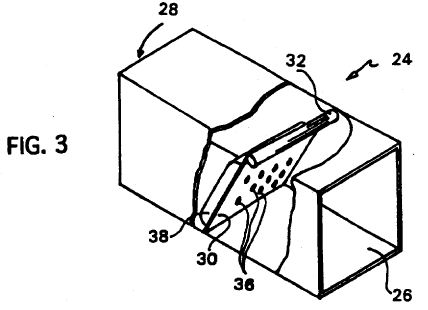
The Board then analyzed the obviousness rejection. The Applicant argued that the door in the reference "is not of integral construction, in that it is made up of a door panel 30, and lure housing 38 that is detachably mounted on the door panel, and a lure 40 placed within the housing." (Fig. 3 of the reference is shown below.)


The Board did not agree that the reference (Stahl) described a detachable lure housing, but did find that Stahl described "a separately manufactured element (the lure housing 38) mounted on the rear surface of the door." Despite the presence of a separately manufactured lure housing 38, the Board nonetheless found that Stahl had an integral door under the meaning argued by the Applicant.

Explaining its reasoning, the Board stated that the Applicant's specification described the doors of Fig. 4 and Fig. 5 as "separately manufactured." (Fig. 4 of the specification is shown below.)


Yet the Applicant's Appeal Brief argued that the (separately manufactured) doors illustrated in Figs. 4 and 5 were "integral." Therefore, despite the presence of a separately manufactured lure housing 38, the Board found that “Stahl has an integral door as much as the present invention does."

Despite finding that the claimed integral door read on the door in the reference, the Board ended up reversing the obviousness rejection because another claimed element was missing from the combination.


My two cents: Be careful what you ask for. The Applicant convinced the Board that the spec and drawsings supported "integral" – but in doing so admitted that "integral" covered "separately manufactured."

Since the door in Applicant's Fig. 4 looks an awful lot like the door in the reference, maybe the Applicant should have stayed away from Fig. 4 in arguing written description. Using Fig. 3 wouldn't have been so harmful, since it does not look to be of two piece construction like Fig. 4, nor did the spec describe the door in Fig. 3 as "separately manufactured." It looks to me like Fig. 3 showed possession of an integral door embodiment, which should be enough to overcome the written description rejection.

It seems to me that the Applicant could have used Fig. 3 as support for an integral door and still argued that the door in the reference was not integral. Instead, by arguing that all embodiments showed doors of integral construction, the Applicant walked himself into an admission that the reference showed an integral door.

Monday, August 2, 2010

District court finds claim impossible to infringe, and also invalid on four separate grounds

Takeaway: A district court found a nonsensical claim to be not only not infringed, but invalid under written description, enablement, inoperable and even the rarely invoked § 112 Second "not what the patentee regarded as his invention." (Frazier v. Wireline Solutions, LLC, C-10-3, S.D. Tex., July 16, 2010.) The claim recited: "[a] head member attached to the lower portion of the mandrel having a slot for catchably retaining the engaging portion of a superposed bridge plug." The court found it impossible for the lower end of one bridge plug to connect with another bridge plug located above the first.

Details: The accused infringer argued that Chef America controls (Chef America v. Lamb-Weston, Inc., 358 F.3d 1371 (Fed. Cir. 2004)), so that the court must construe the claim as written and grant summary judgment of non-infringement. The accused infringer further argued that under such a construction, the claim was invalid under § 112 Second and § 101.

The patentee accepted that the plain meaning of "superposed" was "above." Even so, the patentee argued that one of ordinary skill in the art would interpret the claim as referring to one plug above and a different plug below, since the claim contained two references to "a bridge plug."

The district court rejected the patentee's "strained and entirely unpersuasive attempt to reinterpret Claim 4." Having concluded that the claim contained an error, the court then phrased the next issue as whether it had the authority to correct the error by replacing "superposed bridge plug" (i.e., above) with "subjacent bridge plug (i.e., below).

As a threshold matter, the court held it would not correct the error because the patentee had argued in a hearing that the claim did not contain an error. Furthermore, correction is appropriate only when the correction is not subject to reasonable debate – and here reasonable debate existed because the patentee argued "no error."

The court then quickly disposed of the issue of infringement (none – not even possible) and moved on to invalidity. The court found the claim failed to meet both the written description requirement and the requirement under § 112 Second "applicant regards as his invention:" 
With Claim 4 written as is, the specification would have to describe a bridge plug that has a lower end capable of engaging another bridge plug located above it. Instead, the specification describes what one would expect to find, namely a bridge plug with an engaging portion at an end that is capable of connecting with another bridge plug positioned adjacent to that end. Because Claim 4 is not described anywhere in the specification (due to the use of "superposed" instead of "subjacent"), it necessarily fails the written description requirement ...
[T]he bridge plug as described in the specification of the '376 Patent differs materially from that described in Claim 4. Thus, due to the use of "superposed" rather than "subjacent," the claim is invalid under paragraph 2 of Section 112.

Since the claim recited an impossible limitation, the court also found that the claim failed to meet the enablement and utility requirements, citing Process Control Corp. v. HydReclaim Corp., 190 F.3d 1350, 1359 (Fed. Cir. 1999):
[W]hen an impossible limitation, such as a nonsensical method of operation, is clearly embodied within the claim, the claimed invention must be held invalid. . . . [W]hen the claimed subject matter is inoperable, the patent may indeed be invalid for failure to meet the utility requirement of § 101 and the enablement requirement of § 112.
My two cents: Definitely the right result. Though I do wonder if four grounds for invalidity were overkill.

The court treated as fatal the patentee's refusal to admit error in the claim. But I feel certain that the court would have reached the same result anyway. The facts here seem very close to the burning bread dough in Chef America.

I'd be surprised if the claim at issue was an originally filed claim. Instead, it was probably the result of careless prosecution. I'd say the four lessons here are:
  1. Proofread your claim amendments.
  2. Proofread your allowed claims. 
  3. Proofread your issued claims.
  4. Proofread before filing a lawsuit. 
 The decision did not mention a certificate of correction, so I assume there wasn't one. The patentee did file amended infringement contentions, replacing "superposed" with "subjacent."

Thanks to Scott Daniels at the Reexamination Alert blog for bringing this case to my attention.

Sunday, April 25, 2010

Difference between written description and enablement

In a lot of file histories that I read, both practitioners and Examiners seem to confuse the written description and enablement requirement, conflating the two into a single requirement that "claim terms must have support in the spec."

Maybe there's good reason to be confused. The recent en banc decision by the Federal Circuit in Ariad v. Lilly affirmed that these two requirements are separate, but also suggested that the two requirements can be confusing. The majority recognized that in some fields "there is little difference between describing an invention and enabling one to make and use it" and that "written description and enablement often rise and fall together."

I read a recent blog post at Intellectual Property Directions which included this concise summary of the difference between written description and enablement, put in terms that anyone can understand:
In effect the [Ariad v. Lilly] court said that a pure enabling description was like a bare bones cookbook recipe in which the how to make is included but you are never told what you are making! Take flour, sugar, shortening, leavening, and water, mix them until smooth, and bake for 1 hour at 325 degrees in a greased cake pan. You can follow the steps but it’s up to you to guess what it is you are serving. Without a written description you almost have to try it to find out if it’s a cake or a giant cookie.
(from If it walks like a duck… you need a written description)
Thanks to blogger Bruce Horwitz for coming up with this explanation.

Thursday, November 5, 2009

Claims implied by specification not enough for 112 First (Ex parte Abdel-Hafez:)

Ex parte Abdel-Hafez
Decided March 30, 2009
(Appeal 2002-3826; Appl. No. 10/691,696; Tech. Center 2100)

I view this case as a warning to avoid the word "implied" in your arguments against a § 112 rejection. The Applicant argued that a claim element was "implied" by the disclosure, and Board read "implied" as "renders obvious":
... the question of written description support should not be confused with the question of what would have been obvious to the artisan ... Whether Appellant's proffered provisional application support "implies" and thus renders obvious the later claimed "global" limitations is not relevant to the inquiry before us.
(Decision, p. 10.)
I think the Board was confused about written description vs. obviousness, since I do not read the Applicant's argument (a claim element was implied by the disclosure) as an argument that the claim element was obvious in view of the disclosure. Instead, I view the Applicant's argument as a reliance on the implicit teachings of the specification. And there's nothing wrong with that: an Applicant is entitled to rely not only on the explicit teachings of the specification, but also on the implicit teachings, since the specification is viewed not from the standpoint of a layman, but from the standpoint of a person of ordinary skill in the art.
 Although [the applicant] does not have to describe exactly the subject matter claimed, ... the description must clearly allow persons of ordinary skill in the art to recognize that [he or she] invented what is claimed.... The test for sufficiency of support in a parent application is whether the disclosure of the application relied upon reasonably conveys to the artisan that the inventor had possession at that time of the later claimed subject matter. 46 Vas-Cath Inc. v. Mahurkar, 935 F.2d 1555, 1563, 19 USPQ2d 1111, 1116 (Fed.Cir. 1991).
Okay, sometimes there's a fine line between saying that something not explicitly described in the spec is rendered obvious by the spec, and saying that something not explicitly described is implicitly disclosed. But the line exists, and I don't understand why the Board thought the Applicant crossed this line. After all, the Applicant said the claim element was "implied" by the spec, not that the element was "obvious" in view of the spec.

It's not clear whether the Board relied on this finding alone to uphold the §112 rejection, since the Board went on to indicate that "Appellants have not provided any meaningful analysis explaining how the pertinent portions of the provisional application meet the written description and enablement requirements under §112, first paragraph."(Decision, p. 10.)

It's true that the Applicant here did nothing more than point to two paragraphs of the provisional and make this statement:
While the word "global" is not used, taken with the provisional drawings, these all imply that the scan-enable SE signals and the set-reset enable SR_EN signals are global in nature in that provisional application.
(Brief, p. 11.)
So another takeway from this case could be: if you're relying on implicit rather than explicit disclosure, explain your reasoning. In this particular case, the argument might go something like this:
The provisional application discloses: “[t]he present invention uses A scan enable (SE) and and/or gate to disable the asynchronous set/reset signals of ALL scan cells. A new set/reset enable (SR_EN) signal is introduced to propagate the faults of asynchronous set/reset signals in a dedicated capture cycle.” (Capitalization and italics added for emphasis.) Although the provisional uses the article A rather than the adjective ONE, when used in ordinary English and outside of a claim, “A scan enable” is understood to mean “ONE scan enable.” Thus, the provisional discloses that one scan enable disables set/reset for all scan cells. Since "global" means "of, relating to, or applying to a whole," ONE signal that disables something for ALL scan cells is understood to be a “GLOBAL scan enable signal,” as is recited in claim 83. Thus, the provisional does “convey with reasonable clarity to those skilled in the art that, as of the filing date sought, [the inventor] was in possession of the invention.” Vas-Cath, Inc. v. Mahurkar, 935 F.2d 1555, 1563-64 (Fed. Cir. 1991). The written description rejection of claim 83 should therefore be overturned.
I won't say that Ex parte Abdel-Hafez holds “using 'implied' in reference to the disclosure is inapplicable to a § 112 argument” — that would go too far. However, I do think this case shows that if you rely on implicit disclosure, you should explain the inferences that a POSITA draws from the disclosure.

Friday, September 4, 2009

Must you identify support for claim amendments? (Part I)

Here's a basic patent prosecution question: are you required to identify support in the specification when making claim amendments?

My answer to this question is: No, Applicants are not required to do so. One portion of the MPEP does baldly state that Applicants should identify support in the spec. [I'll get to that in a minute.] However, "should" is not "must", and that's why I say Applicants are not required to do so.

I'll go further and say that I don't think the MPEP, when read as a whole, even says that Applicants "should" do so. But I've talked to a number of practitioners who take the opposite position, so I in this post I'll explore reasons why I think this is a commonly held belief. In future posts, I'll discuss a) reasons for and against providing support for claim amendments even if not required, and b) what actions an Examiner is and is not entitled to take if you don't.

I think one reason might be confusion about the term "new matter." Technically, new matter refers to material added to the "disclosure" (specification, drawings, and abstract), not to the claims. So while MPEP § 2163.06 does state that "Applicant should therefore specifically point out the support for any amendments made to the disclosure," that doesn't apply to the claims. This section also explains the distinction between a new matter objection to the specification and a written description rejection of a claim.

The most obvious reason for holding that Applicants should identify support in the spec is this bald statement in MPEP § 2163.II.A:

There is a strong presumption that an adequate written description of the claimed invention is present in the specification as filed, Wertheim, 541 F.2d at 262, 191 USPQ at 96; however, with respect to newly added or amended claims, applicant should show support in the original disclosure for the new or amended claims.
(Emphasis added.)

As support for this "should" statement, MPEP 2163.II.A goes on to cite to other sections of the MPEP – which do not support its position:

...See MPEP § 714.02 and § 2163.06 ("Applicant should * * * specifically point out the support for any amendments made to the disclosure.");
(Emphasis added.)

As noted above, § 2163.06 refers to the disclosure, not the claims. And although MPEP § 714.02 states (citing CFR § 1.111) that an Applicant is required to "point out the patentable novelty" and "how the amendments avoid such references or objections", it says nothing at all about pointing to support in the spec. Nor does the final cite in MPEP 2163.II.A support the position "should provide support for claim amendments" :

...and MPEP § 2163.04 ("If applicant amends the claims and points out where and/or how the originally filed disclosure supports the amendment(s), and the examiner finds that the disclosure does not reasonably convey that the inventor had possession of the subject matter of the amendment at the time of the filing of the application, the examiner has the initial burden of presenting evidence or reasoning to explain why persons skilled in the art would not recognize in the disclosure a description of the invention defined by the claims.
(Emphasis added.)

This cite to MPEP § 2163.04 is not on point because it describes what the Examiner is required to do if the Applicant does point out support, not what the Applicant should or must do so.

Thus, I think the MPEP is inconsistent on this basic issue, and when read as a whole, does not even clearly say that Applicants "should" provide support for claim amendments.