Heads up: Big changes to patent practice starting September 16, 2012. Several new rules packages to implement various provisions of the America Invents Act (AIA) take effect on that date. The only rules package I'll talk about here relates to inventor declaration and power of attorney. The Federal Register Notice can be found here. PharmaPatents has a nice overview of these rules here. IP boutique Oblon Spivak has a FAQ here.
The new rules affect both the procedures for filing declarations and the substance of the declaration itself. Carl Oppedahl, an experienced practitioner who has studied the new rules extensively, says "it is not much of an exaggeration to say that they change everything about the Oath and Declaration of the inventor."
Carl's guest post on Patently-O explains the importance of using the "old" declaration for "old" applications and the "new" declaration for "new applications". Sounds like transitional practice in the days leading up to September 16 changeover will be tricky -- you don't want to send out the old declaration for signature before September 16 and then end up filing it after September 16. To get all the gory details without reading the 52 page notice in the Federal Register, you can purchase Carl's webinar "What will change about the oath or declaration on September 16?"
One far-reaching change in the AIA is that inventors are no longer required to be “applicants” on patent applications. To implement this change, the same rules package taking effect on September 16 allows assignees to not merely prosecute applications, but to actually file in the name of the applicant.
Assignees will probably be glad to hear that the onerous procedures for handling missing or non-signing inventors have been replaced by a much simpler procedure. Under the new rules, you file a much simpler "substitute statement."
Friday, September 7, 2012


Wednesday, September 5, 2012
AIPF Annual Meeting October 1 and 2: "Intellectual Property as a Corporate Asset"
If you're interested in learning about using IP as a corporate asset, and in getting your CLE at the same time, check out the upcoming program put on by the AIPF (Association of Intellectual Property Firms) on October 1 and 2 in Washington, D.C.
The theme of this year's Annual Meeting is "Intellectual Property as a Corporate Asset", and the program includes presentations on theme topics such as "Models for Monetizing Patents in the 21st Century," "Asset Valuation," and "Tech Transfer after the Obama Technology Objective." The program also includes various IP law topics such as the AIA and the Patent Prosecution Highway, as well as practice development topics like "In-Person and Online Strategies for Networking" and "The Paperless Office".
This year will mark the third time I've attended this event. More info at AIPF 2012 Annual Meeting and Program Schedule.
The theme of this year's Annual Meeting is "Intellectual Property as a Corporate Asset", and the program includes presentations on theme topics such as "Models for Monetizing Patents in the 21st Century," "Asset Valuation," and "Tech Transfer after the Obama Technology Objective." The program also includes various IP law topics such as the AIA and the Patent Prosecution Highway, as well as practice development topics like "In-Person and Online Strategies for Networking" and "The Paperless Office".
This year will mark the third time I've attended this event. More info at AIPF 2012 Annual Meeting and Program Schedule.
Monday, September 3, 2012
BPAI affirms indefiniteness when claim positively recites "at least one flooring panel" and then refers to "panels of the least one flooring panel"
Takeaway: During prosecution, the Examiner rejected a claim to a flooring system as being indefinite. The claim positively recited "at least one flooring panel" but then referred to "lips configured to overlap ... a joint between panels of the at the least one flooring panel and the connecting element". The Examiner found that the inconsistency between "at least one flooring panel" (singular) and the "panels" (plural) rendered the claim indefinite. The Board affirmed, finding that the broadest reasonable interpretation of "at least one panel" encompassed a single panel, yet the reference to panels implies multiple panels. (Ex parte Grafenauer, BPAI 2012.)
Details:
Ex parte Grafenauer
Appeal 2010009906; Appl. No. 11/533,634; Tech. Center 3600
Decided: February 29, 2012
The application on appeal disclosed flooring panels with connecting elements. Claim 15 read:
15. A system, comprising:
at least one flooring panel with a decorative layer top layer, the at least one flooring panel comprising a tongue and a groove on side edges lying opposite one another; and
a connecting element comprising a groove and a tongue on side edges corresponding to the tongue and the groove of the at least one flooring panel,
the connecting element further comprising, in an area of the side edges, lips configured to be a sole sealing mechanism and to bear on a top side of the at least one flooring panel and overlap a butt joint between panels of the at least one flooring panel and the connecting element.
During prosecution, the Examiner objected to claim 15, which used the phrase "at least one" with the plural term "panels."
As applicant is only claiming one panel, it appears the claim should be directed to --at least one flooring panel-- rather than "at least one flooring panels".
In response, the Applicant amended to consistently refer to "at least one flooring panel" (singular), so that the claim read:
A system comprising:
at least one flooring panel ...; and
a connecting element comprising ...
the connecting element further comprising ... lips configured to ... bear on a top side of the at least one flooring panels and configured to overlap a butt joint between panels of the at least one flooring panel and the connecting element.
However, the claim did still refer to "panels of the at least one flooring panel." Because of this inconsistency, the Examiner rejected claim 15 as indefinite, taking issue with the "overlap" limitation:
Further, the limitation "overlap a butt joint between panels of the at the least one flooring panel and the connecting element" renders the claim indefinite (lines 8-9 of the claim). It appears the limitation should be directed to more than one panel as the claim recites the lips of the connecting element bearing on the top side of the panels (see fig. 1 of disclosure). However, the claim as presented, only positively recites a singular "at least one flooring panel" as previously noted.
(Emphasis added.)
The Applicant appealed the indefiniteness rejection of claim 15, along with several prior art rejections. Claim 15 is repeated below:
15. A system, comprising:
at least one flooring panel ... ; and
a connecting element
the connecting element further comprising ... lips configured ... to bear on a top side of the at least one flooring panel and overlap a butt joint between panels of the at least one flooring panel and the connecting element.
(Emphasis added.)
In the Appeal Brief, the Applicant referred to Figure 1 (shown below) to explain how a person of ordinary skill in the art would understand claim 15.
More specifically, Figure 1, clearly shows lips (9) configured to bear on a top side (8) of an adjacent panel (2) and configured to overlap a butt joint between panels (1,2) of the at least one flooring panel and the connecting element (7).
(Additional numbers added.)
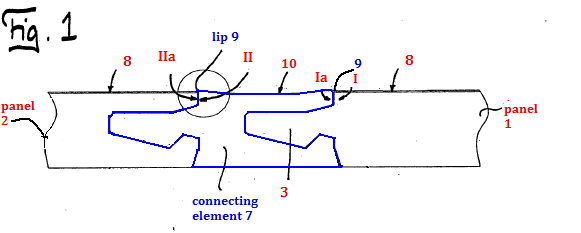
The Examiner's Answer reiterated that the claim recited a singular panel with lips bearing on the singular panel, yet the figures showed each lip bearing on a separate panel. The Answer also stated that "it is unclear if the claim is reciting a singular flooring panel or more than one flooring panel."
The Applicant filed a Reply Brief with a lengthy rebuttal. The Applicant explained why a claim to a single panel nonetheless recited plural panels.
Claim 15 recites, in part:
... the connecting element further comprising, in an area of the side edges, lips configured to be a sole sealing mechanism and to bear on a top side of the at least one flooring panel and overlap a butt joint between panels of the at least one flooring panel and the connecting element.
... That is, a lip on each panel can overlap with an adjacent panel. This language is clearly described in the specification. The claims do not recite that more than one lip is configured to bear on the singular at least one flooring panel. The Examiner is misreading the claims and taking the claim language out of context.
Also, Appellants submit that although one lip is shown in FIG. 1 and FIG. 2 for each panel, ... two lips can be required so that the lips can provide the sealing mechanism for two, adjacent panels. Additionally, in the context of the claims, the lips are used so that they can provide sealing between at least one panel (e.g., "singular"). ...
Lastly, for claim 15 to read correctly and for it to be understandable, it is necessary to place the claimed elements in the proper environment. For this reason, although claim 15 is directed to at least one panel, the claim uses the terminology "panels" in order to show how the lips are used with adjacent panels. This is clear from the record and the specification.
The Board affirmed the indefiniteness rejection, focusing on the inconsistency between "at least one panel" and "panels of the at least one flooring panel."
The broadest reasonable interpretation of the term “at least one panel” is that the term is sufficiently broad to encompass a single panel. On the other hand, the recitation of “panels of the at least one flooring panel and the connecting element” implies that the at least one flooring element must include a plurality of panels. The use of two different terms to identify the “at least one panel” and the “connecting element” implies that the connecting element is not a panel.
Therefore, the broadest reasonable interpretation of claims 15-20 and 23 is indefinite. Depending on which interpretation of the term “at least one flooring panel” one adopts, claims 15 and 23 may be sufficiently broad to encompass systems having only a single floor panel or may be limited to systems each having a plurality of panels. The disclosure of paragraph [0016] and Figure 1 of the Specification, cited by the Appellant at page 6 of the Appeal Brief, does not resolve this ambiguity.
(Emphasis added.)
My two cents: The Applicant really stuck to his guns here, and seemed unwilling to claim two panels – even though the novelty seemed to lie in the interactions between the connector and the two panels (i.e., tongue and groove). I don't get this reluctance.
What infringement scenario was the Applicant concerned about giving up by claiming two panels? Sure, such a claim would require a flooring manufacturer to sell two panels and a connecting element, even though the connector did provide a benefit (sealing) when used with only a single panel. But is that really giving up that many infringers? Won't a large number of flooring systems be sold with pairs of panels and a connector in between? Yeah, it's great to have a claim that catches every infringement scenario. But the Applicant here put the entire patent at risk by refusing to rewrite the claim in a way that made sense.
This very issue was explored a bit during oral arguments. The Applicant's representative stated that "a flooring system would ordinarily have more than one panel" and that the tongue and groove of the connecting element would be "connected to a groove and a tongue of respective flooring panels." The judge then asked: "If that's the case, then why not just recite flooring panels?" To which the Applicant's representative responded: "The client had decided that we want to say 'at least one' in this particular case to make it broader."
Monday, August 27, 2012
BPAI affirms obviousness of substituting parallel connector for serial even if reference did not teach equivalence
Takeaway: A Patentee in an inter partes reexamination appealed an obviousness rejection of a dependent claim. The Examiner used the substitution rationale from KSR, substituting a Firewire connector for a USB connector. The Applicant argued that "[the reference] does not disclose that the pin configuration, the wiring scheme required or operation of the two [connectors] are equivalent." The Board affirmed the rejection since the Examiner made the requisite findings of fact discussed in MPEP § 214(B), and the Patentee did not show error in these findings. The Board explained that a teaching of equivalence is not required support a rejection under the KSR substitution rationale. (Milan v. Apple, BPAI 2012.)
Details:
Milan v. Apple
Appeal 2012008569; Reexamination No. 95/001,083; Tech. Center 3900
Decided Aug. 7, 2012
The patent under reexamination described a flash memory device designed for use with a set of converter plugs. As shown in the figures below, the pin configuration (416) on the flash memory device (400) was configured to mate with several different converter plugs, including a 4-pin USB plug (FIGs. 12A-C) and a 5-pin mini-USB plug (FIGs. 12A-C).


The Patentee appealed various rejections, including independent claim 1 as obvious over two non-patent references ("Palm V Handbook Travel Kit" and "Handbook for Palm Tungsten Handhelds"), and dependent claim 3 as obvious over Palm, Tungsten, and Sirichai.
After rejecting independent claim 1 as obvious over the combination of Palm and Tungsten, the Examiner added Sirichai and used the substitution rationale to reject dependent claim 3. In rejecting claim 3, the Examiner made several findings of fact, including the ones discussed in MPEP § 2143(B) for the substitution rationale:
The Patentee attacked the obviousness rejection of claim 3 by disagreeing with the Examiner's finding that Sirichai taught the equivalence of USB and Firewire connectors. According to the Patentee, Sirichai's discussion of lighted electrical connectors instead taught that:
The Patentee then concluded that "simply substituting the USB connector of Tungsten with the connector body for a firewire connector will not result in functionality of the resulting connector" and as a result, the combination would not result in claim 3.
The Board was not persuaded by the Patentee's "no equivalence" argument. According to the Board, "a teaching of such equivalence is not required" to support the substitution rationale described in KSR. The Board found that the Examiner had made the requisite findings of fact for a substitution rationale, and the Patentee had not demonstrated error in these findings. The Board therefore affirmed the rejection of dependent claim 3.
My two cents: The Board reached the right result -- at the level of detail expressed in the claim, it is obvious to substitute a USB (serial) connector for a Firewire (parallel) connector. Yes, the operation of a serial bus and a parallel bus is different. But none of those differences have anything to do with what's in the claims. Yes, the pin configurations and wiring schemes are different. Nonetheless, substituting one connector for the other is within the knowledge of a POSITA, and the Applicant didn't argue otherwise.
I do have a problem with the Board's statement about findings of equivalence, because I think it's misleading. Of course the claimed feature and the substituted feature from the reference aren't required to be equivalent in every way. But the two must be equivalent at some level, otherwise you couldn't substitute one for the other, right?
And you can fight an obviousness rejection on this point, i.e., by explaining the differences and why the reference feature wouldn't act as a substitute for the claimed feature. Maybe the lesson here is not to characterize such an argument as being about equivalence, but instead to couch it in terms of "results would not have been predictable" (i.e., the third finding mentioned in the MPEP discussion of substitution)?
I have a problem with this too, however, as the results of a badly-conceived substitution are probably quite predictable: the combination doesn't work as intended, or work as well, or too many modifications are needed to consider it obvious.
So to me, it is about equivalence, not predictability. Because it makes sense to argue that a POSITA would not substitute a blodget for a widget because they are not equivalent in these specific ways which relate to what is claimed. The Patentee here didn't win because he didn't (or couldn't convincingly) explain why the differences matter for what is claimed, and/or why the differences were too great for a POSITA to handle.
Details:
Milan v. Apple
Appeal 2012008569; Reexamination No. 95/001,083; Tech. Center 3900
Decided Aug. 7, 2012
The patent under reexamination described a flash memory device designed for use with a set of converter plugs. As shown in the figures below, the pin configuration (416) on the flash memory device (400) was configured to mate with several different converter plugs, including a 4-pin USB plug (FIGs. 12A-C) and a 5-pin mini-USB plug (FIGs. 12A-C).


The Patentee appealed various rejections, including independent claim 1 as obvious over two non-patent references ("Palm V Handbook Travel Kit" and "Handbook for Palm Tungsten Handhelds"), and dependent claim 3 as obvious over Palm, Tungsten, and Sirichai.
1. A flash memory device comprising:
a housing having opposed first and second ends;
a flash memory drive enclosed in said housing; and
a quick connector mounted in said housing and having a plurality of pins exposed at said second end, said pins being configured for electrical connection to a selected one of at least a first interchangeable connector and a second interchangeable connector ...
3. The flash memory device according to claim 1 wherein said plurality of pins is six female pins arranged in two parallel rows of three pins each.
After rejecting independent claim 1 as obvious over the combination of Palm and Tungsten, the Examiner added Sirichai and used the substitution rationale to reject dependent claim 3. In rejecting claim 3, the Examiner made several findings of fact, including the ones discussed in MPEP § 2143(B) for the substitution rationale:
- One type of Firewire connector is known to have a six pin configuration arranged in two parallel rows of three pins each.
- The prior art (Palm combined with Tungsten) contained a device which differed from the claimed device by the substitution of one component (Sirichai's connector) for another component (Palm's connector).
- Sirichai disclosed USB connectors and Firewire connectors, and described them as known equivalents.
- A POSITA could have substituted one known element (Sirichai's Firewire connector) for another (Palm's USB connector), and the results of the substitution would have been predictable.
The Patentee attacked the obviousness rejection of claim 3 by disagreeing with the Examiner's finding that Sirichai taught the equivalence of USB and Firewire connectors. According to the Patentee, Sirichai's discussion of lighted electrical connectors instead taught that:
... the connector tip is a USB connector tip and in another embodiment the connector tip may be a firewire connector tip. The connector tip 150 of Sirichai is simply referring to "an opaque metal shell[.]" Sirichai only provides that both USB and firewire connector tips could utilize the light source disclosed; it does not disclose that the pin configuration, the wiring scheme required or operation of the two are equivalent.
(Emphasis added.)
The Patentee then concluded that "simply substituting the USB connector of Tungsten with the connector body for a firewire connector will not result in functionality of the resulting connector" and as a result, the combination would not result in claim 3.
The Board was not persuaded by the Patentee's "no equivalence" argument. According to the Board, "a teaching of such equivalence is not required" to support the substitution rationale described in KSR. The Board found that the Examiner had made the requisite findings of fact for a substitution rationale, and the Patentee had not demonstrated error in these findings. The Board therefore affirmed the rejection of dependent claim 3.
My two cents: The Board reached the right result -- at the level of detail expressed in the claim, it is obvious to substitute a USB (serial) connector for a Firewire (parallel) connector. Yes, the operation of a serial bus and a parallel bus is different. But none of those differences have anything to do with what's in the claims. Yes, the pin configurations and wiring schemes are different. Nonetheless, substituting one connector for the other is within the knowledge of a POSITA, and the Applicant didn't argue otherwise.
I do have a problem with the Board's statement about findings of equivalence, because I think it's misleading. Of course the claimed feature and the substituted feature from the reference aren't required to be equivalent in every way. But the two must be equivalent at some level, otherwise you couldn't substitute one for the other, right?
And you can fight an obviousness rejection on this point, i.e., by explaining the differences and why the reference feature wouldn't act as a substitute for the claimed feature. Maybe the lesson here is not to characterize such an argument as being about equivalence, but instead to couch it in terms of "results would not have been predictable" (i.e., the third finding mentioned in the MPEP discussion of substitution)?
I have a problem with this too, however, as the results of a badly-conceived substitution are probably quite predictable: the combination doesn't work as intended, or work as well, or too many modifications are needed to consider it obvious.
So to me, it is about equivalence, not predictability. Because it makes sense to argue that a POSITA would not substitute a blodget for a widget because they are not equivalent in these specific ways which relate to what is claimed. The Patentee here didn't win because he didn't (or couldn't convincingly) explain why the differences matter for what is claimed, and/or why the differences were too great for a POSITA to handle.
Tuesday, August 21, 2012
BPAI decides whether limitation refers to final state of disconnection or action of disconnecting
Takeaway: An Applicant appealed a written description rejection of a claim for a device used in rock drilling. The rejection hinged on the interpretation of "device is loaded .... only when said rock bolt is disconnected from said coupling sleeve by rotation of the rock drilling machine." The Examiner interpreted this to exclude loading after disconnection, while the Applicant asserted that the phrase excluded loading during disconnection. The Board found that the proper interpretation was "during disconnection," since "disconnected" must be read in conjunction with the modifier "by rotation." (Ex parte Kanflod, BPAI 2012)
Details:
Ex parte Kanflod
Appeal 2012005389; Appl. No. 10/539,148; Tech. Center 3600
Decided August 14, 2012
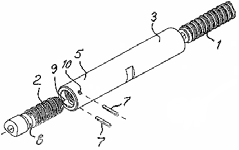
The application on appeal related to drilling machines. The independent claim on appeal was directed to a sleeve that couples a rock bolt (1) to a rock drilling machine (2). (See figure below.)
The limitation at issue read:
During prosecution, the Applicant added the qualifier "only" in response to a prior art rejection. The Examiner then rejected the amended claim under § 112 First ¶, as lacking written description. The Office Action explained the problem with the phrase "only when ... disconnected" as follows:
The Applicant submitted an expert declaration from the inventor to address the written description rejection. The declaration also explained the meaning of the limitation at issue. Referring to this declaration, the Applicant argued that the "only when ... disconnected" phrase should be read in conjunction with the "rotation" phrase:
The declaration, and the argument, then went on to reference portions of the specification that described this loading behavior in conjunction with the rotating.
The Applicant went to appeal on the written description, indefiniteness, and prior art rejection, with both sides essentially repeating the above written description arguments.
The Board found that the written description rejection was based on an improper claim interpretation, one which read the first portion of the wherein clause in isolation from the remainder of the claim.
The Board reversed the written description rejection, finding that the Applicant's specification did convey possession of the properly interpreted claim.
My two cents: Once again, the real issue is claim construction. It seemed to me that both sides recognized this, but could have done a better of job of explaining exactly how they were interpreting the claim. I had to keep reading the claim, and the arguments, over and over again.
The Examiner apparently read "disconnected" as referring to the bolt's final state, so that the phrase "only when" was interpreted to exclude loading with the bolt disconnected. On the other hand, the Applicant apparently read "only when ... disconnected" to refer to the action of disconnecting the bolt, or perhaps the bolt's intermediate state of being disconnected.
The choice of tense in "when disconnected" definitely sounds like a state rather than an action. It's only when the "by rotation" portion of the claim is considered that it even becomes possible to understand "disconnected" as an action. Still, I think the phrasing "only when said rock bolt is being disconnected" does a better job of conveying the Applicant's apparent intent.
My sense is that the issue of what tense to use comes up more in mechanical cases where you focus on describing structure first, and then on associating actions and states with the structure. Whereas action and state are more central to the claims I deal with every day in computer and electronics applications. Even so, I can think of instances where I've had to think about how to properly convey state, action, or a combination of the two – and it can be a challenge.
Details:
Ex parte Kanflod
Appeal 2012005389; Appl. No. 10/539,148; Tech. Center 3600
Decided August 14, 2012
The application on appeal related to drilling machines. The independent claim on appeal was directed to a sleeve that couples a rock bolt (1) to a rock drilling machine (2). (See figure below.)
The limitation at issue read:
a locking device (7) ... said locking device is loaded to retain the rock drilling machine connected to the coupling sleeve only when said rock bolt is disconnected from said coupling sleeve by rotation of said rock drilling machine in a direction for disconnecting said first part of said coupling sleeve from said rock bolt for reinforcing a rock with said rock bolt.
(Emphasis added.)
During prosecution, the Applicant added the qualifier "only" in response to a prior art rejection. The Examiner then rejected the amended claim under § 112 First ¶, as lacking written description. The Office Action explained the problem with the phrase "only when ... disconnected" as follows:
[T]here is no structure to prevent the loading of locking device (7) to retain the rock drilling machine (2) connected to the coupling sleeve (3, 5) regardless of whether or not rock bolt (I) is connected or disconnected, since rock bolt (I) has no contact with either of locking device (7) or drilling machine (2) (even when the bolt is installed) and thus cannot prevent relative loading between device (7) and machine (2).
(Emphasis added.)
The Applicant submitted an expert declaration from the inventor to address the written description rejection. The declaration also explained the meaning of the limitation at issue. Referring to this declaration, the Applicant argued that the "only when ... disconnected" phrase should be read in conjunction with the "rotation" phrase:
[T]he locking device is loaded (locked) to lock the drilling machine to the coupling sleeve only when the drilling device is rotated in a direction to separate the rock bolt from the coupling sleeve, and not during a percussion operation.
The declaration, and the argument, then went on to reference portions of the specification that described this loading behavior in conjunction with the rotating.
The Applicant went to appeal on the written description, indefiniteness, and prior art rejection, with both sides essentially repeating the above written description arguments.
The Board found that the written description rejection was based on an improper claim interpretation, one which read the first portion of the wherein clause in isolation from the remainder of the claim.
A person skilled in the art would understand the above limitation to mean that the locking device is loaded just prior to disconnection of the rock bolt from the sleeve, i.e., when the rock bolt is still connected to the coupling sleeve. The Examiner improperly interprets the limitation to mean that the locking device is loaded only after disconnection of the rock bolt from the sleeve.
The Board reversed the written description rejection, finding that the Applicant's specification did convey possession of the properly interpreted claim.
The specification as originally filed explains that (1) during drilling the locking device 7 is unloaded (Spec. at 2:13-14) and (2) after drilling the locking device is loaded to disconnect the rock bolt from the coupling sleeve (Spec. at 2:14-19).
My two cents: Once again, the real issue is claim construction. It seemed to me that both sides recognized this, but could have done a better of job of explaining exactly how they were interpreting the claim. I had to keep reading the claim, and the arguments, over and over again.
The Examiner apparently read "disconnected" as referring to the bolt's final state, so that the phrase "only when" was interpreted to exclude loading with the bolt disconnected. On the other hand, the Applicant apparently read "only when ... disconnected" to refer to the action of disconnecting the bolt, or perhaps the bolt's intermediate state of being disconnected.
The choice of tense in "when disconnected" definitely sounds like a state rather than an action. It's only when the "by rotation" portion of the claim is considered that it even becomes possible to understand "disconnected" as an action. Still, I think the phrasing "only when said rock bolt is being disconnected" does a better job of conveying the Applicant's apparent intent.
My sense is that the issue of what tense to use comes up more in mechanical cases where you focus on describing structure first, and then on associating actions and states with the structure. Whereas action and state are more central to the claims I deal with every day in computer and electronics applications. Even so, I can think of instances where I've had to think about how to properly convey state, action, or a combination of the two – and it can be a challenge.
Friday, August 10, 2012
BPAI provides concise summary of how to rebut an Examiner's claim interpretation
Takeaway: In an appeal involving a cartridge for caulking compound, the main issue was the meaning of of the term "punch" in claim limitations such as “punching an opening in the tubular container.” The BPAI explained that the Applicant's mere assertion that claim language did not encompass the teaching of the reference was not sufficient to rebut the Examiner's interpretation. To rebut, an Applicant should point to "precise
meaning" in the specification, to a dictionary definition, or to a statement by a
POSITA. (Ex parte Longo, BPAI 2012.)
Details:
Ex parte Longo
Appeal 2009014183; Appl. No. 11/328,537; Tech. Center 3700
Decided: May 23, 2012
The subject matter on appeal was a cartridge for caulking compound. The main issue on appeal was the meaning of the term "punch" in claim limitations such as “punching an opening in the tubular container.”
For the "punching" limitations, the Examiner relied on a reference teaching of a "rapidly actuatable tool for making cuts" which "deforms the cylinder wall to form catches 17 as it cuts." The Applicant argued that the cutting described in the reference was not the same as punching.
The Board presented a dictionary definition ("to cut, stamp, pierce, perforate, form, or drive with a tool or machine that punches") to show that the Examiner's interpretation (punching" includes "cutting") was reasonable. The Board found that the Examiner's interpretation was "essentially unrebutted" by the Applicant.
My two cents: I picked this decision not because it was controversial in any way, but because it included a clear and concise statement of what the Board is looking for in an argument about claim construction. A mere assertion in the Appeal Brief that a widget is not a blodget probably won't be convincing. Instead, you should refer to a "precise meaning" in the spec, to a dictionary definition, or to a statement by a expert about what the term means to a hypothetical POSITA.
On this last point, the Board's phrasing suggests that an Applicant statement in the Brief about what the term means to a hypothetical POSITA would be sufficient. However, other decisions I've read suggest instead that you need evidence. This evidence can take the form of another reference that uses the term, or a § 1.132 declaration from a person of ordinary skill in the art about the meaning of the term.
Details:
Ex parte Longo
Appeal 2009014183; Appl. No. 11/328,537; Tech. Center 3700
Decided: May 23, 2012
The subject matter on appeal was a cartridge for caulking compound. The main issue on appeal was the meaning of the term "punch" in claim limitations such as “punching an opening in the tubular container.”
For the "punching" limitations, the Examiner relied on a reference teaching of a "rapidly actuatable tool for making cuts" which "deforms the cylinder wall to form catches 17 as it cuts." The Applicant argued that the cutting described in the reference was not the same as punching.
The Board presented a dictionary definition ("to cut, stamp, pierce, perforate, form, or drive with a tool or machine that punches") to show that the Examiner's interpretation (punching" includes "cutting") was reasonable. The Board found that the Examiner's interpretation was "essentially unrebutted" by the Applicant.
Appellant, however, points to no specific wording in the specification that shows a precise meaning given to the term “punching” or to any related terms such as “punch” that would amount to interpretive guidance. Appellant also fails to provide support for this argument by pointing to any type of general purpose or technical dictionary as interpretive guidance that punching would not encompass the cutting performed in van Manen, nor does Appellant state that this is a term of art known to those of ordinary skill to exclude van Manen’s cutting. Appellant merely provides attorney argument against the Examiner’s interpretation with nothing further.Based on this claim interpretation, the Board affirmed the prior art rejections of the independent claims.
My two cents: I picked this decision not because it was controversial in any way, but because it included a clear and concise statement of what the Board is looking for in an argument about claim construction. A mere assertion in the Appeal Brief that a widget is not a blodget probably won't be convincing. Instead, you should refer to a "precise meaning" in the spec, to a dictionary definition, or to a statement by a expert about what the term means to a hypothetical POSITA.
On this last point, the Board's phrasing suggests that an Applicant statement in the Brief about what the term means to a hypothetical POSITA would be sufficient. However, other decisions I've read suggest instead that you need evidence. This evidence can take the form of another reference that uses the term, or a § 1.132 declaration from a person of ordinary skill in the art about the meaning of the term.
Subscribe to:
Posts (Atom)